


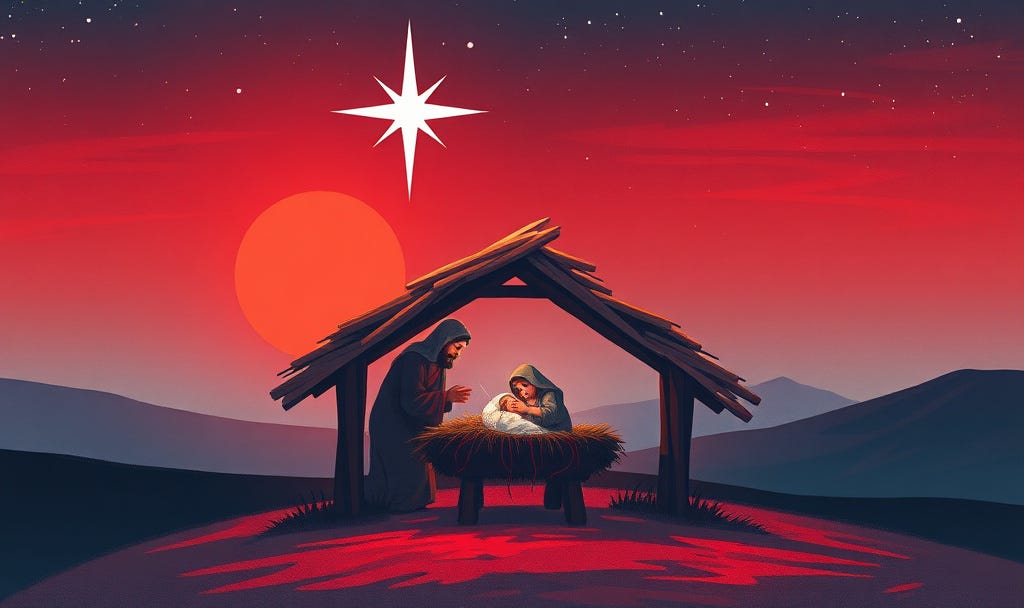
(This article is a Christmas letter to all my readers. As such, it is religious in nature. If you don’t like that sort of thing, you may want to take a pass on this one, and we’ll return to my regular writings a week from now after I take a Christmas break. However, if you have received any benefit out of all my other writings in The Daily Doom, maybe you will indulge me by just reading this Christmas message and giving it a thought as your Christmas gift to me.)
I’ll start by stating the essence of Christmas through a single magnificent prophecy from the Old Testament that is often quoted at Christmastime:
For unto us a child is born; unto us a son is given. The weight of the government shall be upon his shoulders, and he shall be called Wonderful Counselor, Mighty God, Everlasting Father, the Prince of Peace…. (Isaiah 9:6)
We often focus on the last phrase of this prophecy about the Messiah who would come and bring peace, but look at some of the other proclamations about the Messiah in this prophecy that I’ve emphasized. For those who ask, “Why do you worship Jesus, instead of just honor him as a great teacher,” these are the reasons.
He is called here, “Wonderful Counselor,” a term very similar to what Jesus, himself, used to describe the Holy Spirit of God—“the Comforter.” He’s also called “Mighty God.” That is the hardest part for many to swallow—a point at which many turn away. Yet, the promised “son” is even called the “Everlasting Father,’ a term for the Father of all creation or “God the Father,” who was, therefore, before all of creation.
These words were recorded in Jewish prophecy long before Jesus was born. So, Christmas started as a day for worshipping Jesus because he is the one they believe fulfills every aspect of this central prophecy about the birth of a boy (a “son”) that would become known by all these names, an event which we now celebrate as “Christmas.”
That Old Testament (Old Covenant) prophecy is a mystery and an amazing thing—a conundrum to rabbis of old—that the human child that was born should be called “Mighty God” and that the “given son” would also be called the “Everlasting Father.”
This miracle, the New Testament Christmas story tells us, happened when the Holy Spirit of God (called “the Holy Ghost” in the King James Version, which I use here because it is so traditionally used in the telling the Christmas story) entered Mary and she conceived a son.
26 And in the sixth month the angel Gabriel was sent from God unto a city of Galilee, named Nazareth,
27 To a virgin espoused to a man whose name was Joseph, of the house of David; and the virgin’s name was Mary.
28 And the angel came in unto her, and said, Hail, thou that art highly favoured, the Lord is with thee: blessed art thou among women.
29 And when she saw him, she was troubled at his saying, and cast in her mind what manner of salutation this should be.
30 And the angel said unto her, Fear not, Mary: for thou hast found favour with God.
31 And, behold, thou shalt conceive in thy womb, and bring forth a son, and shalt call his name Jesus.
32 He shall be great, and shall be called the Son of the Highest: and the Lord God shall give unto him the throne of his father David:
33 And he shall reign over the house of Jacob for ever; and of his kingdom there shall be no end.
34 Then said Mary unto the angel, How shall this be, seeing I know not a man?
35 And the angel answered and said unto her, The Holy Ghost shall come upon thee, and the power of the Highest shall overshadow thee: therefore also that holy thing which shall be born of thee shall be called the Son of God. (Luke 1: 26-35)
What does it mean in Luke and in Matthew when it says, “for that which is conceived in her is of the Holy Ghost?”
The Apostle Paul explains, starting with an unusual statement:
6 But to us there is but one God, the Father, of whom are all things, and we in him; and one Lord Jesus Christ, by whom are all things, and we by him. (1 Corinthians 8:6)
To put that in more familiar contemporary English, the New International Version says,
6 yet for us there is but one God, the Father, from whom all things came and for whom we live; and there is but one Lord, Jesus Christ, through whom all things came and through whom we live.
It almost sounds as if God—the Father of Creation—and Jesus—the Lord of Creation and Son of God—are both the source of all things that were created. How is that possible when the Son was born long after creation began?
Paul gives an explanation to the mystery that I think many people gloss right over and miss:
In one verse in Corinthians, Paul says,
The Lord IS the Spirit…. (2 Corinthians 3:17)
And then, in the very next verse he makes this simple declarative statement again:
… the Lord, who IS the SPIRIT. (2 Corinthians 3:18)
In this part of his letter to early Christians in Greece, Paul was explaining the spiritual work of Jesus and calling him “Lord,” and then he says the Lord Jesus “IS THE SPIRIT.” Says it twice even. Now think of that in light of the earlier prophecy that the Spirit of God (“Holy Ghost” in the old King James) would enter Mary. And that is how Jesus was born, “conceived of the Spirit,” as stated in another part of the Christmas story that is told from Joseph’s side:
... an angel of the Lord appeared to him in a dream and said, “Joseph son of David, do not be afraid to take Mary home as your wife, because what is conceived in her is from the Holy Spirit. (Matthew 1:20)
In order to understand what that phrase really means, the Holy Spirit of God, the Father of Creation, did not just enter Mary to make some miraculous chemistry happen, but entered her to become the Spirit of the child formed inside of her.
Many of us from many different faiths believe we have a spirit—that we are embodied spirits, as in having a spiritual consciousness that is anchored in these bodies in this life but that transcends these bodies after life (and sometimes in experiences on Earth). That is a common belief of many religions. In saying Jesus, whom Paul often calls “the Lord,” “IS the Spirit” Paul seems to be saying the Holy Spirit of God became embodied as a human being inside of Mary—a miraculous child, fully human in body, fully divine in consciousness and origin.
That is the miracle of Christmas: We do not serve and worship a God who is an impersonal cosmic force but a God who loved his creation so much that he joined it! Joined us!
That is why we read in the one verse that is often considered most central to Christianity,
For God so loved the world that he gave his one and only Son, that whoever believes in him shall not perish but have eternal life. (John 3:16)
How can God have a true “son,” except that a human woman gives birth to him? “Son” is a word we reserve for human offspring. We don’t call the offspring of a dog a “son.” It’s a “whelp” or a “pup.” If we are talking about the offspring of cat, then it’s a “kitten.” A bear, then a “cub.” We don’t use “son” for anything but human offspring.
If the Spirit of God comes into the world as an embodied human being through the womb of a woman by the miraculous conception of a son, then the Spirit of God has become fully a human being, born of a woman, but divine in origin and consciousness, for “spirit” refers to consciousness while “soul” refers to the personality (person) that is produced by the union of spirt and body with all of the animal feelings and chemistry and wiring, etc, and limited (finite) perspective that body brings to our conscious awareness of the universe.
That God should become part of the humanity he created was considered scandalous by most religious Jews in Jesus’ time, for they saw humanity as too dirty—the human body as too unholy of a vessel—for God to enter it like a temple, much less become part of humanity. In fact, it was due to that very claim by Jesus that the religious leaders of Judaism in his day became so outraged they sought to have him killed by the Romans, for they recognized the almost incomprehensible magnitude of what he was actually claiming about himself—a claim big enough to bring on his execution.
(Thus, according to New Testament writings by Jews, Jewish leaders and Gentile leaders both took part in killing this one Jewish son who was prophesied to lead the world as the “Prince of Peace” and also to be thought of as “Mighty God” and “Everlasting Father.” Most likely, both Jewish and Gentile people were also part of the mob of average citizens that gathered to implore the Romans to kill him. Therefore, neither Jews nor Gentiles can wash their hands of the blood of the prophesied son’s death, but neither group can be blamed more than the other either.)
Think of the “soul” as the flowering of body and spirit. The soul is the person we can identify without even seeing the body by the way it laughs, how it responds, what it loves or hates, how it feels, etc. The spirit (pure consciousness without all of those physical feelings) is eternal. The soul, however, is finite and temporal because the body is finite and temporal, yet it is the blossom of a spiritual being made of flesh that “God so loved” that he wants to save every beautiful blossom (or soul that can become beautiful in his nurturing care).
To save the soul, which is the product of spirit and a body, God needs to provide a resurrected body for that spirit that can endure in order to maintain the blossom after the death of this mortal flesh our spirit now occupies. God wants to save that soul, and he will create that new body to preserve everything God perfectly remembers (knows forever) about that soul so that the soul lives on eternally if the spirit participates in that resurrection, which we are told in the book of John, which was just quoted, can only happen through belief in God’s son, Jesus.
That is why in this same chapter Jesus says,
… “Verily, verily, [very truly] I say unto thee, Except a man be born of water and of the Spirit, he cannot enter into the kingdom of God. 6 That which is born of the flesh is flesh; and that which is born of the Spirit is spirit. 7 Marvel not that I said unto thee, Ye must be born again. (John 3:5-7)
Being born of the water refers to natural birth when a woman’s water break, and a son or daughter emerges. When Jesus says “you must be born again” to a Jewish Pharisee named Nicodemus, he was saying something many don’t catch the nuance of—that being born a Jewish human being (a descendent of Abraham, Issac and Jacob) is not enough to get you into that kingdom of God. You also have to experience a spiritual rebirth. That is where the phrase being “born again” really comes from. For every human being that is the only path to eternal life with God. Jesus explains that to this Jewish leader named Nicodemus, who thought just being a religiously law-abiding Jew was enough:
13 And no man hath ascended up to heaven, but he that came down from heaven, even the Son of man which is in heaven. 14 And as Moses lifted up the serpent in the wilderness, even so must the Son of man be lifted up: 15 That whosoever believeth in him should not perish, but have eternal life. (John 3:13-15)
Spiritual rebirth, since spirit is consciousness, comes by belief in the one whose Spirit came from heaven, who was lifted up on the cross for everyone to believe in if they so choose to receive—as Jesus said in verse 16—“everlasting life” like that of the “Everlasting Father” in the first Christmas prophecy I quoted. For those who believe in his Son, God will prepare a resurrected body, just like Jesus had when he rose from the dead, so that the beautiful flowering of the soul that is the product of spirit and flesh may continue. That is why we talk about nurturing the soul. It is something that can grow and change over time. It grows from this body made out of the dirt (elements) of the earth with all of the physical experiences the body brings to our consciousness. That is why we sometimes talk about someone having a beautiful soul—one nurtured well that has become a truly beautiful creation.
See how it is all starting to come together? There is another famous passage at the start of this same New Testament book, written by Jesus’ disciple John, that brings this together in a more mystical and profound way. (I’m going to switch to the New International version so that dated language doesn’t get in the way.)
1 In the beginning was the Word, and the Word was with God, and the Word was God. 2 He was with God in the beginning. 3 Through him all things were made; without him nothing was made that has been made. 4 In him was life, and that life was the light of all mankind. 5 The light shines in the darkness, and the darkness has not overcome it. (John 1:1-5)
These verses crystalize when you read them right alongside the original Hebrew creation story to understand the great mystery that is being talked about here in mystical language:
1 In the beginning God created the heavens and the earth. 2 Now the earth was formless and empty, darkness was over the surface of the deep, and the Spirit of God was hovering over the waters. (Genesis 1:1-2)
The word “spirit” here in Old Testament Hebrew and wherever you read it in the verses above that come from the New Testament Greek is exactly the same word for “breath” and for “wind.” The Hebrews and Greeks used one word interchangeably for wind, breath and spirit.
Now, think about the passage from John in that light—that “the Word was with God … from the beginning,” and the Word was God.” What is a “word” but a breath that gives meaning? We form words (expressed thoughts) out of breath. So, when John says, the “Word was with God in the beginning” and that “all things were made through him,” he is referring to this very first scene in the Bible where the Spirit of God (which can also be translated “breath of God”) is present in the act of creation at the start of time before all things were made—the same Spirit of whom Paul says “the Lord [Jesus] IS the Spirit”—the same Spirit that entered Mary then came out of Mary as the human child that she named “Jesus.” He was present in the making of all things, seen in that first part Genesis where it goes from talking about “In the beginning God” to talking about the “Spirit of God” being present and hovering over the waters of Earth, readying Earth to become the great womb for the birth of life.
The Word that gives meaning to life is also the Spirit that breathed life into being.
Now you can understand why that original Christmas prophecy said this Messiah should rightly be called
… Wonderful Counselor, Mighty God, Everlasting Father, the Prince of Peace….
The Father God (the Creator God) loved his own creation so much that he became one with us by his Spirit entering Mary and becoming the Spirit of a human baby through Mary—a person who walked the earth with his creation, whom we knew as “Jesus.” Thus, Jesus is called in the Bible both the “Son of Man” and the “Son of God.” He couldn’t be a “son of God” if he were not born of a human woman, though he came from God as the Spirit of God who entered Mary, which makes him a true son who came about (was conceived) by the holy Spirit of God.
When we read in the very first and most ancient story of the Bible about the Spirit of God hovering over the waters of the deep, we can think of a “wind” blowing over those waters or the “breath” of God stirring the water to bring forth life or the “Spirit” as the miraculous being who brings life into all the world, starting in the sea. All those are equally valid translations the same word in Hebrew and all carry meaning that amplifies the possibilities.
It is the same when we read in the next chapter of Genesis that the Creator God, whose Spirit hovered over the waters of the primordial Earth, also breathed the “breath of life” into mankind at creation, turning the animal form made from the elements of Earth into a spiritual being as consciousness (spirit) entered the physical form.
7 And the Lord God formed man of the dust of the ground, and breathed into his nostrils the breath of life; and man became a living soul. (Genesis 2:7)
Thus, our spirits long to re-unite with their source—the Spirit from whom all consciousness (spirit) came into this Earth. In that union of spirit, breathed into flesh that was formed from the elements of the Earth, man became an individual living soul. The soul was born—this way pure consciousness, through the body, becomes filled with all the shapeable nuances of an individual person that are colored by physical chemistry.
So often the profundity of these little words, I think, is missed—particularly the amazing fragile beauty of what the soul is—being the product of eternal consciousness (spirit) in union with temporal flesh. While the spirit of a human can and will live forever—whether in a hellish existence, apart from the Messiah, or in a heavenly existence, thanks to the Messiah—the soul cannot live beyond the body because "breathing the breath of life” into this elemental body can also be translated “spiriting the spirit of life” into this body, which, we are told in Genesis, was how the individual soul was made ("and man became a living soul"). The soul is, thus, the product of spirit and flesh.
(Note that the Bible never says God makes hell the awful existence of tortures that it is. I believe it is disembodied spirits that refused the gift of Christmas and so continue on after death separated from God by choice, that make hell awful just as some make hell on earth every day. The gates of hell are locked from the inside to keep God out. Why would spirits do that? You might as well ask, “Why would people choose recreational drugs, knowing how damaging those drugs they are for them?” Yet, they do, and they even become trapped in those choices, continuing to repeat those choices, despite the damage they are doing to themselves. It’s tragic, but it happens every day.)
So, the “Word” that was in the beginning with God and that was God is none other than the Spirit of God who entered Mary and was born into his own creation to save the souls of all of mankind because he loved what he had made so much as to join it and lift it up in a divine way into the presence of God by providing a both divine yet fully human pathway for these souls that blossom (the persons we have become in this life) to live beyond death—to become eternal souls.
Not everything said in Old Testament prophecies about the Word or Spirit who became a part of the human story was fulfilled in the lifetime of Jesus and his disciples. That is why, after Jesus was resurrected from death on that cross into a new and perfected body far less limited than our current bodies, …
6 … they gathered around him and asked him, “Lord, are you at this time going to restore the kingdom to Israel?”
7 He said to them: “It is not for you to know the times or dates the Father has set by his own authority. 8 But you will receive power when the Holy Spirit comes on you; and you will be my witnesses in Jerusalem, and in all Judea and Samaria, and to the ends of the earth.”
9 After he said this, he was taken up before their very eyes, and a cloud hid him from their sight.
10 They were looking intently up into the sky as he was going, when suddenly two men dressed in white stood beside them. 11 “Men of Galilee,” they said, “why do you stand here looking into the sky? This same Jesus, who has been taken from you into heaven, will come back in the same way you have seen him go into heaven.”(Acts 1:6-11)
He will return in his physically resurrected body, which is a perfect immortal body. Jesus’s Spirit was the first to receive such a body, making Jesus the start of a pathway for all other human souls that would experience immortality, preserving that beautifully flowering that is the soul of a human being—the person we come to love. That is why John, who wrote about the Word who is God, wrote just a few chapters later, about an encounter between Jesus and a non-Jewish woman who identified him as the prophesied Messiah because of her encounter with him:
7 When a Samaritan woman came to draw water, Jesus said to her, “Will you give me a drink?” 8 (His disciples had gone into the town to buy food.)
9 The Samaritan woman said to him, “You are a Jew and I am a Samaritan woman. How can you ask me for a drink?” (For Jews do not associate with Samaritans.)
10 Jesus answered her, “If you knew the gift of God and who it is that asks you for a drink, you would have asked him and he would have given you living water.”
11 “Sir,” the woman said, “you have nothing to draw with and the well is deep. Where can you get this living water? 12 Are you greater than our father Jacob, who gave us the well and drank from it himself, as did also his sons and his livestock?”
13 Jesus answered, “Everyone who drinks this water will be thirsty again, 14 but whoever drinks the water I give them will never thirst. Indeed, the water I give them will become in them a spring of water welling up to eternal life.”
15 The woman said to him, “Sir, give me this water so that I won’t get thirsty and have to keep coming here to draw water.” (John 4:7-15)
Think of the waters that covered the Earth in the creation story that brought forth life after the “breath” or “Spirit” of life or “Word” of life hovered over them, and think of when the Creator breathed the breath of life (or Spirit or Word of Life) into mankind when you think of the one who says he can give “living water.” Then you will start to capture the power of what Jesus is saying. And there is that eternal life again.
The story really crystalizes when Jesus explains it to her:
… a time is coming and has now come when the true worshipers will worship the Father in the Spirit and in truth, for they are the kind of worshipers the Father seeks. 24 God is spirit, and his worshipers must worship in the Spirit and in truth.”
25 The woman said, “I know that Messiah” (called Christ) “is coming. When he comes, he will explain everything to us.”
26 Then Jesus declared, “I, the one speaking to you—I am he.” (John 4:23-26)
That would be, “I am the prophesied son who shall be called ‘Wonderful Counselor, Mighty God, Everlasting Father’ and ‘Prince of Peace.’”
Jesus’ first clear statement that he is the prophesied Messiah of the Jewish Old Testament was to a non-Jewish woman because it is a message to all mankind where we are all on an equal footing. Blood rights (birth rights) mean nothing in terms of eternal life, so that even a Jew like Nicodemus was told he would have to have a spiritual rebirth by the conscious act of “believing” in him—Jesus—the miracle child of Christmas. There is no natural birthright into the Kingdom of Heaven that any one race has an advantage over another.
This believing, of course, does not mean believing in the sense of merely believing he existed. It means believing in the sense that a father or mother means when telling their child “I believe in YOU.” It expresses deep dedication to, devotion to and belief in another person. “I believe in all that you are and will be.”
And because this woman believed that deeply, those she shared the story of her encounter with Jesus also believed deeply:
42 They said to the woman, “We no longer believe just because of what you said; now we have heard for ourselves, and we know that this man really is the Savior of the world.” (John 4:42)
Which is why another famous Christmas passage says,
… unto you is born this day in the city of David a Saviour, which is Christ the Lord. And this shall be a sign unto you; Ye shall find the babe wrapped in swaddling clothes, lying in a manger. And suddenly there was with the angel a multitude of the heavenly host praising God, and saying, Glory to God in the highest, and on earth peace, good will toward men. (Luke 2:11-14)
The Prince of Peace.
At the very end of the Bible in the book titled The Apocalypse of Jesus Christ (“Revelation” for short because that is what the Greek word transcribed as “apocalypse” means) we read …
6 Then I saw another angel flying in midair, and he had the eternal gospel to proclaim to those who live on the earth—to every nation, tribe, language and people. 7 He said in a loud voice, “Fear God and give him glory, because the hour of his judgment has come. Worship him who made the heavens, the earth, the sea and the springs of water.” (Revelation 14:6-7)
And who, in all the verses above, were we told is that one we are to worship—the one who “was God” and “is God” and was “with God” in the beginning, who “is the Spirit” (or “Breath” or “Word”) who hovered over the waters in the first story of creation, who breathed conscious awareness of oneself and one’s surroundings into a body made of Earth’s elements to create a “living soul” in the second story of creation, who also brings about spiritual rebirth that is essential for eternal life because just being a human in the flesh is not enough to gain eternal existence as a human soul, even for Jewish religious leaders, and who is to be worshipped in spirit and who says he offers “living water,” which was also a way in Old and New Testament times of saying “springs of water?” A “spring of water” for “eternal life…” now, that is a fountain of youth.
When John, who wrote the mystical passage above about “the Word,” had his great Revelation of Jesus Christ at end of his life, he couldn’t help but want to worship the magnificent angel who gave the revelation to him:
10 At this I fell at his feet to worship him. But he said to me, “Don’t do that! I am a fellow servant with you and with your brothers and sisters who hold to the testimony of Jesus. Worship God! For it is the Spirit of prophecy who bears testimony to Jesus.” (Revelation 19:10)
Later in The Revelation of Jesus Christ (the full name of the book) this same resurrected Jesus Christ says,
12 And, behold, I come quickly; and my reward is with me, to give every man according as his work shall be.
13 I am Alpha and Omega, the beginning and the end, the first and the last.
14 Blessed are they that do his commandments, that they may have right to the tree of life, and may enter in through the gates into the city. (Revelation 22:12-14)
His reward is the eternally resurrected physical life of the soul—the flowering of humanity—because he was the first soul among humanity to become an eternal flowering by receiving an immortal body. He was there in spirit as the Spirt of God in the beginning, stirring over the waters, bringing creation about. That Spirit became known as the “Word,” giving life deeper meaning; and the Revelation of Jesus Christ at the end of the Bible is all about who he is and how he will fulfill the final parts of Messianic prophecy. He was at the beginning of time and will be at the end of time.
I am the Living One; I was dead, and now look, I am alive for ever and ever! And I hold the keys of death and Hades. (Revelation 1: 18)
That is to say, he is the resurrected one—living in the most literal sense of now having an immortal body, having been born with a mortal body. Another ancient Jewish prophet gave the following prediction about the Messiah:
13 “In my vision at night I looked, and there before me was one like a son of man, coming with the clouds of heaven. He approached the Ancient of Days [the Mighty God] and was led into his presence. 14 He was given authority, glory and sovereign power; all nations and peoples of every language worshiped him. His dominion is an everlasting dominion that will not pass away, and his kingdom is one that will never be destroyed. (Daniel 7:13-14)
Do you see how the same words (themes) keep recurring in these prophecies about the Messiah? It was prophesied from days of old that all nations and peoples of every language would worship the “son of man,” the Messiah. That is why, when it comes to who is the one who is appropriate to worship, the Apostle Paul made a proclamation to the people of Athens:
22 Paul then stood up in the meeting of the Areopagus and said: “People of Athens! I see that in every way you are very religious. 23 For as I walked around and looked carefully at your objects of worship, I even found an altar with this inscription: to an unknown god. So you are ignorant of the very thing you worship—and this is what I am going to proclaim to you.
24 “The God who made the world and everything in it is the Lord of heaven and earth and does not live in temples built by human hands. 25 And he is not served by human hands, as if he needed anything. Rather, he himself gives everyone life and breath and everything else. (Acts 17:22-25)
Those are the very things Jesus said to the woman at the well he would do—be a spring of eternal life—like the Spirit of God that hovered over the waters of Earth in primordial time and brought about life on Earth in the beginning—the Word who became flesh and breathed deeper meaning into human existence.
26 From one man [Adam] he made all the nations, that they should inhabit the whole earth; and he marked out their appointed times in history and the boundaries of their lands. 27 God did this so that they would seek him [seek their source] and perhaps reach out for him and find him, though he is not far from any one of us. 28 ‘For in him we live and move and have our being.’ As some of your own poets have said, ‘We are his offspring.’
29 “Therefore since we are God’s offspring, we should not think that the divine being is like gold or silver or stone—an image made by human design and skill. 30 In the past God overlooked such ignorance, but now he commands all people everywhere to repent. 31 For he has set a day when he will judge the world with justice by the man he has appointed. He has given proof of this to everyone by raising him from the dead.” (Acts 17:26-31)
Who is the one from the verses above about whom John wrote “through him all things are?” I.e., “through whom we live and move and have our being”—the one about whom John also wrote that all those “believing in him shall have everlasting life,” the one who told the woman at the well that he was the Messiah and that he could give eternal life like springs of living water?
In the verses just quoted, he is also the man appointed to finally judge the world in all its ways—the man raised from the dead with a new kind of body to be an eternally living soul that all people might have the opportunity to become eternally living souls by following him. Why would you not worship someone like that?
That is why Jesus raised such a huge controversy when he said to the Jews around him,
51 “Very truly I tell you, whoever obeys my word will never see death.”
52 At this they exclaimed, “Now we know that you are demon-possessed! Abraham died and so did the prophets, yet you say that whoever obeys your word will never taste death. 53 Are you greater than our father Abraham? He died, and so did the prophets. Who do you think you are?”
54 Jesus replied, “If I glorify myself, my glory means nothing. My Father, whom you claim as your God, is the one who glorifies me. 55 Though you do not know him, I know him. If I said I did not, I would be a liar like you, but I do know him and obey his word. 56 Your father Abraham rejoiced at the thought of seeing my day; he saw it and was glad.”
57 “You are not yet fifty years old,” they said to him, “and you have seen Abraham!”
58 “Very truly I tell you,” Jesus answered, “before Abraham was born, I am!” 59 At this, they picked up stones to stone him, but Jesus hid himself, slipping away from the temple grounds. (John 8:51-58)
What a breathtaking statement (a claim so big that it almost got him killed on the spot): “Before Abraham was, I am”—not “I was” but said like one who is eternal.
We are promised he will return physically to fulfill the part in that Christmas prophecy I led off with about becoming the “Prince of Peace” who, as the angels said to the disciples when they stood looking up at the sky when Jesus left the Earth, would return to complete his mission, which brings us to that part in the Christmas prophecy at the start of this article where he is called “the Prince of Peace.”
He is called the Prince of Peace because he is the only prince by whom those in Israel who are still looking for their Messiah will ever attain the Promised Land (Israel) in peace. All human efforts to claim that promise apart from him have resulted in endless wars. The land has never been held in peace. We still read about those wars daily in our time.
“The meek shall inherit the Earth,” meaning those who follow him and his loving and kind ways that did not force these truths about himself on anyone as beliefs. His ways allow each person to figure it out and choose to believe for him- or herself (or choose not to). He said the only way to serve him was by loving God and loving others. That loving way is, in fact, central to the Christmas message:
17 The third time he [Jesus] said to him, “Simon son of John, do you love me?”
Peter was hurt because Jesus asked him the third time, “Do you love me?” He said, “Lord, you know all things; you know that I love you.”
Jesus said, “Feed my sheep.”(John 21:17)
Sheep are followers. So, take care of his followers. Feed them—an act of love. Jesus is declared often in the New Testament to be the Good Shepherd.
Jesus began a New Covenant with all of mankind
The Old Testament (Old Covenant), through all of its books written on ancient scrolls, provided a complex pathway to God that required following 613 religious laws, but the Old Testament contained a Messianic prophecy that promised a New Covenant was coming that would be far less complicated and would be based on love, not legalism:
31 “The days are coming,” declares the Lord,
“when I will make a new covenant
with the people of Israel
and with the people of Judah.
32 It will not be like the covenant
I made with their ancestors
when I took them by the hand
to lead them out of Egypt,
because they broke my covenant,
though I was a husband to them,”
declares the Lord.
33 “This is the covenant I will make with the people of Israel
after that time,” declares the Lord.
“I will put my law in their minds
and write it on their hearts.
I will be their God,
and they will be my people.: (Jeremiah 31:31-33)
How will he put the covenant in their minds and hearts?
Simple. By making the commands of the New Covenant (meaning the things you need to do to live under it) so simple that anyone can easily remember all of them (put the in their minds), and by making them so that the hearts of the people tell them how to live honor the commands of the covenant. The commands, as we will see, are “love.”
When Jesus and his disciples were eating the Passover Dinner (Seder), he made the following forward-looking declaration right before he was betrayed by one of his own disciples and then killed:
“…This cup is the New Covenant in my blood, which is poured out for you….” (Luke 22:20)
He was referring to the cup of wine traditionally drunk by Jews at Passover. Jesus was saying he was the fulfillment of Jewish Passover when a lamb was slaughtered for salvation of each family in Israel. He was now the lamb that was slaughtered. He was claiming that Passover was always all about him, an audacious claim if not true.
That is why the next verse in the passage just quoted about the New Covenant says,
No longer will they teach their neighbor,
or say to one another, ‘Know the Lord,’
because they will all know me,
from the least of them to the greatest,”
declares the Lord.
“For I will forgive their wickedness
and will remember their sins no more.” (Jeremiah 31:34)
The “New Covenant in his blood”—the blood of the Passover lamb sacrificed for the forgiveness of all the sins of humanity—that is a massive claim. That is why the Jews wanted to stone him as a heretic, but his disciples took his meaning clearly and accepted it as Paul wrote:
23 For I received from the Lord what I also passed on to you: The Lord Jesus, on the night he was betrayed, took bread, 24 and when he had given thanks, he broke it and said, “This is my body, which is for you; do this in remembrance of me.” 25 In the same way, after supper he took the cup, saying, “This cup is the new covenant in my blood; do this, whenever you drink it, in remembrance of me.” 26 For whenever you eat this bread and drink this cup, you proclaim the Lord’s death until he comes.
27 So then, whoever eats the bread or drinks the cup of the Lord in an unworthy manner will be guilty of sinning against the body and blood of the Lord. 28 Everyone ought to examine themselves before they eat of the bread and drink from the cup. 29 For those who eat and drink without discerning the body of Christ eat and drink judgment on themselves. (1 Corinthians 11:23-29)
Paul is not talking about eating just any bread or drinking just any wine. He is talking about eating the Passover bread and drinking the Passover wine in absence of understanding its true deeper meaning. Those Jews who choose to live under the old laws eat and drink only judgment upon themselves when they take the Passover because they no longer have the temple or its sacrifices that were the pathways of forgiveness under the old religion.
While no longer exist, they also refuse the new pathway of the resurrected Messiah (Jesus) of the New Covenant that replaces the Old Covenant of laws. So, they live trapped in an old religion that requires a very strict pathway to God that is no longer available because the temple was destroyed, and they refuse the new pathway of the New Covenant that is based, not in 613 laws but in love of God, of Jesus, of all humanity. That is why Paul says, “They eat and drink judgment on themselves.”
And how does one drink that cup worthily? What are the simple commands of the New Covenant that must be followed by both Jew and Gentile?
34 “A new command I give you: Love one another. As I have loved you, so you must love one another. 35 By this everyone will know that you are my disciples, if you love one another.” (John 13:34-35)
Not a new command to add to all the others, leaving us now with 614 laws we must follow but cannot because the sacrificial parts of the law have now way of being fulfilled, but a new single command that replaces all the others: Love one another. It’s not just “feel the love;” it is also “do the acts of love”: “Feed my sheep.” That is the core message—the command of the New Covenant that anyone can remember.
Elsewhere Jesus stated this as a slightly more complex compound command of the New Covenant, stating it a little more broadly or completely, but still as easy to keep forever written in your mind just as the New Covenant was prophesied to be:
34 Hearing that Jesus had silenced the Sadducees, the Pharisees got together. 35 One of them, an expert in the law, tested him with this question: 36 “Teacher, which is the greatest commandment in the Law?”
37 Jesus replied: “‘Love the Lord your God with all your heart and with all your soul and with all your mind.’ 38 This is the first and greatest commandment. 39 And the second is like it: ‘Love your neighbor as yourself.’ 40 All the Law and the Prophets hang on these two commandments.” (Matthew 22:34-40)
That’s it—the entire law with its 613 regulations and all the words of the prophets reduced to two easy-to-remember commands. That is why the commandments of the New Covenant can be “put in their minds” and “written on their hearts.” Simple to memorize; and, because it is entirely about love, every detail you need to know about how to carry out those commands—how to follow Jesus—can be weighed and judged in every circumstance by your heart. Ask yourself if what you are doing is love from the heart.
John, that mystical prophet, who called himself “the disciple that Jesus loved,” knew the heart and command of the New Covenant in Jesus, the Messiah, and he spelled it out emphatically in another one of his writings:
2 My dear children, I write this to you so that you will not sin. But if anybody does sin, we have an advocate with the Father—Jesus Christ, the Righteous One. 2 He is the atoning sacrifice for our sins, and not only for ours but also for the sins of the whole world.
3 We know that we have come to know him if we keep his commands. 4 Whoever says, “I know him,” but does not do what he commands is a liar, and the truth is not in that person. 5 But if anyone obeys his word, love for God is truly made complete in them. This is how we know we are in him: 6 Whoever claims to live in him must live as Jesus did.
7 Dear friends, I am not writing you a new command but an old one, which you have had since the beginning. This old command [613 regs.] is the message you have heard. 8 Yet I am writing you a new command [2 regs that can be written as one compound command, summing up everything you need to know and do from the 613]; its truth is seen in him and in you, because the darkness is passing and the true light is already shining.
9 Anyone who claims to be in the light but hates a brother or sister is still in the darkness. 10 Anyone who loves their brother and sister lives in the light, and there is nothing in them to make them stumble….
11 For this is the message you heard from the beginning: We should love one another….
14 We know that we have passed from death to life, because we love each other. Anyone who does not love remains in death. 15 Anyone who hates a brother or sister is a murderer, and you know that no murderer has eternal life residing in him.
16 This is how we know what love is: Jesus Christ laid down his life for us. And we ought to lay down our lives for our brothers and sisters. 17 If anyone has material possessions and sees a brother or sister in need but has no pity on them, how can the love of God be in that person? 18 Dear children, let us not love with words or speech but with actions and in truth. (1 John 2:2-10; 3:11,14-18)
Love is not just a feeling. Love is active: “Feed my sheep.” When our hearts are fully right, and they often are not, love is an active feeling—compassion like Jesus had that causes us to act with kindness. So, the law of the New Covenant in Jesus, the prophesied Messiah in the Christmas prophecy I led off with, is written on our hearts. As our hearts grow closer to Jesus, they will guide us better and better to fulfill his very simply stated, two-part command: “Love God [with all that you are], and love your neighbor as yourself.”
John spelled it out in a very practical way (just as Jesus did):
19 This is how we know that we belong to the truth and how we set our hearts at rest in his presence: 20 If our hearts condemn us, we know that God is greater than our hearts, and he knows everything. 21 Dear friends, if our hearts do not condemn us, we have confidence before God 22 and receive from him anything we ask, because we keep his commands and do what pleases him. 23 And this is his command: to believe in the name of his Son, Jesus Christ, and to love one another as he commanded us. 24 The one who keeps God’s commands lives in him, and he in them. And this is how we know that he lives in us: We know it by the Spirit he gave us. (1 John 3:19-24)
That adds a little more nuance to it. This command to love God and your neighbor stems from first believing in Jesus, the prophesied son. The Spirit who entered Mary was literally born as the fully human son of God to become part of the human story on Christmas Day to show us God’s love and how to love each other. He showed us what that looks like when you live it:
9 This is how God showed his love among us: He sent his one and only Son into the world that we might live through him. 10 This is love: not that we loved God, but that he loved us and sent his Son as an atoning sacrifice for our sins. (1 John 4:9-11)
That belief in him accomplishes (fulfills) all the sacrificial laws of the Old Covenant for us. It is on that basis that God took those demands off of us. We are no longer to show our love to God through obedience to 613 regulations but through belief in his son. That is the Christmas story, and that is why we worship the Son that was prophesied as our Lord (master)—”Mighty God,” “Everlasting Father,” and “Prince of Peace”:
9 For this very reason, Christ died and returned to life so that he might be the Lord of both the dead and the living.
10 You, then, why do you judge your brother or sister? Or why do you treat them with contempt? For we will all stand before God’s judgment seat.11 It is written:
“‘As surely as I live,’ says the Lord,
‘every knee will bow before me;
every tongue will acknowledge God.’” (Romans 14:9-11)
Thus, we celebrate Christmas by rightfully and wholeheartedly worshipping the Son of God as or Lord on that day when he became “Emmanuel,” which literally means “God with us.” That’s the Christmas miracle.
Oh come, oh come, Emanuel. (God with us.)
And, so, the second part of the prophecy I led off with says,
Of the increase of his government and peace there shall be no end, upon the throne of David, and upon his kingdom, to order it, and to establish it with judgment and with justice from henceforth even for ever. The zeal of the Lord of hosts will perform this. (Isaiah 9:7)
He is called the Prince of Peace in the Christmas prophecy I led off with because Israel will never know peace (and never really has since the prophecy was recorded) until its people accept the Messiah that is given to all the earth under the New Covenant he brought, as every human soul needs to do if he or she is to experience the resurrected life of the soul that began in Jesus.
The meek shall inherit the earth.
Christ came meekly, as a child born in an animal feeding trough. He lived meekly, never taking up the sword to establish his rule and telling his disciples not to take it up in defending him either. Why? Because he knew his truth alone would be victorious. His truth was sufficient over the full course of time. It should not ever be forced on anyone, and it never needs to be because that is a violation of the very core of that truth, which is love. Force is not the path of love.
However, when everything else on Earth goes up in a man-made holocaust and even a cosmically rained holocaust as described in John’s Apocalypse, it will be the meek followers of the Spirit of Christ (who was born into humanity to fully join our story as an impoverished child in an animal trough) who return in the resurrection to inherit all of the earth that the rest of humanity built and left behind.
I suppose there may be a lot of cleanup to do. (I have to put in my Daily Doom two bits ; ) However, Earth will have its Sabbath rest, its day in the sun, or under the Son, for …
That time is coming. That is the good news of Christmas. That is the promise.
Have a great Christmas!
Absalutley beautiful
Merry Christmas, David and may God bless you and yours. You’ve earned a vacation considering your commitment to the Daily Doom. My employer pays me for vacation time and we should pay you for yours as well. We more than get our monies worth from what you do. I’m looking forward to your take throughout 2026 - I think there will be much to write about. Thank you for making me think as well as realize what is happening and coming. I love living in Interesting Times!