
A Whirlwind of Dust and Dollars: The Bond Crisis Has Begun!
It is starting as war between stocks and bonds, driven by Trump's Iran War and the resulting Trumpflation.


Back on May 5th I warned that early signals of major trouble were flashing in the bond market in an article titled “Something Funny Happened on the Way to the Bond Market.” In it, I noted the following dangerous bond action:
The anomalous vertical jolts suggested sudden huge moves by a massive whale in US bonds….
Then I quoted Hal Turner as saying just the day before my editorial,
Something very peculiar - and VERY serious - is happening in US Treasury Bond markets. The Yields on the 2-year, the 5-year, the 20-year, and the 30-year Bonds have experienced sudden and dramatic 40bps spikes several times today….
At first, folks thought this might be a data glitch. But it kept happening. Now, the general consensus is that a VERY LARGE Bond Holder is DUMPING U.S. Treasuries and doesn’t care who sees it….
The general consensus is that the sale of the Bonds is triggering the Yield spike (because the sale of such bonds indicates to the market they are now riskier) but almost immediately, someone else is “buying” those bonds, thereby returning the Yield to normal.
The general consensus is that the ONLY entity big enough to be instantly buying the Bonds would likely be the US Federal Reserve….
Keep a close eye on this. If one “whale” is dumping US Treasuries, that could start an avalanche of others doing the same thing. Faith in the Dollar could suffer greatly if this spreads….
I think China is dumping US Treasuries. (No factual basis for this belief, just my gut feeling)
And the market doesn’t have enough buyers to absorb it….
I commented,
It sounds like a battle where the Fed is doing its best to stuff yields down with emergency buys to soak up the sudden sales that spike yields to find buyers. …
and I noted that …
Only a few days before this oddity, Jamie Dimon, CEO of JPMorgan Chase, who does know a bit about these things, being the biggest primary bond dealer for the US Treasury, warned that we should be anticipating “some kind of bond crisis” is coming.
And then, today [the day after Hal Turner’s writing] signs of trouble started showing up in US bond yields that didn’t just flash but held with the 30-year lingering this morning above 5%:
So, first we got a big warning by the United States largest primary bond dealer that a bond crisis was coming. Then we got the flashes that Hal Turner commented on. Then, just a day later, we got the signal that caused me to write the article quoting Turner, which was that yields this time didn’t flash but soared above and held decisively above the 5% Maginot Line, as I have called it, after the defense line France laid against Germany to defend its border from invasion in the 30’s. Crossing 5%, I’ve long said, is a level that means the stock and bond markets are going to war.
I quoted MarketWatch as sharing that warning:
US bond yields have crept above a dangerous level that could signal weakness for stocks
The bond market is sending a new warning to investors: don’t expect any rate cuts soon….
And I concluded for the time being by saying,
Nothing serious yet, but this cluster of phantom strikes may indicate trouble emerging. It is something to keep a watch on. I’ll do that for you because the entire national debt floats on what happens in this market, and we’re now piling on debt like there is a war going on … or three or four or five … which is all necessary, apparently, for some very important empire building because …
Well, the war between stocks and bonds has clearly broken out, and today we learned that Turner was right: The whale that was selling bonds like never before was China, but it was also joined by our ally Japan:
Japan, China lead foreign government retreat from U.S. Treasurys as Iran war fallout stokes currency fears
Foreign governments cut U.S. Treasurys in March as the Middle East war forced central banks to liquidate dollar reserves, defending local currencies against an energy shock that sent exchange rates tumbling.
China reduced its holdings to $652.3 billion, down roughly 6% from February to the lowest level since September 2008, according to U.S. Treasury data released late Monday stateside….
Japan, the single largest foreign holder of U.S. government debt, shed approximately $47 billion to $1.191 trillion. Overall foreign holdings fell to $9.25 trillion in March from $9.49 trillion in February.
The sell-off came as the outbreak of the U.S.-Iran conflict and a subsequent surge in crude oil prices sent the yen and other Asian currencies tumbling. Regional economies reliant on Gulf oil imports, including Japan, faced the largest energy shock in decades, prompting policymakers to sell part of their dollar-denominated assets to fund currency intervention.
The data for April, due next month, may show just how far central banks are willing to go to stabilize their currencies.
Far enough, I suspect to cause those big jolts as well what looked like immediate Fed or Treasury intervention.
Will the Fed come to the rescue and can it come to rescue?
But the trouble is much deeper in terms of trouble for the US than just central banks protecting their national currencies:
Treasurys have come under significant pressure with yields surging as the Middle East conflict stoked inflation fears and prompted investors to demand higher compensation for holding U.S. debt.
The sell-off in foreign holdings also reflected falling bond prices, as foreign investors logged a $142.1 billion valuation loss on long-term Treasury holdings in March alone.
As bond yields go up, the value of bonds investors are holding that have lower yields, falls. While an individual can hold to term and, at least, capture the promised yields, bond funds have to cash out bonds to pay people who don’t want to be in the bond game anymore, forcing them to sell at losses.
With so many entities ditching US Treasuries in droves, particularly over the inflation they see coming, the new Fed boss, Kevin Warsh, will be entering a whole new world. He’ll have a prime reason to run back to major QE in order to have the Fed save the US from its spiraling debt burden by soaking up all those unwanted Treasuries (and maybe the Fed has already started secretly doing that, hence the fallbacks after the jolts from the whales), but it will be hard for him to lower rates because bond investors will ignore him and drive rates higher anyway, making the Fed look incompetent. He’d have to hose up a massive number of bonds in order to keep the flight from bonds from driving up interest rates. The Fed may very soon have to save the US debt from rising so much in interest it becomes unserviceable.
However, major QE fuels higher inflation, which in this situation would be gasoline on the fire that is causing the whirlwind. It’s already a firestorm tornado like this:
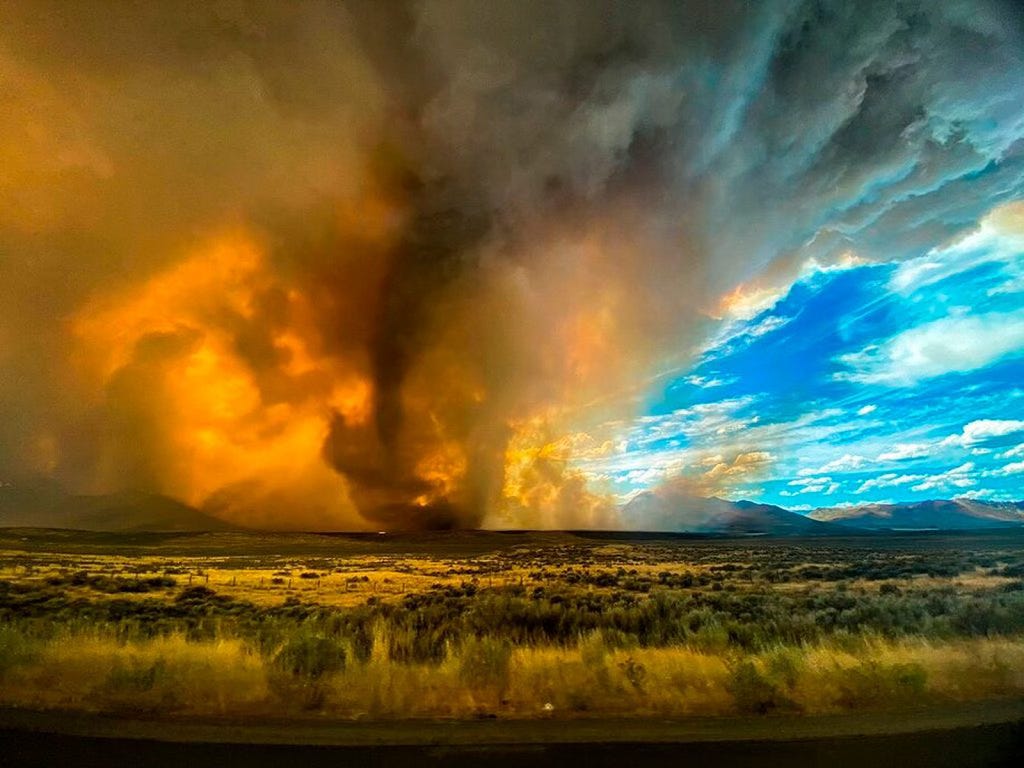
Dousing the storm with QE gasoline could be exactly the wrong thing to do. So, the Fed may not be able to intervene, or will have to invent some new untried intervention.
Hosing up the debt just to save the US from interest increases is, of course, illegal under the Fed’s charter and is called monetizing the debt, if the Fed is not doing it just to set interest rates on a temporary basis for the sake of monetary policy (stabilizing the currency); but when did that ever stop them? They always say they are not monetizing the debt on the basis that their QE is temporary in that they plan to sell those Treasuries back into the open market. Then they do eventually try to do that through “quantitative tightening,” as that is called, but they always fall far short of normalizing their balance sheet.
So, chunk by bigger chunk, they are getting away with monetizing more and more of the debt by holding it as permanent debt they bought onto their balance sheet by creating money out of nothing. When Treasuries go onto their balance sheet, the Fed creates cash to buy those Treasuries away from banks. That frees banks to lend the new cash that is deposited by the Fed in their reserve accounts in exchange for the Treasureis so that new money enters the economy as loans.
The real war became a currency war
In the very least, the present whirlwind easily becomes a currency war when national banks are defending their own currencies from horrendous inflation:
The Bank of Japan was reported to have intervened in currency markets in late March and early April after the yen weakened past the politically sensitive 160 level, as surging oil import costs widened Japan’s current account deficit and stoked fears of a depreciation spiral.
So, yes, this is the bond crisis that Jamie Dimon warned about and that I said I’d keep an eye on to tell you if it is happening. It is happening! It is highly likely that a big part of the present sell off is not a currency war, however. It is more practical as a direct result of the Iran War. Nations need to turn their banked US Treasuries into US dollars to buy oil because the price of oil is rising so much, and oil is priced in dollars.
I did something I don’t do in writing articles today and ran this theory of mine about what is happening in bonds through AI out of curiosity because I haven’t read anyone saying that Treasuries are selling off to raise cash for oil, and this is what came back:
Yes, central banks may be selling US bonds to raise cash, particularly in response to market conditions and liquidity needs. This selling can occur as they manage their portfolios amid economic uncertainties….
Central banks might need to raise cash quickly due to market volatility or other financial pressures…. Adjustments in investment strategies can lead to the selling of bonds to reallocate funds to other assets, including commodities like oil.
While the selling of US bonds can provide cash, it does not directly indicate that central banks are specifically using the proceeds to buy oil. The decision to purchase oil would depend on various factors, including market prices, economic forecasts, and strategic reserves.
In summary, central banks may be selling US bonds to raise cash, but the specific use of those funds for oil purchases is not explicitly confirmed.
No, not explicitly confirmed by anyone, which is why I thought I’d use AI to test my theory. Clearly, those market prices and strategic reserve problems mentioned as necessary conditions for pressing them to raise money for oil purchases are FULLY in play now! Apparently, AI also could not find any explicit confirmation that the reason for their selling is the need to raise substantial US dollars in actual cash to buy oil, but AI agrees the theory makes sense. Central banks typically don’t spell out their reasons.
Correlation may not prove causation, but I think the likelihood of this reason is high. This has the serious side effect of putting the US debt in the middle of a financial war being fought over oil, not expressly by one nation to kill another nation’s currency, but out of desperate need to cash in dollars that nations hoarded before the bonds they bought lose even more value and while they desperately need dollars, particularly to buy US oil. There are other countries like Russia and Iran willing to sell oil outside of the petrodollar system; but it is the US that holds the majority of oil that is not currently under siege, especially now that we’ve expanded the empire with a quick conquering of Venezuela and taken full control over their huge oil resources as plunder for the US from the day-long battle.
The Iranium equation
I suspect Trump was hoping Iran would go down just as quickly and was surprised to find they didn’t fold under severe US military pressure. In fact, he is back to pitching the same story again today, that Iran is dying to make a deal, that he was about to blow them to bits and end their existence on this very day, but he is patiently holding off because other nations in the Middle East are (again) telling him that Iran is really ready to deal now, so “we shall see,” but if they don’t hurry he will blow them to bits in a matter of 2-3 days. Only now he is already hedging his TACO bets because he added, or it could 4-5 days … or maybe six. We shall see. Iran fired back with the usual (and always ignored by Trump), “No thanks. Not interested in ending the war by giving up our uranium, and here is the list of all our same demands as last time.”
Yes, we are now in a bond crisis, but the problem is we are also in a stock crisis all caused by a war crisis that doesn’t look ready to go away.
How to reap the whirlwind
Equities are in trouble, too. As we’ve seen for the last three days they have been falling even as bond prices have been plunging (yields rising); and, yet, we learned today that investors are depleting cash to buy more equities, and yet equities are still falling as hard a bond prices. So, what a whirlwind of a market to try to figure out.
BlackRock today is yelling “BUY” equities while a major bank is yelling “SELL!”
In the rest of this article, I will lay out the contours of this multi-front storm for my paying subscribers, as you consider your investments. I’m not an investment advisor, so do your own research; but I think I can sort through the complexity for some clarification. As I’ll show, there is even more to the chaos in these winds that are whirring about, so one has to be extremely cautious right now. I am certain you will find the magnitude of it all and the ramifications quite stunning—perhaps breathlessly so.
That is because the driver for bonds right now is serious fear of inflation that I’ve said is about to “tear your freakin’ face off.” I call it Trumpflation because, like all things Trump, it will be the biggest inflation ever. The most amazing inflation anyone in the US has ever seen! People will be saying they have never seen anything like it. So, hang on! Here we go: