


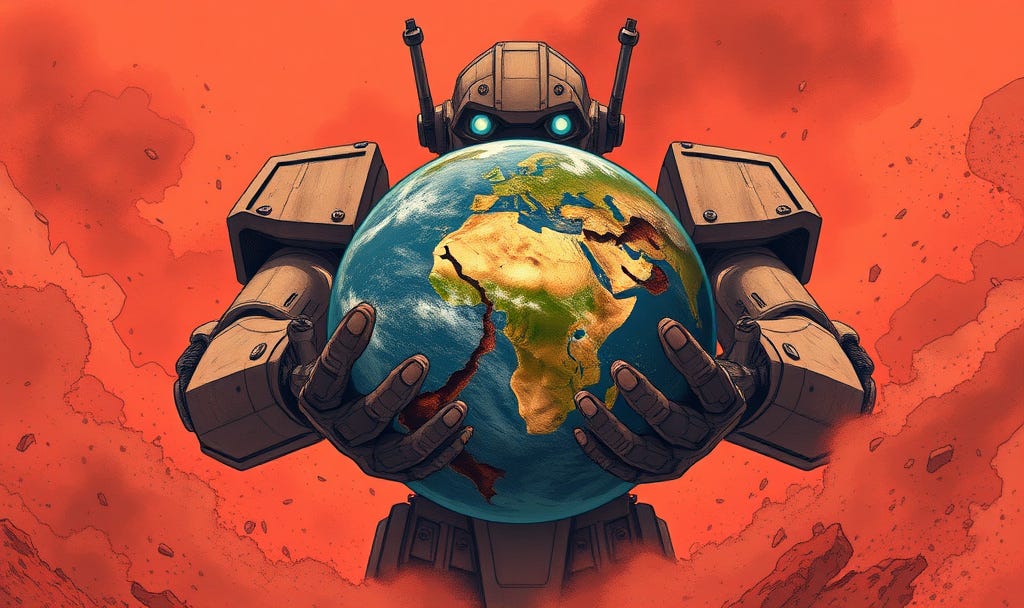
It seems like a mere two days ago that I wrote, “Feeling All Shook up.” That would have been a better headline for today when four major earthquakes appeared in less than 24 hours around the world with two of them back-to-back in the same place. The one-two-punch of earthquakes, at 7.2 and 7.5 on the Richter scale in Venezuela with less than a minute separation, was enormously devastating. Then the Hayward fault in California woke back up with a medium-scale EQ felt in three states. And to top it all off, Japan had a huge earthquake that nearly touched being a 7.0.
What on earth is going on? Literally. What on earth?
While I cannot answer that question because the quakes have no apparent correlation geologically with each other, that is an extraordinary number of high-intensity EQs for a single day. Many headlines below cover the quakes with photos, etc.
Inflation shakeup
We got a tremor today for inflation, too, which hit 4.1 on the inflation Richter scale. News focused on a somewhat friendlier number—the much more restrictive core inflation that factors out entirely the two largest areas of current inflation (energy and food), the ones that also hit your budget the hardest. But, even there, the rate rose to 3.4% on the Fed’s favorite more sanguine gauge, which was the highest since October 2023.
So, it is a tick up, even on the minimized gauge in the inflation that I’ve said will be coming this summer as energy prices finally have time to start seeping into other products and services. This reading was for May, so pre-summer. And it underscores my writing yesterday about just how badly the Fed is failing to curb inflation when its core gauge is, as of today, 58% higher than the Fed’s targeted 2.0 level. This is a longterm worsening trend, in play for years now, making total mush out of Treasury Secretary Bessent’s words yesterday about needing to be “open minded” about inflation, as it is likely to come down quickly on its own now that the war is ending.
First, we don’t know the war is ending because, once again, both sides have polar opposite views in how they read the main, intentionally vague sticking points in the MoU; and, second, the Fed hasn’t been able to get inflation down for YEARS now, so what kind of utter nonsense thinks it will level off after this energy crisis without a massive Fed fight? (Even though the Fed cannot do anything about energy-caused inflation, it will have to look like it is trying, and that will cripple the economy further; but, hey, interest rates are going to rise regardless of what the Fed does because bonds are certainly pricing in inflation, so the Fed’s only job is to try to keep up so it can appear to be in control.)
AI shakedown
Speaking of “upheaval,” note the headline below under “Digital Dominance.” The Wall Street Journal reports (but I’ve carried it on MSN so you can read it without subscribing because that is what I always try to do for my readers, which Drudge, for instance does NOT do) a major effort to get MILLIONS of workers ready right away for the coming upheaval from AI.
A new coalition of companies and policymakers said it is time to ready the U.S. workforce for major disruption, no matter the ultimate scale.
To that end, the bipartisan consortium, which includes state governments, philanthropic groups and employers ranging from Amazon.com and Microsoft to Bank of America and Eli Lilly, is coming together to develop a new “people strategy” for the artifcial-intelligence era. Called RAISE US, it launches Thursday and will be led by former Commerce Secretary Gina Raimondo, who served under President Joe Biden, and former Indiana Gov. Eric Holcomb, a Republican.
We’re talking a coming 8.0 magnitude earthquake in the jobs market, but it is likely to hit like a long, LONG rumble, rather than an instant jolt—a quake that keeps shaking for a few years, constantly getting more violent. That headline hits on an interesting day for me, because I was just scanning job openings for writers now that I’m retired to see about a better-paying side gig, and there wasn’t a thing I’d think about applying for. While the positions paid $70-80,000, every single one of them involved either using AI to create stories or (which was MOST of them) training AI how to replace writers! Well, that is going to happen clearly, but I’m not going on that death march.
“We’re going to need to scale, and scaling can never be done by single institutions,” said Brad Smith, vice chair and president at Microsoft.
The mission of the group is to “pull all the levers at once,” Raimondo said. That means teaming up with employers to find ways to help workers gain skills or new roles and joining with educators to roll out different types of training.
Right now, given what I just saw this morning on LinkedIn, it looks like the number-one type of training is learning how to train AI to replace you!
It also plans to propose policy changes such as tweaking unemployment benefits to let displaced workers continue to get them while they, for instance, start new businesses with AI.
What did I just say?
Business groups and lawmakers have warned that more must be done to prepare the U.S. workforce for potential upheaval. The Leadership Now Project, a group of more than 400 current and retired business executives, devoted several sessions at its annual spring meeting to AI’s potential threat to jobs, comparing it to the effects of globalization and offshoring in recent decades.
It’s already coming in much faster than globalization or offshoring as I described in this week’s radio interview in the article I linked to at the top of this editorial. It is a transition that is changing with exponential speed since the start of this year.
This time, though, “The scale of change and reshaping of jobs and careers is different—and more so than it has ever been, I think, in human history,” Holcomb said.
That’s more like it.
An effort in Arkansas will focus on supporting “an AI-powered career navigation platform.”
And that’s NOT more like it.
Said one of the people working in this joint effort:
“I personally don’t believe there’ll be nothing for humans to do, so we’re just going to sit around and take up leisure time,” Raimondo said. “But I am worried—obviously, I wouldn’t be doing this if I weren’t worried.”
In another story today, Indian factory workers, which was where all the jobs once fled under George Bush 2.0, are being instructed to make videos that train AI in how to replace them. Your final gig under the old world order is training AI to replace you.
The 32-year-old had been working at the garment factory on the outskirts of Delhi for nearly a year when management asked workers on her line to strap small cameras to their foreheads before starting their shifts. Nobody explained why.
As Lalita sat stitching shirts and trousers, the camera recorded everything: the rhythm of her hands guiding cloth through the sewing machine; the precision with which she aligned collars and seams; the speed at which her fingers corrected folds and imperfections; even interactions with colleagues. “We found it funny at first, because of how we all looked with that headgear,” she says.
Well, guess what? It’s not funny now that they know it was so they can be replaced with AI robots. Instead, it is earthshaking as they ask at the top of the story, “Who is going to pay us when we are replaced by robots?”
What Lalita and her colleagues did not know was that their daily routines were being captured as part of a growing effort by companies in India to collect first-hand data from factory floors, information increasingly valuable in the race to automate industrial work.
Well, they know now!
Humanoid robots have emerged as the latest frontier in the rapid evolution of artificial intelligence. Industry experts increasingly describe data as the biggest bottleneck in robotics and automation. Unlike large language models such as ChatGPT or Gemini, which were trained on vast quantities of text available online, robots require first-person recordings of physical work.
Don’t worry. They’ll catch up in a year via video training.
Probably a lot less than a year.
Companies collecting egocentric footage say the future may require hundreds of millions – and potentially billions – of hours of human activity filmed across factories, warehouses, shops and homes before robots can reliably navigate real-world environments.
Don’t count on it. The new AI can extrapolate and figure out how to do things even faster once it gets the basic picture. So, yeah hundreds of millions of hours to cover EVERY industry on earth, perhaps, but only hundreds of hours to cover the ONE that you work in.
Elon Musk has predicted that roughly 80% of Tesla’s future value will come not from electric vehicles, but from its humanoid robots.
This type of filming is actually called “egocentric data.” Good name for something that will strike right at the heart of the human ego since many people evaluate themselves AS TO WHO THEY ARE by WHAT THEY DO. They probably shouldn’t, but they DO.
Sensing the opportunity, a growing ecosystem of firms, including Humyn AI, FPV Labs, Micro1, Egodata, Neocambrian, XP Robotics, Objectways, Scale AI and CynLr, has emerged to build data pipelines for robotics companies.
That’s the new field, but it may well finish replacing ITSELF in less than two years. I’d call that a short-term business model because soon the AI robots can collect all the video data. They’ll be teaching other AI robots how to do the work they’re doing by filming themselves doing it faster than humans, so AI can learn how it’s done RIGHT.
“South Asia remains the workshop of the world for many labour-intensive industries. If you’re trying to teach a robot how humans work, there are few places that offer the same combination of scale, diversity and density of human labour as India. On any given day, millions of workers are sewing garments, assembling products, sorting goods and performing tasks that robotics companies want machines to learn,” says Puneet Jindal, the founder of Labellerr AI, a technology company that collects egocentric data in India.
India’s cheap labor is now replacing itself.
This will be earthshaking on a massive social scale for a nation of 1.5 billion people who were only just starting to get the feel of being a modestly prosperous society. It will be for all the rest of us, too, because, if it’s happening in India where labor is cheap, it will be happening more everywhere labor is expensive!
Capturing the footage is only the first step before recordings are cleaned and annotated for clients, ensuring that hands remain visible, movements are accurately tracked and actions are separated from background activity.
Yes, but AI will quickly be doing ALL of that laborious video editing in mere seconds.
The Guardian’s examination of data-collection practices across six factories in five states found that workers wearing devices ranging from meta smart glasses to head-mounted cameras received no compensation for generating footage that would later be sold to technology companies.
“Sometimes they give us a soft drink,” says Lalita, who earns about $200 a month at the factory….
“The demand for egocentric data is exploding, and new companies are entering the market every month promising to deliver it more cheaply,” says Jindal. “International clients are often willing to pay significantly more for this footage, but the pressure to undercut competitors keeps pushing costs downward. By the time that trickles through the supply chain, the workers generating the data are often left with nothing.”
As goes the data stream, so goes the whole AI stream. You’re not going to get any special compensation for teaching AI how to replace your, but you very likely could find yourself teaching AI how to replace you.
Jindal says attempts to compensate workers directly are often resisted by factory owners. “Their argument is that labour costs are already rising and margins are under pressure. They say that if costs increase further, factories may shut down or scale back operations, leaving workers without jobs.”
Yeah, so “to hell with the workers” is, I guess the motto. Typical. And that’s about how well AI benefits are likely to trickle down. It’s not a coming earthquake. It is already rumbling in various parts of the world and spreading toward a part near you, and white-collar workers are the easiest to replace because thinking and decision making are, at least, SUPPOSED TO BE what AI does best.
In some factories, the footage is being used for more than training AI. Records reviewed by Scroll.in found that some companies also generated productivity reports from the recordings, ranking workers based on time spent actively working, estimating losses from “idle” periods, and even tracking how much time workers spent talking to colleagues. In some cases, reports singled out specific workers and identified when and where co-workers gathered to socialise.
Robots, of course, won’t likely be doing all of that nonsense. Or, if they do, they will be communicating telepathically via Bluetooth or WiFi while they work at super-human speeds. You won’t even know they are talking up a storm!
The flip side to all of that, of course, is the likely citizens revolt that will come if AI is allowed to push so many people out of work. Even brick masons are wearing the head gear and training their AI robot replacements. One mason sends the data via a phone and says,
“The phone feels heavy and uncomfortable to wear,” he says. “But I’ve only just started. Maybe I’ll get used to it with time.”
Heavy for a BRICK mason? Well, don’t worry. You won’t have time to “get used to it.”
And the apprenticeship training will go much faster than it did for you:
Unlike conventional workplace data, these recordings capture workers’ bodily knowledge, the movements, instincts and skills accumulated through years of experience. Yet once converted into datasets, that knowledge can be circulated through global AI supply chains.
The move from apprentice to journeyman will take only seconds. Overall, this will be earthshaking in its social and economic impact.
