

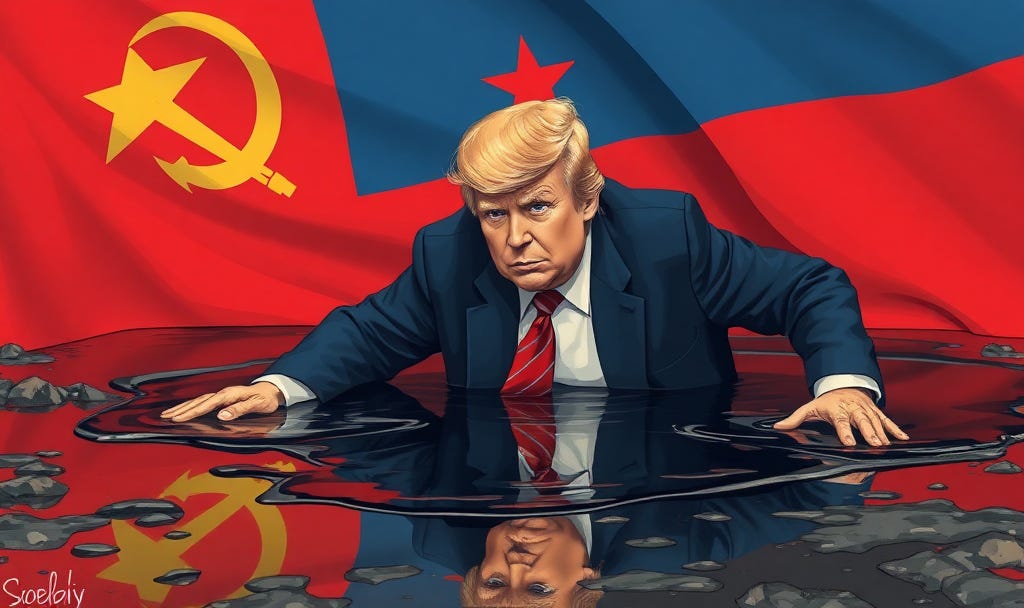
The new Donroe Doctrine is already taking shape around Venezuela’s vast oil plays. Chevron has just contracted eleven tankers to start transporting oil out of Venezuela, making Big, Big Oil the obvious winner. The normally pro-Trump, but always more pro-Putin Zero Hedge notes,
With the Monroe Doctrine effectively rebranded as the “Don-Roe Doctrine,” reflecting the Trump administration’s new approach to exerting control and influence across the Western Hemisphere and rooting out China and Russia, the developments this past weekend involving U.S. Delta Force operators capturing Maduro do not come as much of a surprise.
Consistent with the Don-Roe Doctrine, Chevron has contracted a fleet of tankers scheduled to arrive in Venezuela later this month, reinforcing its role as the dominant player, for now, a critical conduit for Venezuelan crude into US refineries along the Gulf of America.
The fact is that Chevron already had the largest footprint in Venezuelan oil of any company on earth, so this is no surprise. If this was all that happened, you might just think Chevron was continuing to do what it does every month. While eleven tankers is more than Chevron has contracted for the last two months, the lower numbers were during an unsteady oil embargo when bombs were dropping on boats. Now that the US Navy and Coast Guard are fully in place on the seas around Venezuela and now that the US has settled who is running the show, tanker companies working with US Chevron are probably more comfortable running more ships or, at least, making it easer for Chevron to find ships that want to contract for hauls in the region.
Shares of Chevron, ConocoPhillips, and ExxonMobil have jumped on news of regime change in Venezuela, and oil prices are hovering at one-year lows.
However, Chevron’s step back to normal in tanker flow was far from the big thing happening today.
President Donald Trump said Tuesday that Venezuela will turn over 30 million to 50 million barrels of sanctioned oil, which will be sold at market prices.
“That money will be controlled by me, as President of the United States of America, to ensure it is used to benefit the people of Venezuela and the United States,” Trump said in a social media post….
The 50 million barrels are only the first tranche and shipments will continue indefinitely.
You can be sure it will mostly be to the benefit of the United States. “Benefiting the people of Venezuela” by the outpouring of oil from the country is—if this goes like most neocon big-oil wars—mostly window dressing to sell your war to the American people. We’ll have to see who gets the biggest cut from the oil profits that are left after extraction and shipping costs.
Proceeds from the oil sales will settle in U.S. controlled accounts, the sources said, with the money released back to Venezuela at the discretion of the U.S.
Well, we do have the power to take the oil; so, of course, it belongs to us if you accept Stephen Miller’s primary ethic as he stated it repeatedly yesterday.
Energy Secretary Chris Wright later confirmed the plan at a conference hosted by Goldman Sachs in Miami on Wednesday.
“We’re going to market the crude coming out of Venezuela,” Wright said. “First this backed up, stored oil and then indefinitely, going forward, we will sell the production that comes out of Venezuela into the marketplace….”
“Secretary Wright remains in close contact with U.S. oil companies and plans to meet with several of them at the Goldman Sachs Energy Conference in Miami on Wednesday,” a Department of Energy spokesperson told CNBC.
So, yeah, we’ve got the oil and that is largely what this war was all about, not drugs; so we will convene a consortium to figure out how we are going to dive the plunder; but there is more in the geopolitical sphere (a lot more) to all of this. You may recall my speculating that gaining leverage over China right where it hurts was likely a big part of this oil play. We got confirmation of that today.
Another little interesting note confirmed a big point I made yesterday:
Previously, the sanctioned oil would have gone mostly to China but will now be rerouted to the U.S. instead.
Uh huh. As I thought. Another article today adds more dimension to my claim that this was a power play to gain significant leverage over China now that China has, as I laid out, cornered the silver the market by stopping almost all silver from going out of the country, and the US needs lots of silver for its high-tech electronics. An excellent video earlier this week laid out that case, and now we are hearing how the conquest of Venezuelan oil is giving leverage against China:
On Saturday, the Panama-flagged tanker Centuries was seized carrying sanctioned Venezuelan oil, a move condemned by China. The seizure was the latest in the President Donald Trump’s vow to block tankers carrying Venezuelan oil. Maritime experts say the move may have relied on a legal authority that suggests more seizures will be coming, and potentially target more oil intended for the Chinese market….
Of course.
“The most interesting part of the Centuries seizure is the suggestion of the U.S. likely relying on its prior boarding agreement with the Panama Maritime Authority,” said Ampatzidis, adding that the use of this agreement can lead to additional seizures….
Of course, if Trump controls all oil going in and out of Venezuelan waters, he won’t need to seize the tankers at the Panama Canal, under specific terms of an old agreement, as they exit the Gulf of “America.” He will just have the US Navy prevent the Chinese-bound tankers from ever loading in the first place or command Venezuela not to sell to them under the threat of additional military prices to be paid.
But it goes bigger than leverage over China:
“Beyond already-sanctioned vessels, the U.S. appears increasingly willing to target other ships linked to the shadow fleet when they attempt to depart Venezuela with cargo — particularly if they are stateless (no flag) or Panama-flagged,” Ampatzidis said.
In fact, the Trump administration became even more brazen today by seizing two oil tankers that were presenting Russian flags.
“The most interesting aspect of all of this is that by squeezing Venezuelan oil, you are not only putting tremendous pressure on the Maduro regime, but you are also impacting China strategically,” said Aaron Roth, retired Coast Guard captain and principal, federal strategy & security, for the Chertoff Group. “The longer it goes on and it may create negotiating space in U.S.-China diplomacy, because Venezuelan oil is discounted to China, and it’s the type of heavy crude that China can refine,” he said. “Without VZ oil, China will have to go to the market to Russia and the Middle East, which will be more costly to them,” he added.
There we go. Now that the US owns all of Venezuela’s oil for all intents and purposes by seizing control of the state, it can negotiate with China over that silver, as I suggested yesterday: “We’ll sell you oil from Venezuela, so long as you pay the US in silver.” Or some arrangement of that kind—maybe just an agreement to get China to stop its stoppage of silver.
Kpler data indicates China buys about 76% of Venezuela’s output. The U.S. has imported around 17% of Venezuela’s output in 2025. Cuba, Spain and Italy are the other significant customers of Venezuela’s oil.
Trump has gained other powerful leverage for his imperial quest by taking Venezuela. He can shut off oil to Cuba and crush the nation once and fore all. News today says Cuba is hugely concerned about that:
Cuba’s economy is being described as in “free fall” and at its worst time in the almost 70 years since the communist revolution, according to a new report…. The situation could deteriorate further following the capture of Venezuela’s authoritarian President Nicolas Maduro and his wife, Cilia Flores on Saturday.
It’s not just that it could. It is part of the masterplan as President Trump has already made clear his intentionality along those lines:
President Donald Trump and officials have said the Havana regime will fall as a result. Secretary of State Marco Rubio said that while he wouldn’t anticipate decisions, “I don’t think it’s any mystery that we are not big fans of the Cuban regime, who, by the way, are the ones that were propping up Maduro.”
Maduro makes a handy tie-in. We, of course, have to go after the nation that propped up this drug kingpin (whom the Trump administration suddenly and official said today was not really a kingpin after all).
So, there you go: more regime change because, as I argued yesterday, once the strongman starts feeling his muscles, he becomes emboldened to reach for more, especially if the people of his country keep letting him do it, and we all know he had a lot more in his sites anyway.
Trump, on his end, said: “If I lived in Havana and I was in the government, I’d be concerned….”
“I think Cuba is going to be something we’ll end up talking about, because Cuba is a failing nation right now, a very badly failing nation, and we want to help the people,” he added.
“Talking about” is a barely veiled way of saying, “We’ll now be making specific plans for how we’ll handle Cuba.”
Yeah, sure, “we want to help the people.” At least, Trump has returned to applying a little of the old, oil-war slick to his otherwise rough words—a little of the old veneer that always made hostile wars over oil sound noble. Sure, taking control of Cuba will be all about helping the people. That is why Trump is trying so hard to keep them out of the United States. He wants to help them.
His problem in Cuba with immigration enforcement may actually get worse as a result of the fear Cubans now have over the collapse of the country under a potentially hostile US military takeover where the Cuban government may muster more return fire than Venezuela did, prolonging the conflict. Better, if you’re going to be under US rule, to move to the ground where the bombs will not be falling:
According to a recent poll, over three in four Cubans intend to flee the country.
With that many having wanted to flee the country as they saw Trump’s ambitions shaping up last summer, you can be sure the percentage is even higher now that Trump’s ambitions are firing right off their shore.
In another passage of the piece, the WSJ said that Cubans are “going hungry, suffering from spreading disease and sleeping outdoors with no electricity to power fans through the sweltering nights. Some told the outlet that garbage is piling up, communicable diseases are spreading and many children aren’t going to school. Moreover, water is not always available, meaning many can’t bathe, wash dishes or flush their toilets.
The lack of oil, since Cuba gets most of its energy-producing oil from neighboring Venezuela, is why Trump says he would be very concerned if he lived in Havana.
Venezuela has been sending heavily discounted fuel, some of it used to generate electricity, that supplies about a third of the island’s needs.
That won’t be happening anymore.
Adding to the alarm in Havana, Trump and Secretary of State Marco Rubio reiterated their calls for the end of the longtime dictatorship in Cuba, though they’ve been coy about the role the U.S. might play. Over the weekend, Trump said Cuba was so economically depressed it was poised to “fall of its own volition.”
Not that a little kick in the butt won’t help it fall.
There are whispers on the streets of Las Tunas, in central Cuba, that given what happened in Venezuela, something similar could happen on the island.
They are hoping, in spite of the bombing, that the US will arrive in good George-Bushian style to become their great liberators:
“People are scared and nervous, but hopeful,” said García, who opposes the regime. “There’s people who are wondering if Cuba will be free, too.”
And, it’s not hard to see why they want to be liberated from the present regime:
Even before the possible cut in Venezuelan assistance, Cuba was mired in its deepest economic crisis since the fall of the Soviet Union in 1991. Fuel shortages and decrepit infrastructure are leading to massive, economy-crushing blackouts, and about a fifth of the island’s inhabitants don’t have reliable drinking water.
Of course, the desire of people to be liberated, as I’ve pointed out all week, always makes for a more humanitarian rational for US oil wars than Stephen Miller’s stated rationale that entire nations are ours to take because we are mighty and might is right.
Now, here’s the kick help them fall:
If Washington does effectively sever Venezuela’s energy and financial ties to the island, it’s likely to lead to even more dire conditions. Locals describe the daily grind searching for affordable food while dealing with hours-long blackouts as exhausting.
“We’re already living in the dark, but what little electricity we have comes from Venezuela,” said Emilio, who lives in Havana and asked not to be identified with his full name because he’s worried criticism could affect the treatment of relatives who are in prison for political dissent. “It’s us, the people, who are going to have to pay the bill.”
As Trump threatened, if I was living in Havana right now, I’d be feeling uncomfortable. In fact, he is likely hoping the people become uncomfortable enough to form a massive uprising. Then, when the Cuban government tries to crush the uprising, the US military can swoop in to disarm the government as a humanitarian crisis rescue, shut it down and change the regime just in time to be the saviors of the people!
All of this might sound quite noble, except that we have seen how nicely for the people such promises have played out over the long term in Iraq, Afghanistan and Syria. Our regime changes never end as clean and pretty as we think they will, and the nation’s typically, as happened in Iran decades ago when our installed Shaw of Iran ran the country, end in decades of internal conflict and civil wars.
Don’t expect this adjacent adventure will go clean. The other side tends to keep fighting back for a very long time, always costing the US hundred of billions of dollars that we dump into the national debt for someone else to repay. Because we are strong like that. We like to make sure our children will pay for our adventures. We buy the family vacation each summer with the children’s education fund.
Ah, but the boldest part of this week’s adventures happened in the past twenty-four hours when the US military seized two Russian-flagged ships. One of the ships doesn’t deserve to be called Russian because it reflagged itself by painting a Russian flag on its side in order to fall under Russian protection while it was being chased and changed its name from Bella 1 to Marinera after it fled the US blockade of Venezuela with the US Coast Guard hot on its buns.
Regardless of the sudden flipping of the flag,
The Kremlin, a strong supporter of deposed President Nicolás Maduro, accused the U.S. of violating maritime law by seizing the Marinera…. The saga emerged as a new flashpoint between Washington and Moscow.
The ship made it almost all the way to Iceland before it was captured by the US Coast Guard.
Secretary of State Marco Rubio told reporters on Capitol Hill that the tankers were seized as part of “stabilization” efforts for Venezuela.
There spin is getting smoother after a the past day of raw transparency. We are now all bout doing it all for the people; and we had to seize those Russian-flagged ships or Venezuela would have become more unstable.
Unstable because we’d go back to bombing them!
You see, as Steven Miller warned, US Secretary of State Marco Rubio now confirms…
… that the interim authorities in Venezuela “understand the only way they can move oil, generate revenue and not have economic collapse is if they cooperate and work with the United States.”
But here is where it gets good:
Russia’s Transport Ministry said in a statement following the tanker’s capture that the Marinera had been granted temporary authorization to sail under the Russian flag in late December, and that it had lost all communication with the ship after U.S. forces boarded it on Wednesday….
Chairman of the State Duma Committee on International Affairs Leonid Slutsky told Tass the seizure was “unquestionably a violation of maritime law and UN conventions,” while Senator Andrei Klishas, of the Putin-aligned United Russia party, said on Telegram that the U.S. had “turned to outright piracy on the high seas.”
White House press secretary Karoline Leavitt said at a news briefing that the Marinera was “deemed stateless” after “flying a false flag.” She said the crew would be subject to prosecution under U.S. law and “will be brought to the United States for such prosecution if necessary.”
Pressed about whether the seizure would inflame tensions with Russia, Leavitt said that Trump had an “open, honest and good” relationship with Vladimir Putin but that he would “enforce our policy that’s best for the United States of America, and with respect to these ship seizures, that means enforcing the embargo against all dark fleet vessels.”
Here is how the false-flagging story developed:
“We have seen an accelerated shift of vessels changing to the Russian flag over the past month,” said Richard Meade, editor-in-chief of Lloyd’s List. “Seventeen shadow fleet tankers changed fraudulent flags to join the Russian flag in the past few weeks alone.”
This is where it gets dicy as more and more ships are ducking for cover under Russian flags:
“Intelligence tells us several other ships currently attempting to leave Venezuela are similarly using fraudulent flags and may follow others in joining the Russian register to continue trading,” said Meade.
That makes this a US-Russia war, or could if the US keeps seizing these ships that Russia is permitting to run under its flag.
More than 40 shadow fleet ships have been registered under the Russian flag registry since June, according to Lloyd’s List.
“The shadow fleet is highly flexible,” Meade said. “Ships that have been engaged in Venezuelan trades will now likely move into Iran or Russia trades. There is a ready supply of vessels able to switch between these trades.”
And one, so far, one member of the Russian Duma today stated that it is time for Russia to sink a couple of ships next time it takes over Russian ships and confiscates their oil. He even implied that seizing Russian ships might lead to nuclear war. That can be averted, of course, if Trump manages to hand Russia some major chunks of Ukraine.
This is how the game of Risk is played. I’m putting four more pieces on Venezuela, and Putin is moving twenty more to Kamchatka.
