


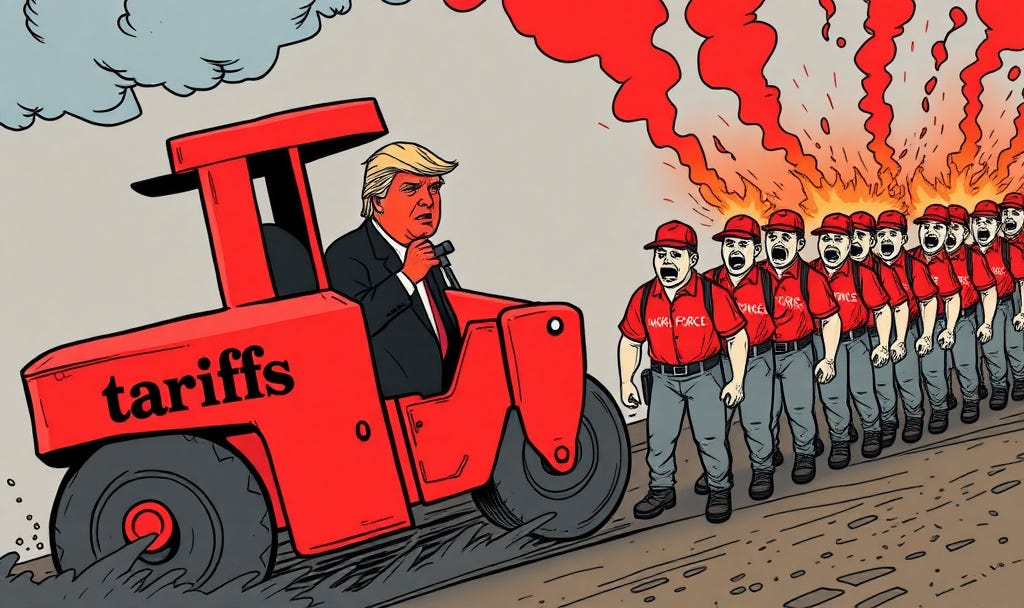
American workers are getting steam-rolled by tariffs. The economy has, according to ISM (the Institute for Supply Management), been contracting ever since Trump took office. Manufacturing has shrunk for nine months in a row, and while production saw a tiny bump in October, new orders have gone down for all of the last three months, so that took production back down to a lower point. (No sense producing more, if people are not buying.) Lowering production, equals declining employment, and we easily see that now in the data.
‘Business conditions remain soft as a result of higher costs from tariffs, the government shutdown, and increased global uncertainty’
Chaos comes with a cost. As tariffs have flashed on and off and higher and lower, businesses have been saying constantly that this is creating uncertainty that makes intelligent planning next to impossible. I’ve been trying to keep that complaint up front in these editorials, knowing it was going to take a serious toll over time.
American manufacturing contracted for the ninth straight month, a survey showed, as uncertainty tied to ever-changing tariffs and a historic government shutdown weighed on business.
Not only is new manufacturing not moving to America to any significant degree, but existing manufacturing is suffering because tariffs cause foreign counter-tariffs that hurt those manufacturers’ exports, while US tariffs cause higher costs for production due to so many imported materials and parts. It’s all wearing thin at this point.
“At any given point, trade with our international partners is clouded and difficult,” one executive at an electrical-equipment maker told ISM. “Suppliers are finding more and more errors when attempting to export to the U.S. - before I even have the opportunity to import.”
All of this, of course, has also been taking a toll on employment, which I’ve tried to point out by using non-government sources, as government data fails to come through.
Manufacturers continued to reduce staff by leaving open jobs unfilled or resorting to layoffs in some cases. Some two-thirds of companies said “managing head counts is still the norm at their companies, as opposed to hiring.”
As for future prospects that Manufacturers will realign their supply lines to the US, not really so:
Many companies say overseas suppliers are still cheaper even after high U.S. tariffs are factored in, giving them little incentive to seek out domestic sources that in many cases don’t even exist.
It’s easier to say than do. It would take a long time to build factories to create the same supplies here, if investors could even be convinced it was worth the effort, given that their ability to export those supplies would be crimped by retaliatory tariffs and given that the foreign supplies, where they are available, still tend to cost less, so are tough to compete against.
Simply put,
The tariffs are “not having the intended effect, unfortunately.”
Anyone reading here has had plenty of reason to believe all along that they never would.
Employment weakens
As for the employment impact, another article in today’s news points to just how much the impact has accumulated:
Layoff announcements top 1.1 million this year, the most since 2020 pandemic
That’s actually, extraordinary, given that the layoffs in 2020 were the most extreme in US history as Trump forced unemployment through mandatory economic lockdowns.
Announced job cuts from U.S. employers moved further ahead of 1 million for the year in November as corporate restructuring, artificial intelligence and tariffs have helped pare job rolls, consulting firm Challenger, Gray & Christmas reported Thursday.
… job cuts in November have risen above 70,000 only twice since 2008: in 2022 and in 2008….
Companies have, at least, gotten enough heart over the years to stop timing layoffs for the holidays:
“It was the trend to announce layoff plans toward the end of the year, to align with most companies’ fiscal year-ends. It became unpopular after the Great Recession especially, and best practice dictated layoff plans would occur at times other than the holidays,” said Challenger.
So, it is not surprising that …
November offered some relief from the more than 153,000 cuts announced in October, which was the highest total for the month in 22 years.
Those figures from ADP are non-government cuts.
Employers have also announced 497,151 planned hires through the past year to present, but those planned hires are down 35% from the same point in 2024.
The Trump administration tried its best to blame the layoffs on Democrats, of course:
Commerce Secretary Howard Lutnick denied President Donald Trump’s tariffs were to blame after ADP reported a drop in private payrolls in November.
Commerce Secretary Howard Lutnick on Wednesday denied that the Trump administration’s tariff policies were to blame after a new report showed a surprise drop in private payrolls in November.
Instead, Lutnick argued on CNBC’s “Squawk on the Street” that the government shutdown temporarily slowed small-business activity….
“Remember, you had the Democratic shutdown, right? And what do you think happens to small business? The people who do business with the U.S. government, they know they’re not getting paid, so they sort of slow down their projects,” Lutnick said.
Nice try Lutnick, except you have no data to back that up. The report says nothing about any businesses claiming their layoffs were in any way related to the government shutdown. So, that’s just a guess and a miss because businesses that are generally doing well are reluctant to lay off employees due to a temporary government shutdown of indeterminate length.
But the Cabinet secretary assured that those figures will “rebalance and they’ll regrow,” claiming “this is just a near-term event” and that “next year, the numbers are going to be fantastic.”
O.K. We’ll let you have the last word, Sputnik.
