


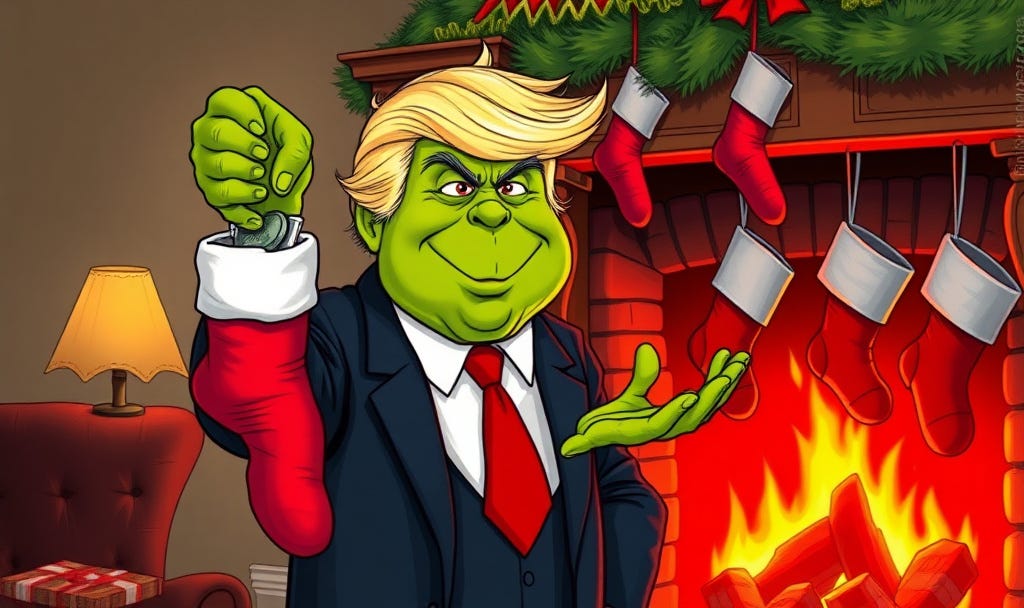
As Trump settles down from his recent raging against voters for being obsessed with inflation, having claimed inflation was now a Democrat hoax, one of today’s articles talks both about the inflation that is happening and the inflation that is not happening due to the president’s tariffs. According to limited available government reports, Trump appears to be right.
What is causing all the perceptions of high inflation? Are consumers feeling something that isn’t happening? If so, is this widespread mass hysteria?
It sounds like they are feeling it quite strongly. Anecdotally …
At a Christmas market outside the US capital, festive cheer alone hasn’t been enough to drive affordability worries out of shoppers’ minds—as American households contend with creeping inflation this holiday season.
“Prices are terrible. It makes it difficult to shop for a lot of your friends and family,” said James Doffermyre, a high school teacher.
“We always have a big Christmas, and we get one or two gifts for everybody,” he told AFP.
But this year, he added, “we said all the adults were okay, (let’s) just buy things for the kids.”
His plans underscore the affordability pressures that American households are facing, with dissatisfaction mounting over costs of living.
We also saw significant Democratic advantages in recent elections, and several polls indicated voter wrath was exercised against Republican candidates because of perceptions that Trump is causing inflation.
Recently, Trump even slightly backed down by acknowledging a problem that needed to be addressed:
Republican President Donald Trump too has acknowledged an affordability “problem” recently, after repeatedly dismissing it as a “hoax” and a “con job” by rival Democrats.
So, what’s really happening? Where is the inflation that I said would start pressuring things in the holiday season? It’s not showing up in government data, but that’s because the government data, itself, didn’t show up due to the convenient government shutdown. So, we’re flying in the dark, right as people are complaining about rising holiday prices. Of course, even when that government inflation data is available, it can hardly be trusted with all of its “seasonal adjustments” that allow lots of room for government apparatchiks to keep from getting fired for bad news now that they saw Trump fire their boss over bad news about jobs. (Same outfit does the government jobs reports and the government inflation reports.)
They may feel pressured, if the boss can be fired, to report the “truth” the president wants to see. On the other hand, getting a new interim boss in place only resulted in even worse job numbers for the president. So, someone must be trying to tell some truth, in order to report worse job numbers after Trump said he fired the last gal for creating fake labor reports to make him look bad.
Was I wrong in predicting inflation would get notably worse in the fall?
I’ll hold to my prediction that tariffs would start to pass through to consumers in the fall, even against presidential claims to the contrary, as I always do no matter how many writers and politicians stand on the other side of the argument. Even today’s article, which gives anecdotal evidence that people are suffering from an inflation surge, claims the surge in consumer inflation that I said would be hitting now hasn’t arrived:
While Trump’s wide-ranging tariffs this year have not sparked a broad surge in consumer inflation, companies have noted steeper business costs, with some opting to pass them on by raising prices.
That said, very few articles argue that tariffs and inflation have not hit producers. You see, a producer buys a resource from China and pays a tariff, but then he buys a part he needs for the same product from the US where there is no tariff charged to him but pays an inflated price because the manufacturer of the part paid tariffs on some the resources purchased from abroad that went into that part.
So, US producers are both paying tariffs directly to the government as they import materials or parts, and paying inflation on American items they buy that were hit by tariffs during their production. While consumers are not being reported as seeing much inflation yet, producers are passing their costs on to retailers and to other producers; but consumers are waging a war and turning away from higher prices, making retailers reluctant to lose customers. In fact, that kind of behavior is exactly what you see the people in the story above doing by deciding not to busy as much for Christmas. So, the anecdote helps confirm the reason consumer prices are not rising much.
The official reported rise for consumer inflation has been meager so far. It has risen, but not by much:
Inflation has edged higher, with the consumer price index rising 3.0 percent on an annual basis in September, up from 2.9 percent in August.
Still, those statistics, due to the shutdown, only reach to the end of summer, and my prediction was that we would see inflation hit prices in the fall, especially once holiday shopping began. September is mostly a summer month. So, are consumers seeing and feeling what the government is not yet reporting because the government is, well, just not reporting much at all right now?
Or is their deep-seated concern expressed in the stories of the article being quoted from the headlines below just mass hysteria—just a response to media stories that keep claiming inflation is deeply troubling people? While the data isn’t there at all because it was never collected in the void of the shutdown, the stories of inflation-angry consumers abound, and the rage they expressed back at President Trump when they felt he was telling them to just eat cake if they cannot afford bread seemed to have even toned down Trump’s vitriol for a few days.
Another shopper, 73-year-old special education teacher Karen Jenkins, called grocery prices “outrageous….”
For her part, she is buying less and cutting down on going out for shows.
See: fighting back, making it as hard as they can for retailers to raise prices.
On the producer side, however, the tariff impact on their prices is a lot tougher:
Pastry chef Olivia McPherson, 30, noted that prices have been rising during the past three years: “It’s been getting worse and worse.”
She said that she rents from a friend because she cannot afford her own apartment, and buys less meat to cut costs.
“I’m lucky enough to work at a place where I get meals provided for me,” McPherson added.
But this year, she might not be able to buy gifts for all of her friends.
“I would never ask them to get me a gift as well, just because I know everybody’s feeling it,” she added.
So, what are consumers feeing that government isn’t around to report? If we take the consistent anecdotal evidence, the inflation is there, but it will likely take until the start of next year for poorly collected data to start catching up or for us to move on to a period of better data collection because the government has reopened and can start collecting it. We’re in a blind spot right now. So anecdotal evidence may be all we get for the time being.
Non-government economic reports/surveys have consistently reported businesses complaining about their high-rising costs.
Predictably, it didn’t take long for the president to revert to his hoax claims:
President Trump is hitting the road today to address Americans’ affordability concerns head-on. But it’s a trip that comes as his rhetoric and actions often appear at odds with each other….
“You can call it affordability or anything you want, but the Democrats caused the affordability problem,” Trump offered Monday at the White House as he again falsely claimed that prices now are falling overall.
In blaming the Democrats, he now admitted there is a problem. In fact, if it’s a big enough issue to get the president to hit the road, then it must be bothering people a lot. So, I guess you have to decide for yourself whether it’s all a hoax as the president first claimed or if the bite of inflation is hitting consumers while the lack of government reporting is providing some cover. Now it’s a problem since he got a to of flack over the hoax claims but the problem is caused by the Democrats, not by his tariffs.
So, is president Trump out to lunch when he claims consumers are falling for a Democrat hoax that has now morphed into a Democrat-caused problem? If he is, I’ll bet he’s lunching at a much ritzier establishment than all those consumers whining about the cost of bread, who should just start enjoying cake like he does at Mar-a-Lago, if their bread is too expensive.
His actions now say he doesn’t really believe the “affordability crisis” is just a Democrat hoax that has triggered mass hysteria and even say he doesn’t really believe tariffs have nothing to do with the price increases:
On Saturday, President Trump signed an executive order creating task forces to investigate possible price-fixing in the food supply chain…..
On one front, Trump and his team often seem to dismiss the sense that everyday costs are becoming harder to manage (or at least whether the White House holds any responsibility for it).
On the other hand, Trump and his team have taken a series of actions in an apparent acknowledgement that affordability is more than a media creation.
Recent weeks have seen the president reverse some of his tariffs on grocery store items. He has also floated ideas like $2,000 tariff rebate checks and even 50-year mortgages to lower month-to-month costs.
Billionaire Bessent who runs the US Treasury also argued that consumer concerns about prices are overblown, probably as he dined on the best chocolate cake at the White House.
Out of touch, or dishing it to you straight? A hoax, or something actually demanding the president’s engagement, though he’ll never admit the root cause is his tariffs, even though he admitted that reducing tariffs on coffee, chocolate and bananas would help bring down prices of those items. Hit is hard to see how that will bring down prices … if the tariffs didn’t raise prices on those items in the first place.
A new way stores are trying to push through their inflated costs
And, now, as if tariff inflation isn’t enough, you can shop online at Instacart for your groceries, and, as the company gathers more data about you, it may help out next time by raising the prices of the items you buy the most. Or it will tease you with a good deal on those but raise prices on the rest—whatever works. Forty people who didn’t know each other were chosen for a shopping survey and asked to buy the exact same twenty items via Instacart from the same store at the same time.
Connected by videoconference, they simultaneously selected the same store — a Safeway in Washington, D.C. — and the same brand of eggs. They all chose pickup rather than delivery.
The only difference was the price they were offered: $3.99 for a couple of lucky shoppers. $4.59 or $4.69 for others. And a few saw a price of $4.79 — 20 percent more than some others, for the exact same product.
Nice.
The survey was conducted jointly by Consumer Reports and Groundwork Collaborative. The same test was conducted in …
four cities across the country, [as] nearly 200 volunteers checked prices on 20 grocery items on Instacart.
On item after item, they found significant differences. In a Target in North Canton, Ohio, some shoppers were charged $3.59 for a jar of Skippy peanut butter that others could get for $2.99. At a Safeway in Seattle, some people paid $3.99 for a box of Wheat Thins while others paid $4.89. And at a Target in St. Paul, Minn., some people were charged $4.59 for a box of Cheerios that others could get for $3.99.
“Two shoppers who are buying the exact same item from the exact same store at the exact same time are getting different prices,” said Lindsay Owens, executive director of the Groundwork Collaborative. “The data really backs up how extraordinarily pervasive this is….”
Groundwork’s findings are the latest example of how the notion of a single price, offered to all customers for a predictable period, is breaking down in the digital age. Companies are using sophisticated algorithms to adjust prices quickly in response to competitors’ offers and consumer behavior. “Dynamic pricing” strategies, in which companies raise prices during periods of intense demand, have spread beyond sectors where they have become familiar, such as air travel and ride-hailing services, to other parts of the economy, including restaurants and retailers.
This is one way stores are exploring to find cracks and niches where they can raise prices and monitor the consumer’s response to see who much they will pay and adjust prices up to that limit. I’ve said inflation from tariffs will keep coming in over months or years because the pressure for producers and retailers to pass on all their increased costs under tariffs will relentlessly cause them to keep looking for windows of opportunity to ratchet their prices up. That is what this is.
Who could ask for anything more?
Grocery prices are up more than 25 percent over the past five years and continue to rise faster than before the pandemic. In surveys, voters consistently rank food prices among their top affordability concerns.
Better boycott Instacart as the next battleground. Let them know that kind of kind of sly price manipulation can get a company slaughtered.
