


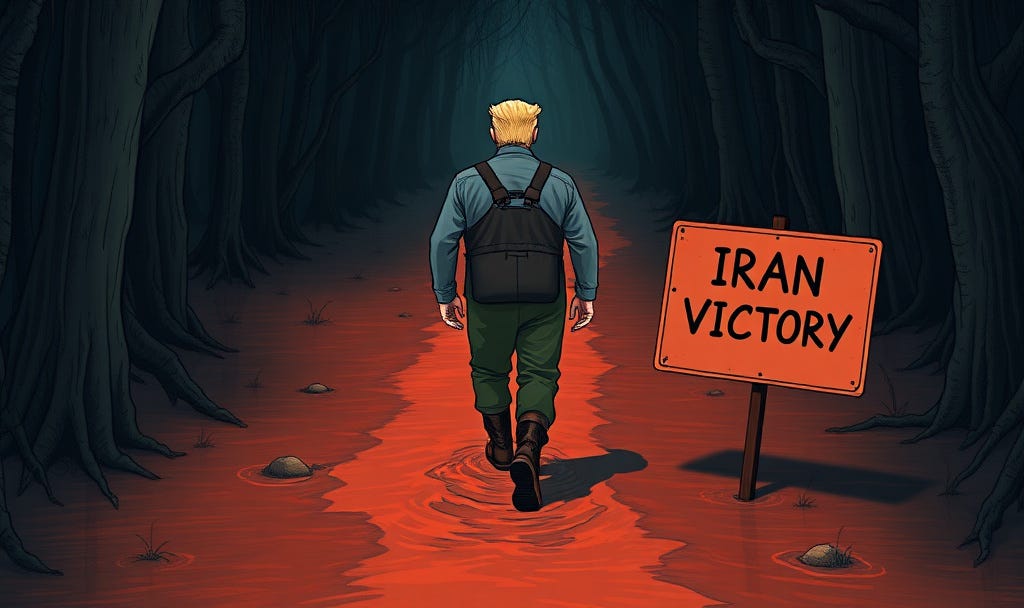
Today, we got more proof of how silly yesterday’s brief heart flutter in oil prices was. The mini plunge came as a response to some vain word about Iran and the US possibly thinking about having a short ceasefire to get together to discuss having a longer ceasefire to negotiate on things neither side is close to agreeing on. Those who think that even matters, fail to understand what Iran is doing here.
Today, oil prices got more realistic and rose and held above $91/bbl for Brent crude, and Goldman Sachs said prices could easily go above $120 if the gulf chokepoint crisis worsens. It did worsen. Immediately. The Houthis announced they were closing down the Red Sea to all Saudi Arabian oil shipments. Tanker traffic that was headed out of the Red Sea via the Bab el-Mandeb Strait immediately turned around in order to avoid being attacked. That effectively knocks out another 7% of the world’s oil supply that had found a side route via pipes across the desert from the Persian Gulf to avoid Hormuz. Who could have seen that coming … since Iran told us it was?
Shipping through the Strait of Hormuz also ground to a standstill over the last 24 hours. So now both sides of the Saudi peninsula are cut off, just as Iran said would happen if the US crossed its red lines, which the US did, as I reported yesterday, when it bombed an unfinished nuclear reactor site that Iran has specifically redlined.
An article on Oilprice.com today says that oil prices will now go higher for longer. It was unintentionally humorous in a couple of things it said.
Oil prices have been on a climb for over a week now as hostilities in the Middle East continue, and despite recent talk of a glut, the physical market is flashing signs of tightness—and higher oil for longer.
I pointed out, when the “glut” talk first began, that it was utterly laughable—as in hard to believe people who are purported to be oil experts could be so deranged as to think there was any possibility of oversupply this year. Even more laughable was the attempted reasoning behind the predicted glut scenario.
Earlier this month, analysts were quick to start warning of an oil glut looming over the world as traffic via the Strait of Hormuz recovered in leaps and bounds amid the U.S.-Iran ceasefire. That was one shaky ceasefire, however, and it broke down soon enough to the apparent surprise of most oil forecasters. Traffic via Hormuz is once again paralyzed, tanker crossings are sporadic, and Iran and the United States are intensifying the exchange of fire. Meanwhile, global oil stocks are melting like snow.
I don’t even know how anyone with two brain cells to knock together to create a spark could possibly think that traffic in the strait was recovering by leaps and bounds. Iran didn’t let a single ship full of oil go out of the strait what was bound to any Western nation. It was shipping as much of its own oil as it could get through the one channel it had opened to its own allies, while not allowing any other tankers through. If you couldn’t see that, you were as blind as the Cyclops after Odysseus poked him in his one good eye. There is something seriously deficient about the coffee you are drinking in the morning if you thought tanker traffic was “recovering by leaps and bounds.”
Yet, that isn’t even the most laughable part. The fact that they were surprised that the latest Trump ceasefire didn’t hold after 39 previous Trump schmeasefires fell apart before the missiles even stopped flying, takes willful ignorance to new extremes. It’s tantamount to saying, “I was surprised that the piranhas attacked the bloody, red meat.” It’s a lot like the way some of these guys were surprised when things went wrong:
How could anything so prone to failing possibly fail? (Sometimes the only thing that is surprising is that more stupid people don’t kill themselves.)
Truth now going unreported
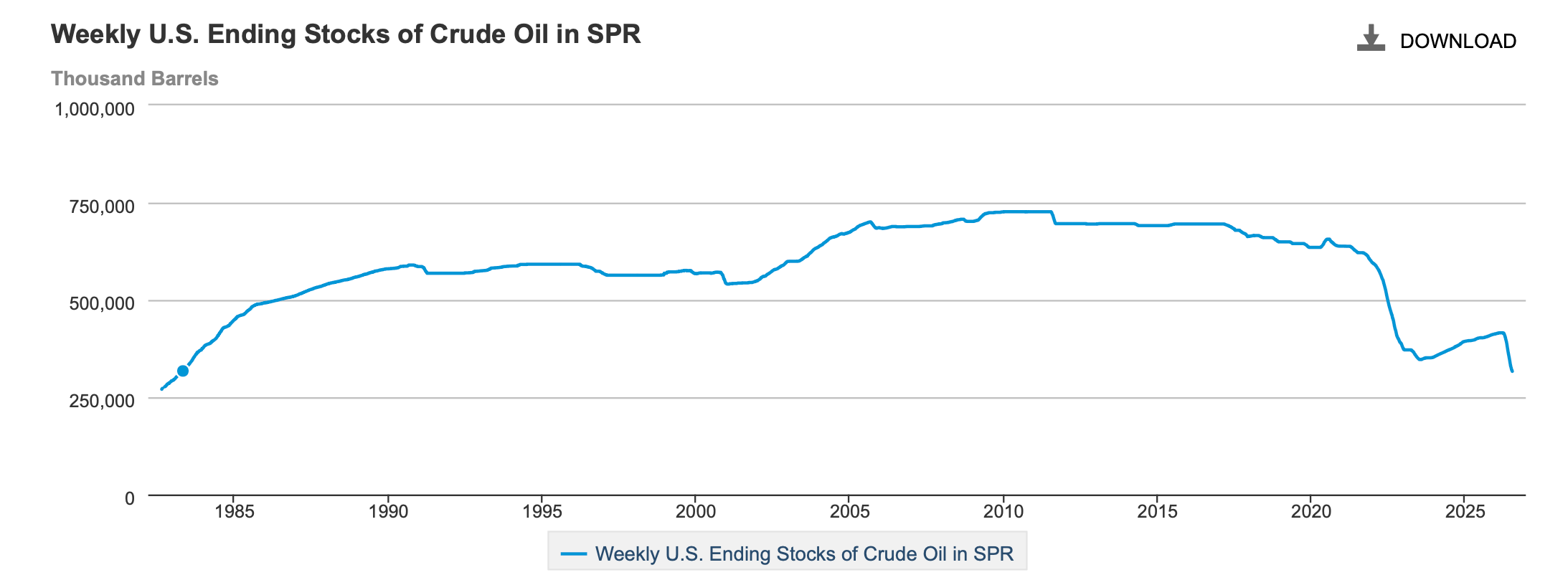
The United States, meanwhile, is approaching critically low levels in its oil storage facilities due to the extensive drawdowns since the start of the war with Iran. These drawdowns have pushed inventories at Cushing, Oklahoma, to minimum operational levels, the Wall Street Journal reported earlier in July, meaning further draws from that facility would be ill-advised as they would compromise the storage facility itself. In more worrying news, inventories in the Strategic Petroleum Reserve are also running low, the WSJ reported in the same news story, sitting at the lowest since 1983.
This is the same information that came out about the level of the SPR a month ago! The story in all of its many iterations hasn’t been updated since then. Has the US government placed a hidden moratorium on reporting the truth about the SPR? By Trump’s own accounting, it should be out of available oil by now, but we’re still hearing that it is sitting at the level last seen when it was in the process of being filled for the first time in 1983. With an additional month of drainage, I’m sure it is in worse condition than that by now, but there is only dead air on that issue.
“The worst fears of the oil market could still be realized later this year as we get to the minimum operating levels,” Andy Lipow, president of Lipow Oil Associates, told the Wall Street Journal. “The only way to get prices back in balance is to have prices go up, such that you would have demand destruction. Once the shelf is bare, there’s nowhere to turn,” Lipow added.
Are we not there yet? The shelves should be getting close to bare with the SPR likely to be at its minimum operational level. (I want to note while I’m on this subject that I may have been wrong in saying part of SPR is only available for the military use. That used to be true, but it appears that limit may have been removed.)
I went to three different government data sites on the SPR, and the reporting on all of them stops at the same point ten days ago, so the latest weekly update hasn’t been reported yet. However, if you look at the rate at which the SPR has been plunging, it should be pretty close to the 250-million barrels level by now.
One bit of news worth noting is that fuel reserves are worse off than oil reserves. There are none. That is why gasoline and diesel prices are not likely to fall even if crude prices did fall. The supply of fuels is tighter than the supply of oil, a problem made worse by Urkaine’s very successful bombing of Russian refineries to where Russia is now begging India to sell fuel to Russia, which it needs for its invasion of Ukraine and for its people. The flow had been the other way between Russians and India until this month.
In Russia, drone attacks have disabled an estimated 25% of refining capacity, which led to the diesel ban, which would have a ripple effect on global markets because Russia supplies an average 11% of the world’s diesel.
No reprieve in site
Even if Iran broke its own recent rule against negotiating with Trump and did agree to another schmeasefire, it wouldn’t make any difference in the rate at which the SPR is falling because Iran would not open the strait up to any oil transport that benefits the West. It never has since the embargo began. A few tankers have managed to sneak through now and then, but Iran blows holes in any it discovers sneaking through the United State’s maintained southern route near the coast of Oman and the UAE.
Trump just avowed that “Tehran will pay … many times over” for the deaths of two US service people. Does that sound like the two sides are moving closer to another ceasefire? The US has struck Iran every night of the past ten days, and Iran has struck back each time. In the latest round or retaliatory fire …
Iran’s Revolutionary Guard Corps said early Tuesday it had destroyed what it called Amazon’s central data infrastructure in Bahrain in a cruise missile strike, along with Patriot air defense batteries in Muharraq and Riffa. The Guard also claimed to have hit a hangar housing U.S. MQ-9 drones at Kuwait’s Ali Al Salem Air Base.
Also in the news today, US intelligence reports that further strikes by the US on Iran are unlikely to change any of Iran’s positions during negotiations, which have held to full control of the Strait of Hormuz, and full retention of its uranium enrichment program and all enriched stocks produced so far. Iran hasn’t shown a bit of flexibility on those sticking points, which was why those issues were left out of the last schmeasefire agreement, known as the Memorandum of Understanding, though it should have been called the Memorandum of Misunderstanding because misunderstandings were baked right in by design as the only way to get Iran to agree to negotiate was by leaving the key sticking points vaguely addressed to be worked out later.
According to US intel, Iran has the upper hand in a war of attrition, which was what I said was Iran’s plan from the day it closed the strait.
A new intelligence assessment suggests U.S. military strikes won’t significantly impact Iran’s negotiating stance. Analysts say Tehran and Washington are stuck in a limbo between peace and war….
Iran’s government is unlikely to feel significant impact or soften its negotiating position as a result of new rounds of U.S. military strikes like those now underway, according to a new intelligence assessment described by current and former U.S. officials.
The word to be used in describing that is “quagmire.” That is what I predicted this war would become from day one, and it clearly is now, as even US intel is calling it “limbo” and a “stalemate” while others are actually using the word “quagmire”:
Analysts at American spy agencies also have concluded that Tehran and Washington are, for now, stuck in an indefinite limbo between peace and war, the officials said — an uneasy dynamic given the increasingly deadly nature of the tit-for-tat hostilities between the two nations. The current and former officials spoke on the condition of anonymity to describe the assessments because of their sensitivity….
Trump’s current course of ever-expanding attacks appears to have led to a stalemate. But with the war deeply unpopular at home, continuing escalation by the United States, such as the possible introduction of ground troops, poses political risks for the president with no guarantee of military success….
Jonathan Panikoff, former deputy U.S. national intelligence officer for the Near East, said that the Trump administration appears to believe that if it keeps hitting Iran harder militarily, Tehran eventually will become more flexible. “That assessment is almost certainly incorrect,” said Panikoff, senior director at the Atlantic Council think tank….
“I’m struggling, because I don’t think there’s a lot of great options for the United States,” Panikoff said, adding that he is skeptical Trump would launch a ground invasion. “You’ll continue to see significant flare-ups in this conflict,” he said, followed by periods of calm and then renewed fighting.
“This is what a quagmire looks like,” said one person close to the White House, who was granted anonymity to discuss private conversations.
Yes, it is, and that likely plays out like this:
Iran may agree to more talks and a ceasefire but not to fully opening the strait as their reason for doing talks is to give the war more time for attrition to do its job. Every single passing day, with our without missiles flying through the air, intensifies the shortages in crude oil and all of its byproducts under which the US and all of the West will be reeling.
Anyone who fails to understand that, doesn’t understand what Iran is doing at all. All it needs is time. The chokehold at the neck of Hormuz will kill Western economies so long as it cuts off the air that they breathe long enough, and it doesn’t take much to keep the hold in place. An occasional missile or drone successfully taking a tanker out of operation does the trick of keeping other tankers from even trying. All you need to accomplish that is literal “decimation,” which originally meant taking out one in ten!
In previous rounds of talks, the Iranians have proven to be obstinate negotiators, particularly on key points such as its nuclear program. At the same time, the administration has repeatedly said Iran has capitulated to U.S. demands, only to see Tehran deny agreement was reached.
That’s because Trump lies even more than Iran. Iran has always said it is not caving in on negotiations in the slightest. Since they have not caved in in the slightest, they must be the ones telling the truth. It stands to reason for those who have some.
Whether this results in “boots on the ground” is debatable because the US populace is solidly against that, and it’s hard to see an upside, but boots on the ground are probably the only way to find and take out all missile and drone launching capability along the strait:
“Anyone talking about boots on the ground, I think, is disconnected from the administration and certainly disconnected from the president,” said Alex Gray, who served as National Security Council chief of staff during Trump’s first term. “They’re pushing an agenda that has certainly no buy-in from the president and his team, and certainly doesn’t reflect the Republican Party today.”
Iran has only said, “Bring that on!”
Meanwhile Team Trump keeps passing out what has become its all-to-familiar canard:
“As the U.S. military degrades the terrorist Iranian regime’s ability to attack commercial vessels and disrupt the free flow of energy through the Strait of Hormuz, oil and gas prices will plummet back to pre-conflict levels,” said White House spokesperson Taylor Rogers.
We’ve had a good four months, at least, of that promise now. Fool is anyone who believes it. Team Trump can say what they want, but I think most of America will be sniffing out the truth at the pump.
“My heuristic always is if the incumbent party has oil above $90 a barrel, they’re going to lose. And if they have it below $70 a barrel, they’re going to win. I think this is already the danger zone,” said Curt Mills, executive director of the American Conservative magazine.
Iran would appear to have Trump by parts of his anatomy that others have only joked about, and I’m probably not talking about his tiny little … hands.
“Trump really has no choice. He put a compromise on the table. He’s not going to surrender, even if he loses the elections” in November.
So, there we are: call it “limbo” a “stalemate” or a “quagmire,” but it all amounts to the same thing: oil stocks keep going down, prices rise. Anyone betting the other way is doing something that has proven many times over to be the wrong bet.
(The headlines that follow connect with stories that lay out the quagmire in full detail as well as the certain trajectory of fuel prices. They also talk more about the AI bubble that is busting as I’ve said all along it will do in leading the way down for all stocks.)
