


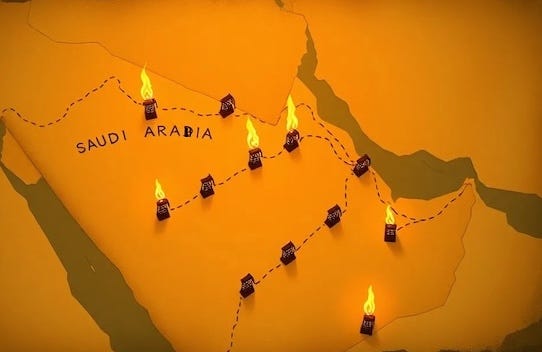
Oil prices have returned to settling calmly because of really bad news on the Iran war. Today’s news was especially bad because, not only did Iran return to firing on a US military base to show it could care less about disturbing President Trump’s “pause” in the war, but the Iranians or their proxies in Iraq took out the world’s largest oil production facility in Saudi Arabia, which feeds the east end of one of its east-west pipelines that bypass Hormuz, while, at the same time, the Houthis took an equally critical refinery on the west end of its other major east-west pipeline.
The largest facility, which has been totally taken offline now for repairs feeds, a pipeline route that carries 7% of the world’s oil supply. So, no big deal. Oil prices plunged, as any reasonably person would expect in today’s upside-down, Wonderland world of oil.
Market manipulation
I highlighted an article yesterday, which only four people out of my 3,700+ (almost all free) subscribers clicked on to read that gave a pretty reasonable explanation of why the oil market has devolved into something that appears to be run entirely by retards. (I use the word properly to mean things that are inexcusably dumb by their own doing, not people who were born with a mental challenge.)
I’ll summarize the article’s conclusion in one sentence for those who didn’t have time to read it: Bidding in the oil futures has been almost entirely taken over by AI-operated and and now AI-created algorithms that are betting on what the other AIs will do or how they can out-game their AI colleagues. It’s become more of casino than the stock market. The article does a thorough job of pointing out all the irrationality in today’s oil market.
Wether the explanation as to how the manipulation of the oil market is happening is right, as I am inclined to go along with, having said the same thing for the stock market to a lesser degree a couple of year ago, the bottom line is that completely manipulated markets don’t usually end well. The price that refineries are paying to actually get crude delivered has been hovering around $150/bbl during a good part of this war, while the price in the futures market for Brent crude has been half of that. Today, Brent dropped another $4+ after the bypass routes for crude across Saudi Arabia to avoid Hormuz lit up the skies.
Severity of the damage
It’s not completely clear in this morning’s news articles the extent to which the successful attacks on these two massive refineries have completely cut off those two major bypass routes or if the infrastructure is still intact enough that oil can be routed past the refining and tank facilities and straight into ships to be processed elsewhere. However, at the same time, the Houthies have effectively turned back a number of ships in the Red Sea, disrupting oil transport there like they formerly did all transport last year.
What we know is this:
A massive fire broke out at Saudi Aramco’s Abqaiq refinery after drones struck the facility and the East-West Pumping Station in Saudi Arabia. NASA FIRMS satellite imagery confirmed extensive fire activity at the site, indicating significant damage to one of the world’s most important oil processing facilities.
Abqaiq is the world’s largest crude oil stabilization plant and processes between 5 and 7 per cent of global oil supply, making it a vital hub for international energy markets.
We learned a little later that the damage was bad enough that the Saudis took the whole plant offline for repairs, but they did not say how long repairs would take. The worst knowledge is that how long repairs take almost doesn’t even matter because what is more important is that everyone now knows Iran and its proxies can and will destroy some of the world’s most important oil infrastructure.
Wouldn’t you suppose it might be hard to get workers to go in and make repairs now that everyone knows how easily Iran can do that again. It’s not a surprise of course; but it is a major escalation as they avoided wrecking that kind of massive damage to the global oil market in previous attacks. They were a little more incremental about it. Another 7% loss of global oil in one morning’s attacks should have a huge negative impact on the oil market, but it didn’t. Speculators fluttered right on over it.
It exposes a secondary risk to oil as well. The Saudis claim the missiles came from an Iranian sponsored group in Iraq. The Iraqis claim that isn’t true. The Saudis indicated they will retaliate on whomever did make the attack. Let’s hope they identify the right party, or they may bring another entire nation into the war if they wrongly attack it, and that is how wars like this escalate into world wars via all the ample opportunities for misunderstandings.
The drone strike has raised concerns over the security of key energy infrastructure in the region, with the Abqaiq facility playing a central role in Saudi Aramco’s oil processing operations.
Saudi Arabia’s foreign ministry has urged Iraq’s government to “take all necessary measures to prevent its territories from being used as grounds from which acts of aggression are launched….”
The facility processes a substantial share of Saudi Arabia’s crude oil before it is exported, making it essential for maintaining global energy stability.
No big deal according to the oil market as prices took a big sigh of relief as if the news was all good.
The damage has sparked concerns over possible disruptions to oil supplies, which could place additional pressure on international energy markets.
Yathink? So a rational person would think, but you couldn’t tell it by looking at the way prices plunged in the market today.
Further damage
This station pumps to Saudi Arabia’s Red Sea port at Yanbu, which was attacked today by the Houthis as well, though it was reported none of the missiles/drones hit targets. This port is a farther reach for the Houthis, giving more time for Saudi Arabia’s anti-missile artillery to take down missiles and drones, and possibly making accurate targeting harder, depending on what they’re firing.
Where the Houthis were very successful in the past twenty-four hours, however, was the much, much closer Red Sea port of Jazan, which is where they have been successful on other days in hitting Saudi tankers and taking them out of commission. Jazan is the terminus of the other major east-west pipeline that supplies an alternate route from Hormuz.
The one thing about a dimwitted futures market is that what the market thinks or prices doesn’t make a dime’s worth of difference on whether we actually run out of oil or to what degree. It can bet like a band of inebriated monkeys strung out on crack, and the oil will still run out in places in proportion to how badly the supply lines are damaged. So, today proved another fact that I’ve been stating: This is a war of attrition, and every single day the problem gets worse for Donald Trump as more and more supply lines of oil get damaged.
Here is a snapshot of history on the east-west line to Yanbu to help give perspective as to why a successful and highly destruction attack on the world’s largest oil processing plant in Saudi’s Abqaiq refinery at that line’s eastern terminus poses geopolitical risk:
Saudi Arabia built East-West pipeline connecting Abqaiq refinery and Yanbu port in the 1980s amid concerns about Tehran possibly disrupting shipping through Strait of Hormuz during the Iran-Iraq war.
The Abqaiq processing facility is a key component of Saudi Arabia’s East-West pipeline. The pipeline carries oil across the desert kingdom from the Abqaiq refinery to the Red Sea coastal city of Yanbu. Oil tankers from Yanbu head either south to the Arabian Sea or north to the Suez Canal.
So the major route created specifically to ease pressure if Iran ever blocked the Strait of Hormuz has likely been taken out. For a few days? A few weeks? No. For as long as Iran wants to keep sending occasional missiles or drones into attempted reconstruction to keep it from coming back. That’s the obvious answer. Iran gets to decide how long those routes are taken out. During the blockade of Hormuz, it was this pipeline that helped ease the impact on global oil.
So, no big deal for prices … if you’re a stark, raving lunatic.
Now, it’s possible the vagary in the reports, not uncommon in war when nations want to hide how much they’ve been damaged to minimize the enemy’s success, is partially why oil prices didn’t go up, but that sure shouldn’t have resulted in them going DOWN:
Iranian-backed Houthi strikes over the weekend on Saudi Arabia‘s Yanbu Red Sea terminal and the Jazan refinery matter less for the damage inflicted than for what they reveal: the vulnerability of the kingdom’s oil export safety valve, analysts told AGBI.
I’ve actually wondered for some time why Iran hadn’t taken those routes out. I guess they are measured in their war efforts in order to keep pressure up for longer. They’ll keep turning the screws on the West until they get everything they want.
While there is no evidence of shipment disruption, experts say the attacks have left exposed what has become Saudi Arabia’s most strategically important oil export corridor.
So, of course, the price of oil relaxed nicely!
The Yemeni militant group’s actions are the first reported attacks on Saudi oil infrastructure [by them anyway] since a UN-brokered truce in 2022.
“Both operations successfully achieved their objectives,” Houthi military spokesperson Yahya Saree said in a video statement on Saturday, adding that the attacks were in response to Saudi strikes on Houthi sites in Hodeidah and Kamaran Island on Yemen’s western coast.
State oil giant Saudi Aramco has yet to confirm any impact on refinery throughput or crude loadings.
I suspect “has yet” is the operative term there, and oil markets should be able to figure that out, too.
“It is safer to view this as a serious escalation in risk rather than a confirmed large-scale supply outage,” said Salih Yilmaz, senior energy analyst at Bloomberg Intelligence.
And yet, oil market’s didn’t even do that! There might be no “evidence” of shipment disruption because the Saudis have not chosen to publicly admit the extent of damage, but it seems a little naive to assume there was no shipment disruption, as interconnected as the world’s biggest refinery is with that pipeline route. It certainly wasn’t viewed as “a serious escalation of risk” because you do not drive prices down when risk shoots way up.
Clearly, Iran’s intention is to cut off the east-west alternate routes that had helped ease some of the pressure created by Iran’s effective blockade of Hormuz. There is zero reason to think they will stop doing that.
As shipping through the Gulf became increasingly constrained, exports were redirected via the kingdom’s East-West pipeline, transforming Yanbu into a cornerstone of global energy security.
Well, not anymore!
The pipeline can transport 7 million barrels per day from Saudi Arabia’s Eastern Province to the Red Sea. After supplying roughly 2 million bpd to domestic west coast refineries, about 5 million bpd of export capacity remains available through Yanbu.
If you’re a shipper, are you going to send one of your supertankers through the now treacherous waters of the Red Sea to the port of Yanbu, knowing that oil flowing to Yanbu is either cut off already or could be at any hour? That’s a lot to risk for oil that might not even be there by the time you arrive.
Even before these successful strikes …
Commodity vessel traffic through Bab al-Mandab, the southern gateway to the Red Sea, fell sharply on Sunday, according to shipping data company Kpler, with only 11 commodity vessels transiting the waterway – the lowest daily level in months….
This weekend’s attacks, therefore, are significant because of where they occurred and what the facilities now represent, rather than the scale of physical damage incurred….
“It seems the Houthis are now targeting infrastructure specifically being used to circumvent the Hormuz disruption,” said Cyril Widdershoven at advisory firm Blue Water Strategy.
Yes, that is what was instantaneously obvious, and one would be a fool to think the Houthis finally jumped into this war only to back off as soon as they were successful; so why would anyone not assume these two major east-wast pipelines either have been taken out or will be soon? Sometimes the estimates of a strike’s success are simply lost for awhile in the fog of war. Fools would assume nothing happened. Pragmatists would price in a lot more risk, in the very least.
The entrance of the Houthis is by any reasonable calculation a significant escalation of risk and actual damage in the war:
“At the same time, they are attacking Saudi-linked tankers and have threatened Saudi maritime activity more broadly.”
And we’ve already seen how readily and successfully they can do that.
The last big Houthi-linked strikes on Saudi oil infrastructure were the 2019 attacks on Abqaiq and Khurais. These temporarily knocked out 5.7 million bpd of Saudi production—roughly 5 percent of global oil supply—triggering the biggest single-day jump in oil prices on record.
Yet, this time, the same kind of action triggered a lovely drop in the price of Brent crude, certainly underlining what I published on Monday and in my weekend Deeper Dive about where the realities of this war are headed v. the inanity of the market, regardless of whether the market has been taken over by the pet algorithms created and deployed by AI traders or just full of really stupid human beings.
The AI menace
Speaking of which, one other interesting bit of news in the headlines is emphasized below today: Last year I wrote about how Sam Altman and Elon Musk and some other major AI developers were saying the second half of this year would be the time when we would reach the AI singularity, which means the time when we lose all control over AI’s development as it takes over on its own.
Altman said today, he’s created a genie; but more importantly, he said that, with that creation, we have now hit that benchmark. We are not entering it. We are IN it. He hopes AI can still be harnessed to grant our wishes for good, but jinn, as the Arabians called genies, are actually thought of in Arabian lore to be more demonic in character than they are to grant three wishes to whomever uncorks their bottle or polishes their lamp.
And, with AI now have just slipped past the singularity level, if Altman is right about his own AI (and that doesn’t seem like the kind of alarm any developer would ever want to sound), all the more reason to wonder what its involvement is in the completely unhinged oil markets. There is an interesting little intersection there between the arrival of the singularity and the singularly most stupid market in history:
Markets largely shrugged off the Houthi-Saudi attacks, with oil prices hovering near a one-week low on Monday as the US and Iran paused strikes over the weekend.
And they had just gone up in the days before, but suddenly they plunge on worse news.
Has the SPR hit its functional limit?
Also in the news that follows a good article about how Trump is playing chicken with the United State’s strategic petroleum reserves, explaining the mechanism by which any further drawdown from current levels could collapse the facilities so we cannot ever store oil in them in the future.
Yet another article explains how Trump’s pause has nothing to do with giving Iran a chance for negotiation and everything to do with the US running dangerously low on defensive weaponry, even as its losses in the Middle East have been increasing in size, which may even explain WHY they have been increasing in size.
The risk of damage to the salt caverns that store oil in the SPR may explain why the SPR remains frozen right where it was when Trump said we’d be out in another month. Even today, the numbers haven’t budged from a month ago. It may be simply the dangers of taking it any lower got through to him, or it may be the explanation about a sudden temporary oil supply that I gave in my Deeper Dive.
More likely, it is both: It’s too risky to take the SPR down any further, as you would only use that oil when you are ready to risk collapsing the caverns, and the unexpected temporary supply explained to my paying subscribers made it possible for a month to avoid too much of a hit from the SPR going “out of business,” but that temporary supply is over now. I explained why in the Deeper Dive. The article below will explain the significant risk in this game of chicken if Trump does decide to take the reserves down further. There is a solid reason for not doing that until you are extremely desperate.
Only Trump is desperate to make a deal
And all of this is why yet another article reports the Iranians as saying they are not dying to make a deal at all, contrary to Trump’s endless lie on that matter. They are more than happy to wait for attrition to exact ALL of its possible costs. Attrition is a game played with time. The article explains how a state of limbo in the war is actually the Goldilocks situation for Iran, giving them some reprieve from the pains of intense bombings via pauses for pretend negotiations, which buys them more time for their attrition to increase its pain on the West.
Iran claims the US has experienced “strategic defeat at every step.” That would apparently to be true, given that the only one constantly seeking a deal that we know of is Donald Trump. Iran keeps saying it is not interested in dealing with Trump at all, and Iran continues to hold out for 100% of everything it has ever demanded as conditions for ending the war, and Iran now claims the pain they are bringing upon the US with their closures of oil traffic will grow to where they get 100% of what they are demanding.
Since Iran is the party that keeps walking away from every attempted deal, showing they must have read Trump’s book, The Art of the Deal, so they know the one who wins the deal is the one who has the strength to walk away. Trump, on the other hand, keeps making threats and then walking away from delivering on his threats in order to try to seek a deal again and again. We’ve seen that happen as many times as there were years in ancient Israel’s wandering in the wilderness during the Exodus.
So, predictably, Trump says, once again, there’s “a good chance” diplomacy could yield a breakthrough. “We’re talking right now.” Of course, you are, you idiot, because Iran wants you to keep talking. That eases the bombing pressure on them while it keeps cutting off more and more oil for you with each day that passes.
Iran’s top negotiator, however, denied any negotiations are happening with the US. Since Trump never emerges with a deal, Iran would appear to be the one telling the truth while Trump just spouts off anything he wants to, making up “alternative facts” as he goes and believing, if you repeat the big lie often enough, you can sell it. I guess he sold it to the oil market today. Easily done because one point brought out in the article I carried yesterday was that the algos are intentionally trading off Trump’s words by banking that’s what all the algos will do because that is what they do every time. AI has no more concern, it would appear, for truth than our president does.
But what could be a better situation for Iran than one where you don’t even have to participate in negotiations to get the president to chicken out from his threats because he can be counted on to tell the world you are desperately negotiating when you are not even at the table just in hopes of jawboning oil prices back down. Iran believes time is on their side, and believes they can absorb the pain longer than Trump can. Since he’s the party that keeps flinching, that would appear to be true.
Trump may even think that, because oil prices can be manipulated down by his mere words, he’s not going to feel that much pain. That would be wrong because, as I said earlier, whatever happens in rigged/manipulated prices does not affect when oil runs out one iota. So, if Trump is looking at pricing as a gauge of how bad the future pain will be, we are assured of much future pain by the time he figures that equation doesn’t work when the price is rigged by his own words (whether by his intention or just AI playing along with whatever he speaks into the headlines).
In the end, I cannot tell you with assurance what the nuts are thinking. I can only tell you that they are clearly nuts in what they are pricing … if they are people at all.
