

You can’t find them this dumb out of the box, and frankly I don’t know how anyone makes them become this dumb by any means, but someone has augered the bottom drains of one of the world’s supposedly brightest colleges to try to root out its dumbest renowned economist. We’ll get to the clog of brain hair they found, but first …
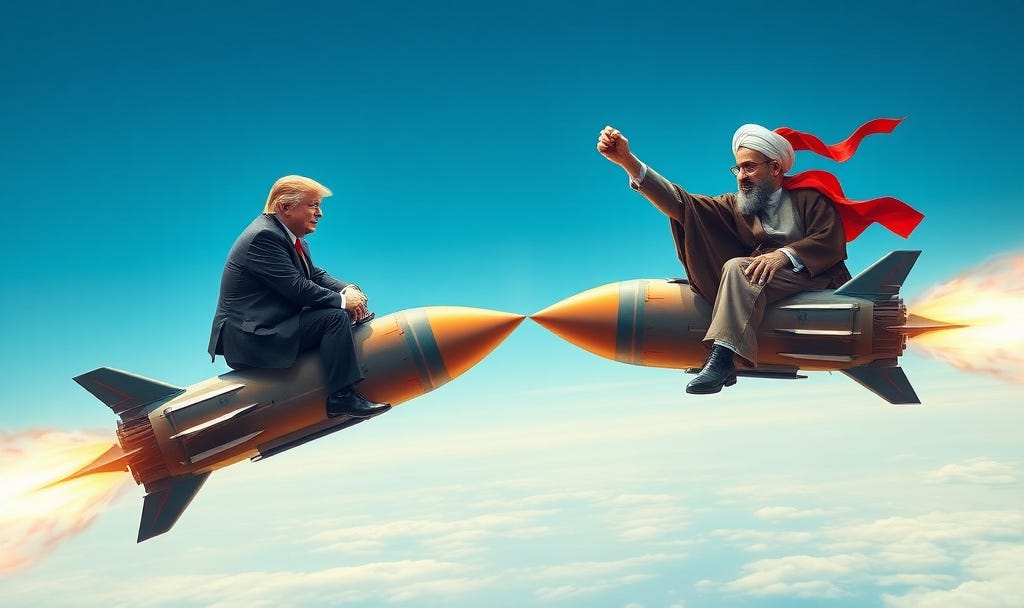
Iran’s military advisor Mohsen Rezaei is threatening mass American casualties if the Trump-Israel-Iran War reignites, and it’s not an empty threat because the war does appear to be reigniting:
We will introduce new capabilities to the arena, and Trump should know that this time he will suffer widespread casualties. If the enemy makes a mistake, the next war will not be like the previous one.
While the comment is intentionally vague so as not to enable the Americans to prepare for the kind of attack Iran has in mind, Iran is telling Washington that round two will cost more in American lives than round one did, should this weekend’s rekindling hostilities spiral further out of control. Is he talking about firing up sleeper cells in America, hitting military housing and not just command facilities and weaponry? While there is no telling, Iran has threatened a much broader and deeper response a few times now if Trump breaks his own ceasefire and goes back to war, and this weekend’s action is looking like that is moving from possibility into probability, which is why I’m taking it up as the subject of this Deeper Dive.
UPDATE: In fact, the latest headline really kicked the risk level up a notch after I completed the first draft of this article:
Look at the events that have unfolded in the last few days: Iran attacked and damaged a container ship that was attempting, Iran says, to pass through the Strait of Hormuz without Iranian clearance, and it is not clear in news reports whether or not Iran is charging tolls for any non-Iranian ships that want through or even just not allowing any non-Iranian ships at all to pass through. So far, reports about ships passing through talk about Iranian-flagged ships. In which case, Iran has not ended its embargo. The US has because it was the only one ever blocking Iranian ships. However, the deal did not say the passage would open immediately because it vaguely allowed time for clearing mines.
The weakness of the deal has always been that it leaves the stickiest points vague so that Iran would not have a reason to avoid making a deal because Trump wants out of the war he started. Trump has made it outspokenly clear at this point that his primary reason for getting out is that the oil crisis will become, in his words, “bedlam” for the world if it lasts another month. The fact that he has clearly lost some of the will to keep fighting this out is one reason I have avoided calling this a “Schmeasefire,” as I did all the other pauses. I was certain those would all fail, and they all did. This one, I give a little chance of it succeeding because I’m certain Trump wants out if he can get any deal that he believes he can sell as a success, but that looks more tenuous this weekend.
Risks to the economy run sky high if the US does return to all-out war, but a lot of damage is already going to have to play through even if the strait clears up by Monday. I found it a bit funny, though, to listen to a couple of experts as they spoke optimistically about the future for the economy and for stocks. Wharton School professor of finance and economist, Jeromy Siegel was the funniest, even though he was, at least, alert enough to say tech stocks are in trouble.
I’ve rarely seen such violent relative volatility. It’s like “I’m for tech” or “I’m against tech.” I’ve seen markets go up and down, and usually the sectors are pretty well correlated. The sectors are as uncorrelated as I’ve ever seen!…
It’s hard to call a top. A couple of weeks ago we had a sharp decline, and I said, “That’s usually not the end. It usually challenges it and sees if it can go above it.” Now the NASDAQ had that decline, challenged it, and now seems to be fading again. So, I think those tech are in a more precarious situation now than we saw in that selloff a couple of weeks ago.
You may recall that was the same take I just gave on the NASDAQ, too, saying that major tops usually occur with that kind of a retest and a fail of the retest and that we are now sputtering along after a “triple top” of such tests in a more precarious situation because the retest failed to hold TWICE. It hit a slightly higher high, but fell much lower right away (the sell-off Siegel talking about), then it attempted to test that ceiling and failed before reaching it. So, on the belief that tech stocks have topped, Siegel and I fully agree, and it’s nice to have some confirmation about the meaning of that pattern in finding a major top.
Siegel, however, is not saying it is a top for the overall market, but just a top for tech. I disagree. This is how the dot-com bust blew up. Tech started the crash and went down the hardest, but it pulled everything down in its undertow. With all the troubles right now, including especially the oil crisis, which is where Siegel starts to sound like a court jester, it’s all going to go down. No need to be timid like Siegel in saying the market is coming down. And that’s where Siegel should be writing comedy, not economic analysis.
First, his setup for the big joke:
The fall in the price of oil is truly stunning.
Maybe in size, but it is no surprise. It is truly predictable. That is why I predict things here—to show that economists should see this stuff coming, but they don’t! I predicted we would see a big reflexive drop in the price of oil as soon as ships started moving through Hormuz because the speculators respond to headlines and think, Oh, Strait reopened, problem ended.
So, I told my readers to expect some major sighs of relief over the oil situation, but also warned those sighs will be short-lived because they will end as soon as we start seeing shortages of gasoline at the pumps, and that is fairly predictable because we already know the Strategic Petroleum Reserve (SPR) will be empty in less than a month, and it will take more than a month for ANY oil to make it from the Strait of Hormuz to the US, if any even does manage to escape, which does not appear to have happened so far. Alternately, ship traffic will end if the strait shuts again, which is a high likelihood.
No one believed it could have a sixty handle.
(Waving my hand over here.) I don’t think I called out specifically that crude would get down into the 60s, but I did say it would take a big drop, so that doesn’t surprise me much. Had I put a number on it, I probably would have conservatively said the 70s, but numbers like $69/bbl for West Texas Intermediate don’t surprise me, and that’s the lowest I’ve seen so far. Not that far off from the 70s.
Then the funny part:
I’ve been looking at futures prices for gasoline…. It’s going to start falling very fast late in the summer to early Fall. By election time, we might have gasoline down around $3.36/gallon.
That’s the point where I snorted my coffee out my nose and had to wipe down the computer screen.
That is very good for the economy. It’s good for the value stocks.
It’s also fantasy.
And then Siegel provides pure comedy gold:
Gasoline prices suggesting we might even have a ZERO or NEGATIVE CPI reading.
Unless Siegel got some clairvoyant reading that Trump is not going to return to war, no matter what Iran does, and is going to have oil flowing through the gulf by Monday in non-Iranian tankers and is going to make sure all oil going through the gulf initially goes directly to the US so that it all arrives, now that Cushing is empty, at the same time the SPR runs completely dry for the first time in its history and is going to somehow wipe out all the energy inflation from AI and eliminate all the chip inflation from AI that is driving up the price of all electronics and is going to cancel all his inflation-causing tariffs, THEN there is ZERO chance that we go to ZERO CPI, much less deflation by the end of this year!
That is where I exclaim you cannot find economists this dumb straight out of the box; so, they must all be smoking some pretty funny weeds over there at the Wharton School. I thought that was a school of economics and finance, but maybe that is just a front for a school of experimental GMO horticulture because they have some weed like no one else’s weed.
Therefore, Jeremy says, the market is just fine; it will just have a different complexion to it.
A very bloody complexion maybe. One that looks like the market has ebola/hemorrhagic fever.
The other somewhat funny guy (but nowhere near as hilarious as Siegel) is a stock expert in the headlines below, who claims the tech route is just the typical “June Swoon” and that it has nothing to do with the end of “irrational exuberance,” as Greenspan talked about before the dot-com bust. We are now past “the bump in the road,” he assures everyone.
That is only true if you consider the final scene in Thelma and Louise “a bump in the road.”
We’re past the bump in the road like Thelma and Louise were past the final bump. Just a bump.
Becoming grounded again in reality
That kind of blue-sky thinking, or maybe blue Thunderbird thinking, is not well grounded, so it typically doesn’t fly for long. Therefore lets look down at the size of the bumps that have already popped back up in the last couple of days. They look more like tire spikes thrown across the road than mere bumps. Just know there are a thousand more possibilities like these that just popped up to threaten to end Trump’s Big Deal.
Here is a short synopsis of the rest of the article that follows for paying subscribers:
Iran closed the strait again and struck a ship in the pilot house to make it clear it was not going anywhere.
Trump told Iran it violated the ceasefire because it violated the ceasefire.
So, Trump attacked Iran to pay it back for violating the ceasefire.
Iran said Trump, thereby, violated the ceasefire, so it attacked Bahrain to pay Trump back for violating the ceasefire, which he did in order to pay Iran back for violating the ceasefire.
This time Iran hit a tanker.
Kurdish forces just put boots on the ground and crossed over into Iran to take part in the war.
Israelis are starting to openly worry they are losing their last friend.
Marco Rubio worries out loud that Iran’s scheme for the taking control of the Strait of Hormuz for good could play out as a template in other parts of the world, causing restrictions other straits by states that will want to now charge tolls—a hemorrhagic contagion that he says will cause global economic chaos if Iran is allowed to set the new standard strait.
And inflation has now moved into services where it has become much more tightly rooted than when it was just in goods or, especially, just in energy. And that’s before the big scare of energy inflation that will hit when fuel stations start running dry. Some of us lived through that and remember that, without the SPR, that’s what happens in an event like this, which will yield the absolute proof of how dumb the economist of high calling featured above is in his prediction of negative inflation by year’s end. I’ll lay that out very clearly at the end.
Now let’s put some flesh on those bones:
2nd UPDATE: This headline popped up as I was proofing this article: U.S. launches additional Iran strikes as tensions flare up over Hormuz
The tit-for-tat attacks that restoked the war
A mere half a week has set the war back to the flash point for total conflagration. The conflict heated up in a major way on Friday after Iran, once again, closed the strait:
A one-way attack drone launched by Iran on Thursday struck the Singapore-flagged cargo ship Ever Lovely in the strait off the coast of Oman, Central Command said in a post on X. The vessel continued on its way through the strait, a major thoroughfare for oil shipments.
Trump said the U.S. military “knocked down” three other attack drones aimed at ships in the strait.
The US, then, felt it needed to punish Iran so that it doesn’t think it can get away with such attacks or like we are afraid to go back to war:
The U.S. military struck Iran on Friday after President Donald Trump accused the Islamic Republic of “foolish violation” of a ceasefire agreement by launching drone attacks at ships in the Strait of Hormuz.
Iran’s military later said it had retaliated for the attacks.
U.S. Central Command said its aircraft “struck Iranian missile and drone storage locations and coastal radar sites.”
So, the US response escalated beyond the single successful strike that was reported for Iran, likely to try to disable Iran enough to make future firing on ships more difficult, though that hasn’t stopped them so far.
Next, Iran felt it needed to punish the US for thinking it could retaliate so that the US doesn’t think it can get away with escalation or think Iran is afraid to go back to war, so …
“The Islamic Revolution Guards Corps (IRGC) Navy targeted several U.S. military positions in the region, warning that any future attacks would draw ‘a broader response than this’,”
Is that the same navy that Trump already said several times was completely destroyed so that it all now lies on the bottom of the sea? Something lies, that’s for sure. Lies all the time.
Iran did not say what it attacked, but it was later confirmed that it attacked nearby Bahrain:
Bahrain condemned an Iranian drone strike early Saturday, describing it as “a blatant violation of its sovereignty, a flagrant threat to the security of citizens and residents, and a blatant breach of international norms and conventions that prohibit targeting civilian objects and terrorizing innocent people.”
That, of course, opens up the additional risk that Bahrain punishes Iran in order to show it that it is not afraid to fight and that Iran cannot simply walk away from attacking Bahrain.
Bahrain has been among the Gulf countries most critical of Iran and hosts the US Navy’s Fifth Fleet.
This is apparently the point at which Iran struck the bridge of a tanker, likely disabling it from further travel. No crew were reported as injured or killed.
Vance, in a post on X on Friday, wrote, “Iran signed a ceasefire agreement. We have honored it.”
“If they have disagreements about how the MOU is being applied, they can pick up the phone,” Vance wrote. “But violence will be met with violence.
Iran summarized the tit-for-tat exchange somewhat differently, showing that, once again, the two sides clearly do not see eye-to-eye on what their intentionally vague agreement means:
After the U.S. strikes, Iran’s Islamic Revolutionary Guard Corp said in a statement: “Following the violation of the ceasefire by the Zionist regime in southern Lebanon, a few hours ago, the treaty-breaking US regime, as always, violated its commitments and, under various pretexts, attacked the coasts of the Islamic Republic of Iran with an airstrike due to the passage of a violating ship through an unauthorized route in the Strait of Hormuz.”
“The IRGC Navy responded to this aggression by striking the positions of the US terrorist army in the region,” the IRGC said.
Let’s be clear and honest: The US did not strike Iran “due to the passage of a violating ship.” The US wants ALL ships to pass through via any non-mined passage. It struck Iran because Iran struck the violating ship because Iran wants only its own ships passing through.
“According to clause 5 of the Islamabad Memorandum of Understanding, the arrangements for controlling passage in the Strait of Hormuz are with the Islamic Republic of Iran; however, the US, by provoking various parties, sought to violate this commitment, to which a necessary response was given, and this will be the case from now on.”
“If the aggression is repeated, our response will be broader than this,” the IRGC said.
Ebrahim Azizi, the head of the national security commission of the Iranian parliament, in a post on X said, “The U.S. attacked Iran in the middle of negotiations once again.”
“The failed U.S. President has shown he has no commitment to the principles of negotiation or a ceasefire,” Azizi said.
“This reckless violation of the ceasefire will, as always, lead to retreat and regret on their part. The blame game does not work anymore.”
The problem with using vague words to get the other party to sign an agreement is, of course, that those vagaries are the fault lines where deals predictably break up so that ships get bombed and people killed during the intentional room for misunderstand–ings. Iran understands that it will control the strait and will charge tolls if it darn well wants to, which makes economists like Jeremy Siegel incredibly naive to be forecasting zero or even negative inflation by the end of the year on the basis that the oil crisis is over now.
That series of strikes over the last three days left the strait in the following condition:
The International Maritime Organization had begun moving stranded vessels out of the Gulf through an alternative route near Oman’s coastline after the interim US-Iran agreement. However, those efforts were suspended after Thursday’s attack on a commercial ship.
Shipping analysts say confidence in the route has weakened again even though commercial traffic continues. Any sustained disruption could have global consequences because around 20% of the world’s seaborne crude oil passes through the strait….
Negotiators are still expected to pursue talks on Iran’s nuclear programme and sanctions relief, but the latest military exchanges, coupled with renewed attacks in the Strait of Hormuz, have significantly raised the risk that the interim agreement could unravel before a final deal is reached.
It could, of course, all stop there with talks resuming.
On the other hand, it could be that all talks stop there. The latest reports call further negotiations into question:
The latest via Reuters:
IRAN WEIGHS WALKING AWAY FROM SWISS TALKS AFTER US STRIKE
IRAN MAY HALT SWISS TALKS AFTER US STRIKE ON SIRIK
Gulf states have newly condemned “in the strongest terms the treacherous Iranian attacks” on Bahrain, after drones hit the country’s territory. The GCC statement further alleged that the Iranians targeted “civilian infrastructure and properties”….
Independent journalist and pundit Michael Tracey points out sarcastically but aptly that Indefinitely bombing Iran sounds a lot like what you might call “endless war”. And so the weekly tit-for-tat escalation might grow more regular until there simply is no more MoU deal to reference back to at all.
But, hey, the “June swoon” in tech stocks is over because the war was just a bump in the road, and gasoline prices will be down to $3.36 per gallon, which I think is as likely as the $0.36 per gallon that was actually the typical price back when I was in Middle School, mowing lawns. But Siegel thinks it is so likely that he is predicting we’ll also see zero inflation. When you see what I’ll be showing you about the path of inflation and broadening types of inflation to date, it should become immediately clear that a total end to inflation so quickly is impossible. The Fed hasn’t been able to end inflation for five years, and the rise is now prominent. We wouldn’t have zero inflation, even if this war had never happened.
Well, there is perhaps one way we could move into his even more bizarre prediction of “negative inflation,” which would be if the world goes strait into nuclear holocaust and we find ourselves living in the pages of The Apocalypse, but that is hardly the rosy picture Siegel painted with a goofy smile of prices falling because oil is falling at record speed and will keep doing so. I seriously do not know how economists become that dumb then smile at their own stupidity as if they just said something smart and encouraging!
So, while the hostilities could, of course, all have stopped there, even if talks remained stalled, hostilities did not stop there as we’ll see in the next section.
3rd UPDATE: This headline also popped up early Sunday morning while I was going through and doing my proofreading of this article: Trump again threatens Iran with annihilation as Kuwait and Bahrain report attacks. None of the article, by the way, has been altered to reflect new facts in these headlines, except for the insertion of these updates. In fact, I am deliberately not even reading the articles until I get to the end of my proofreading. The article is based entirely on the facts as they were when I finished the first draft on Saturday.
