



While I have been saying for a long time the metrics by which we measure the economy are broken, the mainstream media is finally waking up to that, too. And, of course, those metrics have become much worse since the DOGE firings and the government shutdowns, conveniently making it difficult to get a firm reading on the Trump economy right at the time (last fall) when I said the damage from the Trump Tariffs would really start to show.
I already posted one article this week that laid out how broken the metrics are, but today we have another in the New York Times:
Forecasts that turn out to be wrong — or defy expectations — are as routine as a heartbeat.
That breakdown in econometrics, the Times says, now includes the instruments that have long been considered the most reliable. In fact, the paper of note notes that economic reporting has now become SO bad that the economic guideposts regularly report the exact opposite of what most people can sense is actually happening in the economy. Failure to understand where the flaws lie is the reason the mainstream media has been asking for some time why consumers don’t like “the robust economy.” As I’ve said, it’s because it is not robust.
While you don’t need anyone to tell you what you already have felt in your gut, I bring these points up because sometimes confirmation of what you feel helps when the press keeps running with government reports that try to gaslight you into believing the illusions that require the blue pill, and I don’t mean Viagra, though the truth may take that mojo out of you, too. The gaslighting happened in the Biden years, but it has become much worse of late.
Consumer spending far worse for most than reported
One of the measures the Times notes as not working is the consumer spending measure. Here the real truth is masked by a bizarre average, not so much by government deception. The truth about reports that show consumer spending holding strong, even though consumer sentiment has reached a twelve year low, is that “consumer spending” measures actual total dollars being spent while “consumer sentiment” measures the percentage of people who feel a certain way.
The press has been ignorantly asking for some time, “Why do consumers keep spending so much if they truly feel so bad about the economy?” The truth is that most are not spending so much; but the truth is masked in “consumers spending” by an obscene reality. It turns out that most of the spending is being done by the top 10% who keep total spending high because they have been doing quite well, while all the rest of us are cutting back on spending. So, 90% of consumers feel way down about the economy, while the top 10% are still doing so well they are driving the economy by doing more than half of all the spending.
That broken metric isn’t a case of government gaslighting. It’s just averages being thrown way off by a small number of extremely unaverage people. So, “consumer spending” does not measure the economy most of us feel because economic advantage has been so tilted toward the millionaires and billionaires for so many years now that they live on an elite plane far above the rest of us.
The Fed broke the meters
Other measures that have been strong indicators of recession are not working because the Federal Reserve has thrown them completely out of whack with all of its extreme rescues. Those metrics are measuring less what the economy is doing and more what the Fed is doing. Take, for example, a measure that was for decades the most reliable recession indicator—the yield curve on bonds.
The yield curve is failing to clearly show any current recession by inverting as it usually does before a recession because the Fed has manipulated the bond market to such extremes for so many years now that interest rates are skewed by the endless manipulation. That is one of the reason’s I’ve called this a “stealth recession.” The usual metrics that would indicate we’re in a recession are faulty.
The yield curve is something I pointed out clear back in the last recession as being a badly damaged recession indicator due to the Fed owning and controlling the curve with its massive bond purchases and then massive bond sell-offs. The numbers now are almost meaningless as an indicator of financial reactions to the state of the economy. Thus, you haven’t seen me post the yield curve for two to three years. It’s all just noise at this point.
Why are the stocks that “couldn’t fall” leading the crash?
With that said, there are still metrics that are managing to report the things the government doesn’t want you to see, and I’ll go on to those in the section that follows today’s headlines. Before I move on to those metrics, let me point out one other thing where the public has been totally gaslighted with false predictions by stock analysts who apparently have stocks they want to sell you. (Or maybe it is just greed keeping most investors from seeing the obvious truth.)
I have said relentlessly this year that all the claims that the stock market could not crash like the dot-com bust are as false as can be and, ironically, for the very reasons the dot-com bust happened. People believed just before the big bust that high-tech stocks could not fail and were not overpriced; so, they kept pricing them higher and higher at a steeper rate, even after they had taken the market to never-before-seen heights. Those tech stocks supposedly could not fail back then because internet-related companies were the new future economy; therefore the prices were claimed to be justifiable. And then they crashed so bad that Cisco just recovered to its pre-dot-com bust high last fall—a quarter of a century later. That is quite a fall for a major company that “could not fall,” and Cisco was one of the big survivors.
We are now seeing how wrong the same kind of thinking was that has said AI-related tech stocks could not experience a huge crash, even though they have become overvalued to the level of leaving earth’s orbit. One of our stories today reports that traders are yelling “Get me out of tech stocks!” They are dumping tech stocks that are closely related to AI:
… sentiment has gone from bearish to doomsday lately with traders dumping shares of companies across the industry as fears about the destruction to be wrought by artificial intelligence pile up.
The crash in that sector is now being referred to as an “apocalypse” particularly for software-as-a-service stocks.
The anxiety was underscored Tuesday after AI startup Anthropic released a productivity tool for in-house lawyers, sending shares of legal software and publishing firms tumbling.
True, many of these stocks are crashing because AI can beat what they are doing; so they are getting buggy whipped; but read on…
Perceived risks to the software industry have been simmering for months, with the January release of the Claude Cowork tool from Anthropic supercharging disruption fears. Video-game stocks got caught up in the slide last week after Alphabet Inc. began to roll out Project Genie, which can create immersive worlds with text or image prompts. All told, the S&P North American software index is on a three-week losing streak that pushed it to a 15% drop in January, its biggest monthly decline since October 2008.
“People are just selling everything and don’t care about the price.”
However, it is not just software companies that are being displaced by AI that are falling. Some major companies are falling because of their own AI:
For example, Microsoft Corp (MSFT). reported solid earnings last week, but investors’ focus on slowing growth in cloud sales put fresh scrutiny on the amount it’s spending on AI, sending the stock tumbling 10% on Thursday. January was the worst month for Microsoft shares in more than a decade.
In other words, investors are getting critical about whether companies are spending more on their AI development than they are seeing materialize in earnings or even revenue because of that development. Investors are concerned with many AI companies like Microsoft that their massive capital expenditures may not yield the expected returns in the near future. It’s become push time to show you can perform in profits with your AI, and THAT was exactly what happened to companies that went down in the dot-com bust. It is what I’ve was saying all along we would certainly see in the next stock crash, and those stocks are now leading the way down.
Nevertheless, some investors have stayed long and are lapping up what they see as the new bargains to be had on Microsoft stocks:
Sustainable Tech fund … bought Microsoft shares amid the downturn on the expectation that the company will eventually emerge as an AI winner.
That, too, is no different than the past.
It probably will emerge if you can ride it out for the long run. That’s what happened last time. It only took Microsoft about a decade-and-a-half to climb out of the hole it fell into from the dot-com bust. So, you better have a lot of patience for those returns. That was, however, way better than Cisco. If you want a picture of how much more insane stock values are now than they were just before that turn-of-the-millennium bust, just look at Microsoft’s history. The enormous dot-com hole that took Microsoft about fifteen years to claw its way back out of, now looks like a pimple on the present road to stock-crash perdition:
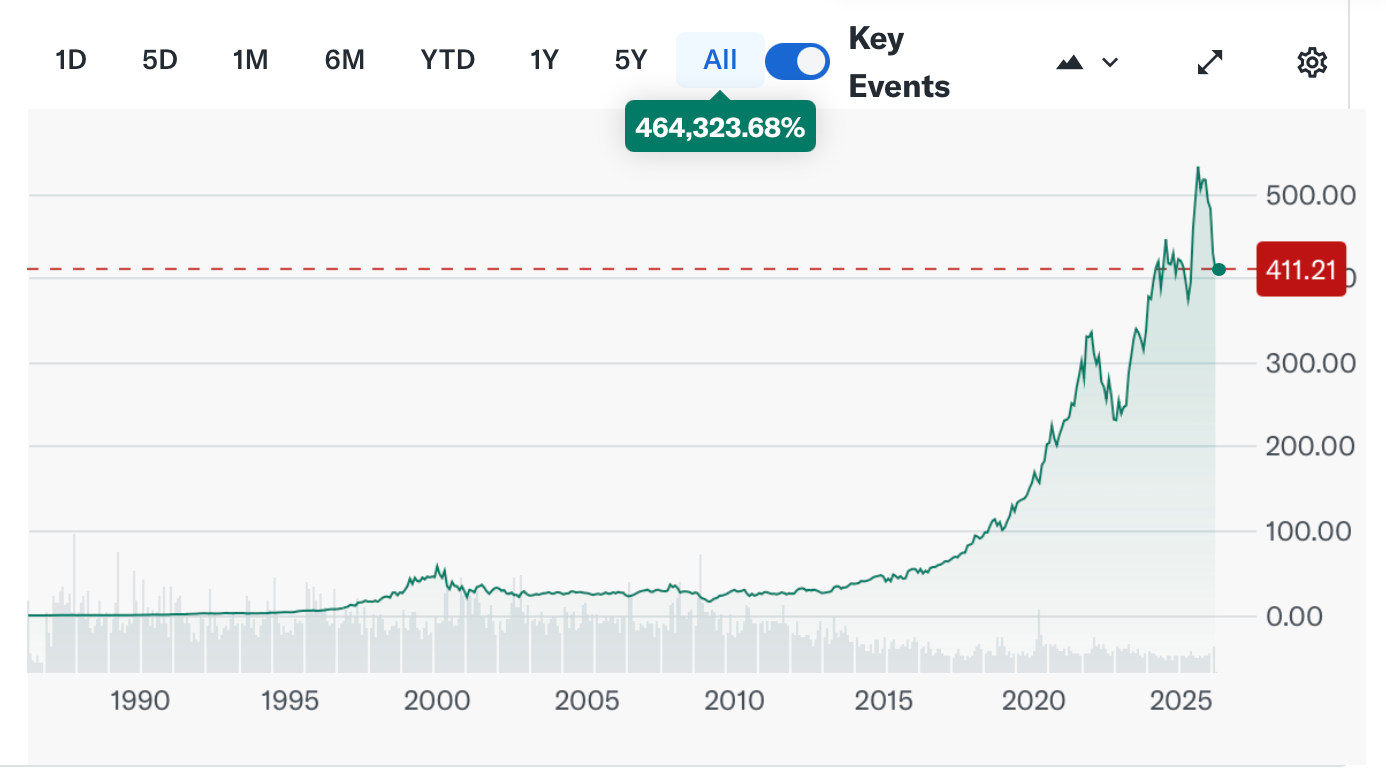
Can anyone say “overbought?”
And the fall Microsoft has taken AS AN AI COMPANY is already, in terms of just total dollars lost, much bigger than the fall they took back then. (Percentage-wise, of course, not so much, but it’s still a huge plunge for the very kind of company we were all told for the last two years couldn’t possibly go down like the dot-com bust, and we have no idea how much further it may fall. Just like people didn’t in the middle of the crash back then. After all, the dot-com bust took about two years to find its eventual stable bottom.
Now, after the headlines, I’ll come back to the metric that shows how deeply into recession US manufacturing has already fallen.
Economania (national & global economic collapse plus market news)
The Global Economy’s Warning Signals Are Broken
U.S. Manufacturing Is in Retreat and Trump’s Tariffs Aren’t Helping
Capitalism has already ended and we don’t even know it, Yanis Varoufakis warns
‘Get Me Out’: Traders Dump Software Stocks as AI Fears Erupt
Dow drops 160 points, S&P 500 sheds 1% as investors rotate out of tech
Money Matters (monetary policy, metals, cryptos, currency wars & going cashless)
Warsh-ing Away the Powell Era: Markets Brace for a New Monetary Regime
David Morgan: What Comes Next For Gold And Silver
Digital Dominance (AI threats, transhumanism, hacks & cyberattacks, etc.)
2026, a space oddity: ‘the cloud’ in orbit (Elon Musk to build AI data centers in orbit.)
Political Pandemonium & Social Senescence (socio-political issues & events)
DOJ release exposes dozens of Epstein victims’ names and nude photos
DOJ slammed for exposing Epstein victims while shielding Trump’s face in file dump
Jeffrey Epstein autopsy photos reveal staggering neck injuries
UN-Secretary General Guterres Warns UN Faces Imminent Collapse Over Unpaid Debts By US And China
Doomer Humor

The manufacturing recession is as obvious as it is odious
One of the metrics that is showing how poorly the Trump Tariffs are performing is manufacturing—the one area that is supposed to be most helped by the tariffs:
