


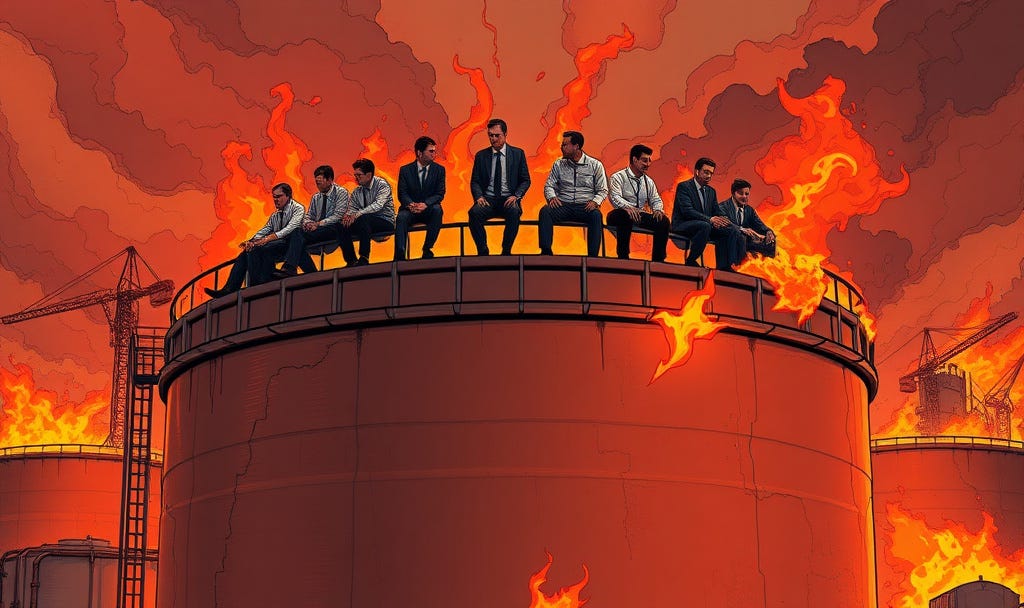
Stocks rose and oil prices dropped today as markets and their analysts completely ignored the biggest outbreak of attacks in the Middle East in the last few weeks. Instead of sitting around the water cooler, they’re sitting around burning fuel tanks, betting that oil prices will be quickly dropping back to prewar levels as the flames of war light their backsides on fire.
Today, they ignored Trump and Iran both saying the ceasefire deal is off yesterday, almost as if they were dumb enough to listen to Trump’s latest words, claiming Iran just called and is dying to make a deal! Yes, he pulled that tired canard out again because I guess there are enough people who have been breathing his missile-exhaust, hot air long enough to keep believing it. You’d think the lies would get more creative; but I guess, if you have enough people who are willfully blinded by their own greed, the lies really don’t need to get creative at all.
I did find, at least, one astute article on this week’s oil market by Tsvetana Paraskova on Oilprice.com. While it was two days old and, so, commented on how oil prices were dropping prior to Trump and Iran both claiming the ceasefire was “dead” yesterday, its observations about what most analysts were thinking only two days ago reveal how stupid analysts have already proven to be:
Oil prices have dropped back to pre-war levels since the United States and Iran agreed to negotiate a deal under a framework that included the reopening of the Strait of Hormuz.
With oil flows out of the Middle East starting to return to the market, analysts, investment banks, and traders expect the global oil glut to return as early as in 2027 and sink oil prices further.
Prices are heading south to $60 per barrel, many analysts think. The futures market seems to think this way, too. Speculators are betting on where they think prices will go in the near term, and most have turned bearish over the past month.
The return of flows through the Strait of Hormuz is making traders confident that the scarcity and supply disruption are over….
Most market speculators bet on Hormuz volumes recovering in the third quarter and oil prices sinking by the end of the year.
Of course all of that proved the analysts are as dumb as this guy (and some of those that follow):
Their predictions were a big, fat face plant because the deal blew up less than two days later. The strait almost completely shut back down over the past night after I wrote about the war re-igniting into a hotter war yesterday. Though oil prices shot reflexively back up under yesterday warfire, stupidity has already settled back in today as thick as the sludge at the bottom of those empty Cushing tanks I’ve been writing about.
Paraskova was smarter than the analysts she was covering, pointing out what should have been obvious to all:
… most bets and oil price forecasts assume that the U.S.-Iran memorandum of understanding is a real, lasting peace deal. It’s far from it—it is just a framework to negotiate a potential agreement by the end of August. Progress on that front is nowhere to be seen, at least publicly, and the situation could deteriorate with renewed tensions at any time.
And, so it did.
There was nothing about this deal that looked like it would last, outside of Trump’s immediately obvious chickening out from the war he started at Israel’s behest, which he did because Iran was destroying the US economy (and the rest of the world’s with it). I’ve pointed out all along that Iran doesn’t want a deal. At least, nothing like what Trump is demanding. It wants to inflict as much pain on the US for what it’s done as it can. As an alternative, it will be happy only with unconditional surrender to its new terms of controlling the Strait of Hormuz for vast future revenue streams so long as that also includes the US and Israel guaranteeing they will permanently end all future hostility toward Iran while also allowing Iran to keep its uranium enrichment program, its current stockpiles of enriched uranium and its vast arsenal of potent missiles. That’s the deal on Iran’s side of the memorandum of intentional misunderstanding.
As Paraskova said with more insight than most of the analysts,
Iran hasn’t given up on asserting some kind of permanent control over the passage through the Strait of Hormuz, including by demanding ‘service fees’ in exchange for safe passage through the chokepoint in coordination with Iranian authorities
These things are fairly obvious to people who are willing to see the truth straight up. So, contrary to the analysts’ euphoric delusions about a return to an oil glut across the world by 2027, the following turnabout was reported by Zero Hedge right after Paraskova laid out the silliness of the analysts:
The US military has struck Iranian targets for a second straight day, while Tehran has responded with ballistic missile and drone attacks targeting Kuwait, Qatar, Bahrain and even faraway Jordan. While our overnight wrap focused on the latest war developments, the focus here is what energy traders are watching most closely: vessel traffic through the Strait of Hormuz.
Bloomberg cites new shipping data showing that the Hormuz chokepoint slowed to a near standstill on Thursday.
That looked like this with ships piling up in anchorage and at docks all along the sides of the strait but very little traffic going through the strait:
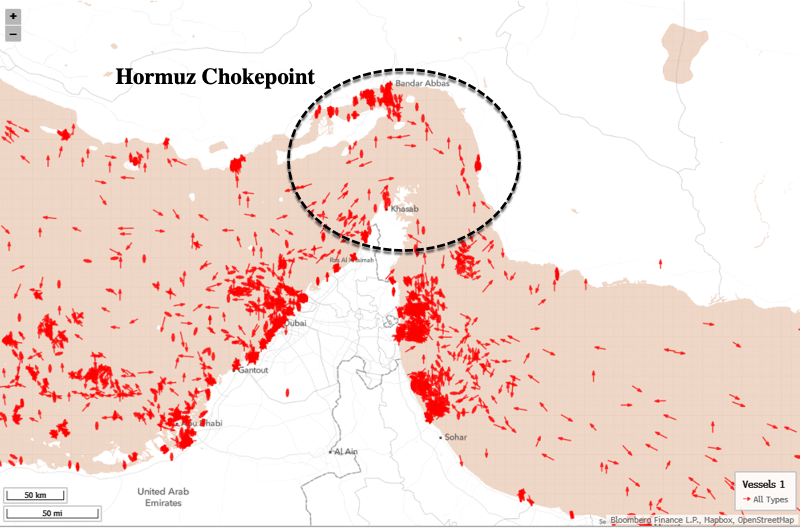
The slowdown marks a sharp reversal from the partial recovery that followed the mid-June interim US-Iran peace deal to reopen the Strait of Hormuz.
But who could have seen the likelihood of that coming? Right? The intentionally-vague-and-misconstrued-by-both-sides ceasefire agreement that put off all the most contentious matters for later discussion in order to get an immediate opening of the strait—all of that collapsing in a flurry of top-leader accusations that the other side is dumb, evil, sick, etc.?
Commodity-vessel transits averaged 34 a day over the past three weeks and peaked at 59 on June 24, according to Kpler data. That compares with just 14 crossings Wednesday, the lowest since the deal and near wartime levels.
And even less now! Overnight traffic through the strait looked like this:


It looked pretty black across those waters throughout the night. All told, overnight, there were four inbound attempts and only one outbound that could be detected, and the outbound ship made a U-turn. But, hey, oil prices have relaxed as the warfare continues to blaze hotter, I guess because Trump said Iran called and is desperate to make a deal … for what, the 40th time? I’ve lost count.
After pointing out the inanity of the analysts, Paraskova laid out the clear reasons why the oil crisis will go rapidly worse:
Traders point to how remarkably well the market handled the worst supply disruption in history.
But this was due to several factors that helped mitigate the shock to a great extent.
Governments, including the U.S. Administration, released stocks from strategic reserves, depleting the inventories to multi-decade lows.
Once those reserves are dry, as is, according to the US president, himself, within a couple weeks now of happening in the US (and in potentially shorter time by other calculations that I covered), that buffer against the truth will be gone. That is when I have been predicting fuel prices will inflate through the roof. To put a finer point on it, it is when the drying up of Cushing and the SPR start causing gas stations to run out of fuel, that the game of pretend is over. But spot situations of running out of fuel, especially diesel, which relies heavily on ME oil, shouldn’t take long to start occurring after the SPR is out. Even announcement of the SPR running out, might be a big enough wake up call to rattle these fume-addled brains back into some semblance of mental activity that is, at least, slightly higher than any seen lately in Senator Mitch McConnell (also in the headlines below).
Paraskova notes that the oil market had started in a soft and easy position when the war first broke out, making it easier to ignore the risks of war in the ME:
The oil market was already headed for a glut before the war began, with millions of barrels of oil sitting in tankers at sea.
But that situation is has gone well past its sell-by date and, with Ukraine having just taken out two Russian oil tankers and even more refinery capacity over the past 24 hours, Russia is now also OUT of the oil exporting market. Putin is not just desperate to retain fuel for his own people to avoid mass rebellion, which he has shown by banning all diesel exports, he’s increasingly concerned about having enough fuel to keep running his war machinery. There is nothing more embarrassing to an imperial leader than being hot at war and having everything suddenly run down to a standstill because you’re out of gas. So, he’s conserving, and that means much of the Middle East and Russia are now out of the oil export business.
The oil market remains dangerously exposed to the next shock, with inventories so low right now….
Now that war is re-igniting in a much more oil-depleted world, price volatility will increase substantially. However, speculators and their analysts (I think they need to switch to psychological analysts) may remain intentionally blind and ready for more face plants until they actually see the shortages show up. That’s the bet I’ve always cast, as it seemed wiser and safer to bet on the markets’ stupidity lasting until it can last no more, while assuring my readers that it won’t last for long because a hard slam into the reality of finite shortages isn’t far down the road and is already fully baked in, even if Iran actually were to call Trump begging for another deal.
I feel safer betting on the entertainment value of face plants than on Iran calling the president to strike a quick bargain.
