

Since covering the meltdown of the latest ceasefire agreement by Trump in my weekend Deeper Dive, several more stories are burning up the press that demonstrate the deterioration of agreement—if there ever was any actual agreement—on anything the MoU says. I threw three of those articles into the Deeper Dive at the last minute on Sunday morning as I hurriedly proofed that article in order to get it published before even more stories emerged. So, I’ll go over now how the newly emerging stories add force to the statements I was making in that article about the ceasefire burning up and what ramifications for the oil market are already showing.
Talks on/talks off, Iran walks off
After the tit-for-tat missile barrages that took place with several exchanges over the weekend, the first repercussion came as no surprise: Iran completely cancelled talks in Switzerland. Trump reactively announced, in time to get ahead of the stock market’s opening, however, that Iran requested a meeting in Qatar; but it appears that is more than a venue change, and both sides temporarily swore off more violence to give those talks a chance. Jared Kushner and Steve Witcoff have dispatched for Qatar, but Iran did not respond as to whether this was a real meeting or an empty Trump claim.
However, if you look at Iran’s eventual rebuttal, you can see it is a carefully worded statement, in which Iran said there are “no technical talks” scheduled anywhere; but it did not say there are no talks whatsoever. So, maybe it qualified things with the word “technical” to make it sound like there might not be any talks at all. It leaves a little room to wonder if the US dispatch will be shunned.
I presume “technical” talks deal with how mines will be removed and what the timeline for doing that must be or how uranium will be handled, how ships will clear with Iran for passage. There is huge room for disagreement on all of that, even as to whether Iran has any say in clearing ships for passage. So, Iran is, at least, saying, all those kinds of details will not be negotiated.
So, maybe Iran left a door open to clarification of the framework of the deal to see what it even means since no sides involved have agreed very well on what even “ceasing fire” means. That still leaves plenty of room for those talks to go up in flames because the vagary was intended to skirt the thorny issues for now. As both sides attempt to become more definite in what the terms mean when they use them, impasse may easily be reached.
Even on the matter of “technical” talks, the two sides contradict each other:
U.S. officials said both sides would pause hostilities and allow commercial vessels to transit the strategically vital Strait of Hormuz.
“Technical talks are slated to continue on all areas of the MOU,” a U.S. official told CNBC on Sunday. “Both sides will stand down for now and vessels can move freely.”
Things went so bad over the weekend that the president already ramped his own rhetoric back up to threatening annihilation of Iran.
“There may come a point when we are no longer able to be reasonable, and will be forced to militarily complete the job that we very successfully started. If that happens, the Islamic Republic of Iran will no longer exist!” he wrote on Truth Social.
That threat didn’t stop some in Iran from coming right out and saying there will be no talks of any kind whatsoever. In fact, Trump’s threat may have pushed Iran back to a more hardline position:
Earlier Monday a White House official said the Witkoff-Kushner delegation was en route to Qatar for Iran talks, but it’s looking like Tehran will give the US a cold shoulder. Iran state Tasnim is citing Iran’s Foreign Ministry spokesperson, who says:
“We will not hold any negotiation meetings at any level with the American side in the coming days,” directly contradicting prior reports coming out of Washington.
But, hey, at least Trump got to get word out to his stock market in time this morning to make some highly profitable bets, I read.
Bloomberg is also confirming the new statement out of the Iranian side….
Also Fars has separately stated within the last hours:
“No nuclear negotiations have been held with the US so far, and there will be no negotiations on nuclear issues until Iran’s conditions are met.”
More latest:
IRAN SAYS DELEGATION WILL VISIT QATAR BUT RULES OUT US TALKS
So, it kind of looks like Trump is, once again, overselling Iran’s desire to negotiate with the US.
So it seems Witkoff and Kushner will merely meet with Qatari and Pakistani mediators? It remains an open question whether the Iranians will be present in Doha at all. It could be Tehran is issuing the contradictory messaging in order to keep leverage and pressure up, or else to try and humiliate the White House.
Qatar, in the meantime, has halted all marine traffic, even fishing boats and recreational craft, through the part of the strait that is its maritime territory.
Oil prices slide and glide
The next ramification to play out was a change in the oil market. Oil prices, which had touched fractionally below $70 per bbl for West Texas Intermediate and nearly $72 for Brent, edged back up today to $70.85 and $73.20. The move probably remained just a quiver because the strait was supposedly opened back up, and talks are supposedly back on, and missile fire has supposedly stopped for now. But not so fast.
The Thursday attack on the container ship Ever Lovely prompted some shipowners to pull back and wait for additional information about how safe transiting the Strait is. The U.S. military on Friday carried out strikes on Iran in response to the attack on the vessel….
“Participants appear to be shrugging off these developments, instead focusing on what a continued recovery in oil flows would mean for the global balance,” ING’s commodities strategists Warren Patterson and Ewa Manthey warned in a note on Monday.
“This complacency is odd and clearly leaves significant upside risk if the supply recovery proves slow – or if we see significant re-escalation. While the oil market is technically in oversold territory, momentum appears to still be to the downside,” they added.
ING’s strategists continue to believe “the market is too optimistic about the timeline for a recovery in Persian Gulf supplies.”
While the strait has reopened, tanker traffic has slowed as shippers thought the last attempted passages might be safe, but suddenly they were not. So, shipping companies are timid about tempting fate.
The attacks on commercial vessels and the U.S. retaliatory attacks on Iran continue to test not only the fragile ceasefire, but also the willingness of shipowners and operators to press on with transits through Hormuz.
Since a weekly peak of vessels transiting Hormuz on June 24, traffic has materially eased, both in the outbound and inbound directions, according to ship-tracking data by Kpler compiled by Bloomberg….
Although traffic through the Strait of Hormuz has resumed and more vessels are openly broadcasting their position, a return to normality is far from certain and far from near amid persistently volatile operating conditions in the Middle East and its key shipping lane.
Other analysts agree in warning that a stable move back to prewar prices is unlikely.
Commodity strategists warned Monday that prices could reflect an overly optimistic stance from markets, which are underestimating the scale of persistent supply-side challenges.
Analysts argue that shipping traffic through the Strait of Hormuz is unlikely to swiftly return to pre-war levels, even after a pickup in activity following the U.S.-Iran ceasefire agreement, as Tehran seeks to exert leverage over the critical chokepoint.
Those are some of the reasons I have said that oil prices would plunge upon reopening, but then soar again. Prices plunged based on the unrealistic optimism I had expected—relief over the temporary opening of the strait.
Nikos Petrakakos, managing director of investments at Tufton Investment Management, said many shipping companies remain wary of sending vessels back through the key energy chokepoint, citing uncertainty over the peace framework, lingering concerns over sea mines and elevated war-risk insurance premiums.
“Even though there is some more motion going on, in general, we’re nowhere near being back to where it was,” Petrakakos told CNBC’s “Europe Early Edition” on Monday.
Rather, what we see is a few companies willing to test the waters—mostly just to get their loaded tankers the heck out of there if they see moments that seem like they might be safe. Sitting there hasn’t proven to be completely safe either.
While vessels that had been trapped are now transiting the Strait, she said the bigger challenge is persuading shippers to send vessels back in. “Shipping costs are incredibly high right now, and you still can’t find enough shippers willing to go back out in there,” Sen told CNBC’s “Squawk Box.”
Markets have been disconcertingly ignorant of the real problems that must be addressed to get oil flows back up to helpful levels.
Amrita Sen, founder and director of research at Energy Aspects, said markets may be underestimating how far shipping conditions remain from their pre-war norm….
“Before this war, Iran really had no power or say over what goes through the Strait of Hormuz,” Petrakakos said. “That is a status quo that’s changed going forward. I don’t see Iran going back to where it was before.”
Shippers also fear sanctions will stop the flow of money if they do try to pay a toll. Then they’ll be stuck in the strait again:
But Sen said that an official toll mechanism would be unacceptable to Gulf Cooperation Council countries and Western companies, noting that the fees issue is tied more to Iran’s need to repatriate funds for its post-war reconstruction.
“Iran is using its leverage aggressively to make the point that they are the ones that will control shipping, especially through that southern lane,” Sen said. “Western companies are simply not going to be allowed to pay that toll.”
There is also the issue of insurance, which does not suddenly become available just because the strait becomes available:
While vessels that were stranded in or near the Strait may gradually exit, Petrakakos said insurers are still a long way from being comfortable enough to provide cover for ships entering the Strait to pick up cargo.
“I think insurance will only really start moving in, I would say, months,” he said, adding that it takes time for insurers to become comfortable before lowering premiums, highlighting the issue with Houthi attacks in the Red Sea.
Today’s articles bring up another factor that I brought up this weekend as to why things are not going to just pop back to normal, even if an agreement were completely settled today and tanker traffic resumed normal operation today:
For oil markets, the focus has shifted from immediate supply disruption to the question of how quickly depleted inventories can be rebuilt, Spanjer said.
“The narrative that’s come into the market is: ‘How are we going to backfill all the stocks we’ve taken out?’” he said. “Every importer in the world is going to build higher stocks.”
That is where I said the SPR is still going to run dry and Cushing will be slow to refill because there will be high demand by everyone all over the world to backfill tank farms. Global restocking is going to keep fuel prices elevated for a long time.
Unlike nutty Jeremy Siegel whom I criticized this weekend for inanely predicting oil will settle down into the sixties by the end of this year,
Spanjer said his year-end target remains $80, arguing that additional supply could be absorbed by buyers looking to rebuild inventories.
Looking further ahead, Spanjer said he sees oil trading in a $75 to $85 range in 2027. Once inventories have been rebuilt, he said, upside risks are likely to be more limited.
Even that is a big if because it depends on the ceasefire holding.
Then, of course, there is that little problem of the mines:

Russia adds to oil shortages with Ukrainian help
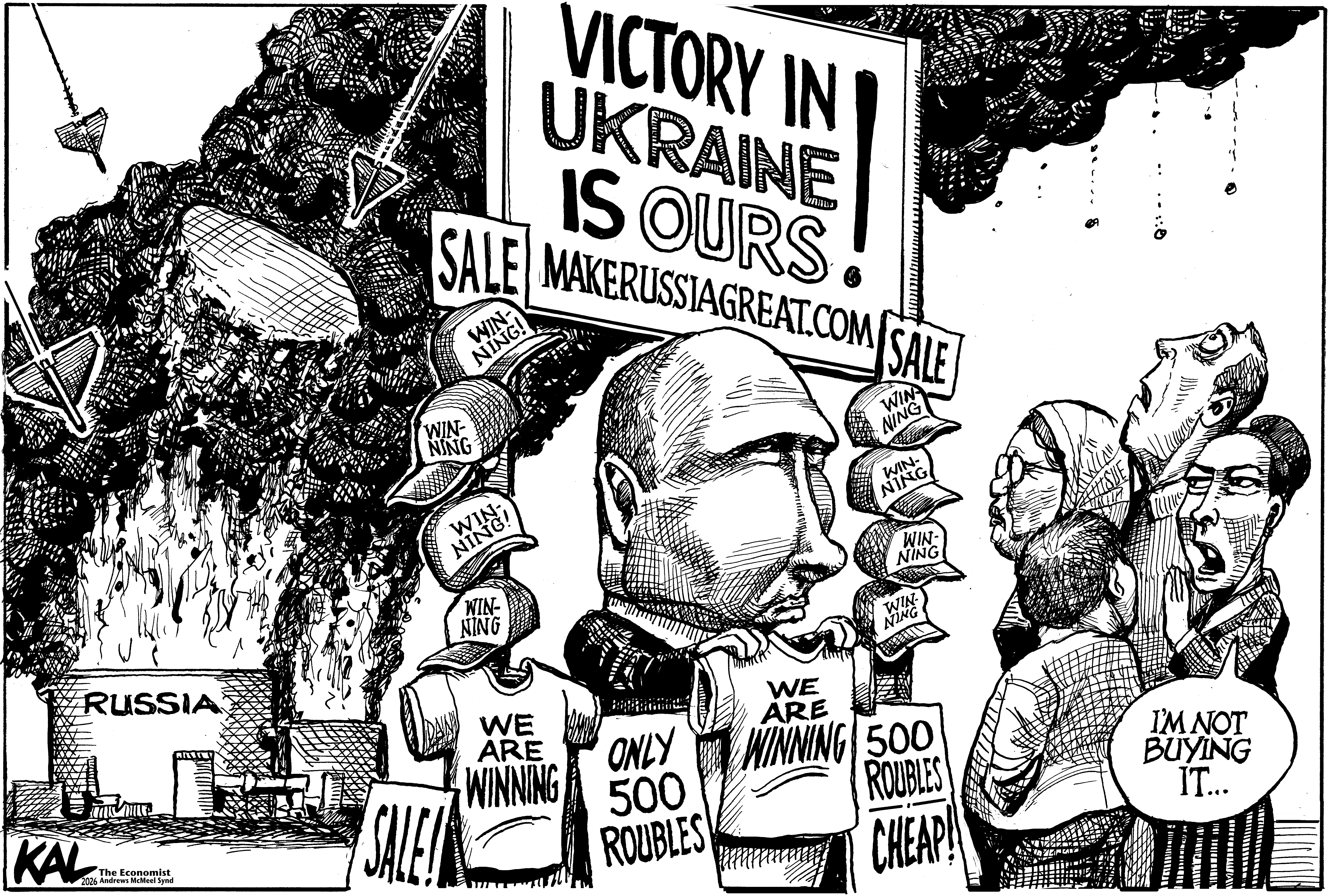
We are also hampered by the fact that Russia, thanks to Ukraine, is now running out of fuels. So, its ability to export and help fill the vacuum is becoming increasingly limited by political rebellion when citizens see their government selling oil to outside interests while leaving Russian citizens dry. Putin acknowledged for the first time this weekend that this has become a problem for Russia.
Russian President Vladimir Putin has conceded that the country is facing fuel shortages following a barrage of long-range Ukrainian drone strikes on key energy infrastructure, although he insisted the Kremlin was dealing with them.
The Russian president’s comments during an interview with a state TV reporter on Sunday mark the first time he has detailed the extent to which Ukraine’s deep-strike success has hampered Russia’s fuel production.
Russia, in fact, is now pressed to switch from being a net exporter of oil to being an importer:
Putin said Russia would import more fuel and expedite repairs of oil facilities to end what he described as the “temporary deficit,” according to The Associated Press.
And Ukraine says Russia is far from having seen the end of this degradation of its oil industry, which means still less ability to fill in the supply gap created by the gulf’s shutdown.
Ukraine has stepped up attacks on Russian oil facilities in recent weeks, seeking to cut off Moscow’s energy revenues and try to force Putin into bringing an end to the more than four-year war.
The attacks, including a huge explosion at Gazprom’s Moscow Refinery earlier in the month, have prompted analysts to suggest that the conflict could be shifting in Ukraine’s favor….
“Putin did not explicitly discuss Ukraine’s strike campaign against Russia or the wide-scale gasoline shortages experienced across the entire country, but Putin is likely subtly trying to portray himself as cognizant of the economic and social struggles Russia is facing,” ISW researchers said Sunday….
Ukrainian President Volodymyr Zelenskyy said on Sunday that the country’s forces struck two more Russian oil refineries, one in the Krasnodar region, which was estimated to be about 186 miles from the front line, and another facility in the Yaroslavl region, about 435 miles from the Ukrainian border.
Collateral burn
Meanwhile either that Iranian air force that Trump said long ago was completely destroyed or Iran’s completely sunken navy delivered some severe damage to the US during the weekend skirmishes:
U.S. Navy Fifth Fleet Headquarters in Bahrain “Completely Destroyed”
Arab media are airing video they report is from this weekend, claiming it shows Iranian missiles raining down on the US Navy Fifth Fleet Headquarters in Bahrain. Arab media says the Headquarters is now “completely destroyed.”
Here’s the video being aired by Arab media outlets tonight (Sunday, 28 June 2026) …
The United States military is claiming all inbound missiles and drones launched by Iran were shot down, that no US facilities were hit, and no one was injured. That certainly doesn’t comport with the spectacular explosions shown in the video. So, either the US is lying again, as it was proven to have done in previous strikes and as has become common practice under Trump, or Arab media used AI to concoct a video of massive destruction to the facilities.
Another report that came out late yesterday said that Iranian missiles were flying over Jordan toward Israel. There was no report of any hitting Israel, however, and Jordan was said to be intercepting them; but Israeli fighter jets were also reported heading toward Iran. I cannot find any followup reports on how that turned out or corroborating whether any of it was true.
Netanyahu celebrated a new framework agreement with Lebanon that he said could be historically significant, even as he celebrated giant explosions set off by the IDF in Lebanon today to destroy a deep 200-meter long tunnel.

Prime Minister Benjamin Netanyahu and Defense Minister Israel Katz have freshly announced that the Israel Defense Forces (IDF) completely demolished a massive Hezbollah underground fortress embedded deep beneath the southern Lebanese village of Majdal Zoun. The village itself was leveled, with the IDF having released footage showing an unusually strong explosion:
Ceasefire/schmeasefire?
Bombing like that makes “significant historic agreements” look pretty fragile, and Israel hasn’t seen a ceasefire yet that it couldn’t blow up, usually, of course, with plenty of Arab help to get the ball rolling.
So, maybe oil has gotten just a little ahead of itself by settling so close to the 60s? It won’t stay there for long.
Economania (national & global economic collapse plus market news)
Piling on Meltdown Risk: Margin debt tops $1 trillion as leveraged funds fuel record binge
Record $1.4 trillion margin debt fuels risky stock market leverage
The AI boom is colliding with a new threat: Severe weather
Dow jumps more than 200 points as U.S.-Iran halt hostilities, Alphabet shares gain
Michael Pento Warns: A Bigger Crisis Is Coming
Money Matters (monetary policy, metals, cryptos, currency wars & going cashless)
Supreme Court Expands Presidential Power Over Regulators, but Not the Fed
Tether’s USDT Jumps To 8.5% Premium In India After Crypto Payment Crackdown
Gold Stocks: Across The Board Buys Now
Repatriation Picking Up Steam as Countries Bring Their Gold Home for Safe-Keeping
Inflation Factors (too much money chasing too few goods due to weather, sanctions, tariffs, quarantines, etc.)
Strait of Hormuz Tanker Traffic Slows After Fresh U.S.-Iran Strikes
Oil Prices Climb as U.S.-Iran Flare-Up Shakes Market Complacency
Oil prices near pre-war levels — but persistent supply risks could spark a rebound, analysts warn
Oil prices rise as U.S. and Iran reach deal to halt attacks, U.S. oil above $70 per barrel again
Putin’s fuel shortage admission signals growing strain on Russia’s infrastructure
Wars & Rumors of War (including cyberwar, civil unrest and revolts)
Video: U.S. Navy Fifth Fleet Headquarters in Bahrain “Completely Destroyed
Iran Has Just CANCELED Swiss Talks with the United States
Trump says U.S. and Iran to hold fresh talks in Qatar on Tuesday following weekend clashes
Iranian Missiles Over Jordan Headed toward Israel; Israeli Fighter Jets Headed Toward Iran
U.S. launches additional Iran strikes as tensions flare up over Hormuz
Trump again threatens Iran with annihilation as Kuwait and Bahrain report attacks
Trump Warns Iran It May ‘No Longer Exist’ After U.S. Strikes Missile, Drone Sites
Trump starts up his war on Iran
—
Giant Explosion Rocks Lebanon As IDF Destroys Hezbollah’s Underground Drone Complex
—
Hamas Crushes Planned Gaza Protests Calling for End to Terror Group’s Rule
—
Humiliated Vladimir Putin finally admits Russia faces ‘problems’ in war with Ukraine
—
Are We Already in World War 3?
Digital Dominance (AI threats, transhumanism, hacks & cyberattacks, etc.)
Ford rehires human engineers after AI fails to match quality checks
Political Pandemonium & Social Senescence (socio-political issues & events)
Supreme Court OKs late-arriving mailed ballots in loss for Trump
Supreme Court Lets $5 Million Sex Abuse Verdict Against Trump Stand
America first or family first? Trump’s $1.6 billion deal set to profit his sons
Trump Cut a Billion-Dollar Mining Deal. His Sons Stand to Profit.
Trump bought as much as $5 million in Axon stock before ICE sought $220 million Taser deal
Florida Closes ‘Alligator Alcatraz’ After Transferring Detainees
Newsom Calls for National Billionaires’ Tax, Federal Stake in AI Companies
A Pox Upon Us (the plagues, pandemics & health police of the 2020s)
New lawsuit against Pfizer: Depo-Provera – the killer birth-control shot
Calamity, Catastrophe & Climate Craziness
Europe Heatwave Kills More Than 1,300 As Records Tumble Across Continent
Doomer Humor