



Today, gasoline prices exploded to another a new high for the year, coming in at a national average of $4.23 per gallon, which looks enviably cheap compared to where I live in the liberally taxed Northwest. Prices here are the highest I ever remember seeing. I occasionally run a tankful of premium Chevron through my Jeep because Chevron doubles the amount of their usual detergent in the premium. Yesterday, I stopped at a quarter tank of the good stuff because the price for premium was $7/gallon! “Enough!” I said. The price for regular was $6/gallon! Diesel was $8/gallon!!! (Ag. diesel, as I noted in my article about frazzled farmers yesterday, is under $7 because it doesn’t include state taxes.)
President Trump, today, decided those high prices I paid yesterday are not nearly enough. He made an announcement that shot Brent crude up (at the time of this writing to $120/barrel and US WTI up to $108. That’s the highest peak for the past year for Brent crude, bursting past anything the war has done to gasoline prices to date. In fact, you have to go back to the summer of 2022 to find a peak that beats it: (which was when Putin started his war on Ukraine.)
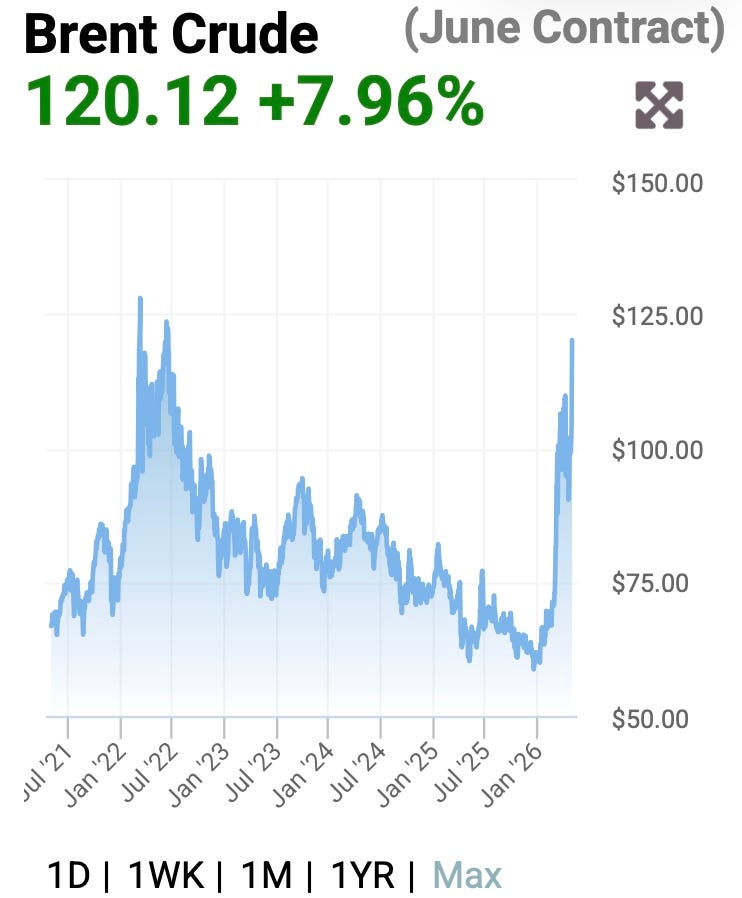
With the exception of the spike that hit during the first part of Putin’s invasion, this is the highest price for crude since the Great Recession, which means prices at the pump will be soaring rapidly now because the president promised even higher crude prices are here to stay for awhile as part of an extended oil crisis, and I’ll tell you how he did that.
A new of war of attrition for the entire world
The president’s promise went like this, and it might make sense in terms of breaking Iran’s back by making sure its blockade of the Strait of Hormuz hurts it more than anyone else, but it will also make sense in breaking yours because everyone pays:
Trump orders aides to prepare for extended blockade on Iran — as Tehran’s economy collapses.
To force Iran to get serious about negotiating and giving up its nuclear material, Trump is committed to a longer halt of Iran’s oil exports, the lifeblood of the Islamic regime, the Wall Street Journal reported.
The move comes as experts estimate that Iran has at most 12 to 22 days of oil storage left, as Tehran has nowhere to send its crude under the blockade.
That turns this from a war of directly forced genocide that Trump had threatened to a war of attrition for the whole world. Of course, Iran may be able still to sell and transport oil by road, railroad and pipelines … unless Trump/Israel takes out all of those options, too, or already has; and the people of Iran will suffer greatly under all of this; maybe even genocidally, since oil is the central part of their modern economy.
Key to understanding the difference here between today and World War II is that we are not taking out their fuel supply routes for war; we’re taking out all of their economy by laying siege to it. We are seeking to damage civilians as much as possible, short of bombing the rest of them to bits.
The move comes as the Islamic Republic’s economy is in a death spiral.
At least one million people have lost their jobs since the start of the war, according to early estimates cited by Gholamhossein Mohammadi, an official at Iran’s Labor and Social-Affairs ministry, and reported by the WSJ.
The cost of living has also soared, with the annual inflation rate reaching an eye-watering 67% in the month through mid-April, compared to the same period last year, according to Iran’s central bank.
“Living is not affordable anymore,” Mahdi Ghodsi of the Vienna Institute for International Economic Studies told the outlet.
“Iran is at its weakest point.”
While Iran will struggle the most under the blockade now, even Trump says to expect this is not going to be immediate. So, all of us will struggle a lot more under scorching-hot oil prices and rising everything-else prices that go along with that as the collateral damage of an oil war.
Trump allegedly made the decision to extend the blockade after Iran proposed a three-step offer to reopen the Strait of Hormuz, a key oil choke point that Tehran has kept shut since the war began on Feb. 28.
Iran’s offer, however, called for the nuclear talks to be postponed, which Trump believed was proof that Tehran was not negotiating in good faith and was trying to string the US along, according to the WSJ.
And the cost of reduced production could be permanent, even after the strait opens, because what is said next for Iran is also true for other gulf nations shipping their oil out through the strait:
The regime is believed to have at most seven weeks before it’s forced to shut down oil production, a tricky process that threatens to permanently damage its abundant wells, experts previously told The Post.
Perhaps to some extent all nations around the gulf will be able to keep some oil production going by shipping via other routes, but this route is so important that it still will restrain actual oil production in all nations around the gulf, potentially forcing the shutdown of some of their wells, too.
So, it’s a war of attrition, and everyone all over the world will have to suffer it until one side of this siege gives up:
With a halt to Iran’s exports set to set gas prices soaring, the situation has boiled down to who is able to withstand more pain, with Trump confident that Iran is already on the brink, as he described the Islamic Republic on Tuesday as being in a “state of collapse.”
The question is who will chicken out first? Trump may underestimate Iran’s willingness to bear up under pain rather than give up. It is hard, on the other hand, to overestimate Trump’s willingness to chicken out and find an excuse to cover for it. That is now his modus operandi on an almost weekly basis—the art of the weave that he’s proud of.
Everyone in the world is in the fight now. Everyone is paying for it. Maybe some nations like Russia will benefit, having suffered long under US sanctions on Russian oil, now, at least, partially lifted. In the US, however, the economy will suffer far more under higher oil prices while millionaire and billionaire oil barons (and a few common folk who have made some good oil investments) will profit. Likely only the richest will profit more than their prices for everything increase.
The scale of the oil shock
It seems like only yesterday that I wrote,
The oil shock and its grip on food is going to be so much worse than most people think….
Oh yeah, it was yesterday; but I’ll bet the oil shock just got a lot worse today in the minds of many because their eyes will be opened to how these things don’t end as easily and neatly as they want to hope they will. Now that Trump has promised a longer-term closure of the strait right after fuel prices just hit their highest since the war began, the price rise could become shocking because he has largely jawboned speculative pricing down by promising the war is almost over.
An article that I ran in the headlines yesterday for paying subscribers also noted that the president’s jawboning as a way of getting prices back down is likely coming to the end of its effectiveness:
The jawboning has mostly worked. Even as the global price of oil has crept up over $100 per barrel on the futures market, it is significantly less than the $140 per barrel spot price, or what it would take to buy a barrel today.
But the president’s promises can only work for so long. Supply of oil — especially in Europe and Asia — is dwindling and a price shock is coming, said Dan Pickering, chief investment officer at Pickering Energy Partners.
He said that when the summer driving season begins there will be another gas price shock that “hits people in the face.”
“There’s a day of reckoning coming,” he said. “It will be painful because I can tell you that the stock market’s ignoring this.”
We seem to be back to not ignoring for the moment, but maybe Trump will chicken out first. He has a reputation for doing that.
Following the headlines section below, I will continue with the reasons this will be a far worse energy crisis than we have ever seen and worse than most people are imagining.
Before I do, though, I want to add one interesting note from another article today: The very objective that Donald Trump hoped to improve with his tariffs just got worse: The US goods trade deficit widened in March as US buyers increased purchases of tariffed goods.
The U.S. trade deficit in goods widened more than expected in March as a rise in imports outpaced exports, suggesting that trade was likely a drag on economic growth in the first quarter.
More on that below, too.
