

More Wall Street experts have crossed to my side of the street and are speaking a truth that once could not be told. For a long time, nearly everyone said the very thing that is suddenly being widely predicted was impossible. It felt kind of lonely in the truth market a year ago, but now it’s getting crowded.
Today, two of the biggest of mainstream financial publications, The Wall Street Journal and CNBC, have started openly worrying that the AI bull could die and kill everything around it on its way out. They are even saying the AI bubble bust will likely start with one of the biggest of all high tech companies, Oracle, particularly because of its close association with one of the biggest of all AI companies:
A terrifying warning has sent shockwaves through Wall Street as financial experts warn that a stock market crash is looming on the horizon.
At the eye of the hurricane is tech giant Oracle, which veteran financial analyst David Desjardins fears will be the ‘first domino to fall’ in a brutal tech market collapse.
Oracle has now been downgraded to one mere step above junk-bond status, yet it is desperately hungry for more money to finance its continue AI rampage.
Oracle has effectively bet the farm on the AI revolution, building colossal data centers to power the technology, but experts warn this high-stakes gamble could backfire spectacularly.
‘OpenAI is entirely dependent on capital markets remaining wide open to meet its financial obligations,’ wrote Desjardins, who warned that if the company had trouble raising money, ‘Oracle would be in the eye of the storm.’
The collapse would not just destroy Oracle, it could take down the rest of the AI market and touch off a massive stock market meltdown.
A spectacular fall of the stock market’s kingpins is exactly what I’ve been saying you are going to see—a collapse so great it will pull nearly everything else down in its undertow like a sinking ship pulling down surrounding swimmers who are trying to flee the shipwreck.
The company has borrowed mountains of cash to fund the highly complex, energy-hungry data factories needed to fuel the artificial intelligence boom.
According to Desjardins, the credit ratings downgrade by S&P, which left Oracle at the lowest level of investment grade, just one stop before junk, could light the fuse that blows up the company.
When it is finally seen that Oracle can sink like a stone, delusional investors should finally flee like rats leaving the sinking ship as they suddenly realize that, if Oracle can implode, anything AI can implode. As I pointed out yesterday when I was flagging Oracle’s huge stock plunge and the fact that a large part of AI reported “earnings” are built largely on stock speculation inside of companies like Oracle, those internal, incestuous investments in their own customers are not only extremely leveraged, therefore fragile, the AI companies are also extremely dependent on energy at a time when the energy market has returned to soaring inflation.
The companies that have expanded way too rapidly in lunatic zeal are hollow on the inside, as often happens in this kind of manic company expansion. Their earnings off of AI are way too small to justify their investment, and they are hollow because most of their reported earnings are created by using margin debt in some cases to buy stocks in other AI companies. The whole thing reeks of being an incestuous circle, and now even major Wall Street experts are starting to wake up and forecast what many said could never happen: The behemoth bubble is getting ready to burst.
When a public company’s credit rating is downgraded to junk, its borrowing costs spike and its stock price typically drops. That’s because institutional investors don’t invest in junk bonds, which drastically reduces the company’s access to funding.
They are starving for cash to complete their buildouts, and lenders are pulling back, as are stock investors. They are energy starved, and local communities are mounting huge and successful campaigns against them because of how they drive up local energy rates and noise pollution, etc. Another successful protest hit the news today right in Trump’s Mar-a-Lago back yard, even as the president criticized New York for putting a legal moratorium on all data center construction, telling them they had better leave his billionaire buddies alone.
Desjardins warns that Oracle is balancing on a financial tightrope: If the company’s financial health slips even slightly further, it would become incredibly expensive for the company to borrow more money.
Oracle is another classic example of a company expanding far too quickly and developing a hollow core so that it can nova like a dying star and collapse into itself.
Building data centers requires an astonishing level of investment that is currently draining Oracle’s finances at an unprecedented speed.
To put the scale of the spending into perspective, Oracle spent a massive $55.7 billion on its data center base in fiscal year 2026, with spending expected to jump by around 70 percent to a staggering $90 billion in fiscal year 2027.
Yet, not long ago, you could hardly convince people of how foolish this euphoria was. When you reminded them that this was shaping up exactly like the dot-com bust, they insisted it was different this time because these are the leaders of the new business world, oblivious to the incredibly obvious fact that saying that is equivalent to actually saying, “This time is different because it IS EXACTLY THE SAME!” It was that exact core delusion that blinded the majority last time.
This delusional mess has become the perfect setup for reaching critical mass where one company’s collapse assures the next company’s cascade into collapse:
But for Desjardins, the biggest risk for Oracle isn’t just its own massive debt load, it’s the fact that the company has hitched its wagon almost entirely to a single, high-stakes customer.
That customer is OpenAI, the parent of the ChatGPT and the controversial leader of the AI revolution.
SEC filings show that Oracle has a staggering $638 billion in future contract volume on its books - and approximately half of that amount is from OpenAI alone….
OpenAI is trying to secure its future by actively planning a highly anticipated initial public offering on the stock market, helping it raise the massive mountains of capital it needs to stay afloat and keep paying Oracle, among others.
All it will take for everything to crash in a huge spectacle is for OpenAI’s IPO to fail.
If OpenAI fails to secure this funding … Oracle and its massive debt will be left completely exposed.
Desjardins warned that if OpenAI were unable to meet its payment obligations, Oracle would be left with long-term data center rental agreements that ‘could neither be easily terminated nor transferred to other customers on comparable terms.’
At the end of the day, Oracle’s wild spending is what keeps the entire semiconductor industry alive, as its cash flows directly into the pockets of chipmakers.
The capital expenditures of hyperscalers like Oracle are ultimately recorded as revenues by semiconductor manufacturers like Nvidia, Sandisk or Micron.
If Oracle crashes, it will drag down the chip giants with it, turning the AI boom into a historic bust.
But now Wall Street is getting it—so much so that even CNBCs normally rabid Jim Cramer jumped on the antagonist bandwagon and said stocks are dangerously close to crashing into the the hollow core of the AI bubble, and it is precisely the risk of an IPO failure tipping everything over that has Cramer worried:
CNBC’s Jim Cramer said Wednesday that while Wall Street was focused on re-escalating tensions between the U.S. and Iran, he is more concerned about a flood of new stock and bond issuance that could threaten the bull market.
“At least when it comes to the stock market, I’m a lot more worried about supply — specifically, the flood of new equity and bonds that have inundated this market, sopping up a lot of sidelined capital,” the “Mad Money” host said.
Companies have issued staggering amounts of equity and debt in the last month, Cramer noted, including Alphabet’s big stock sale, SpaceX’s $85 billion initial public offering and $25 billion bond sale, as well as large debt offerings from companies including Amazon.
While the market has absorbed that supply so far, Cramer warned demand may be approaching its limits.
With the market nearing its available cash constraints, and debt of some companies like Oracle being seriously downgraded, protests building successfully against AI data centers, the illusion of earnings starting to get exposed, energy prices again soaring for these energy gluttons, and the new Fed chair sounding more hawkish than Powell ever did, OpenAI could easily fail to launch at its initial public offering.
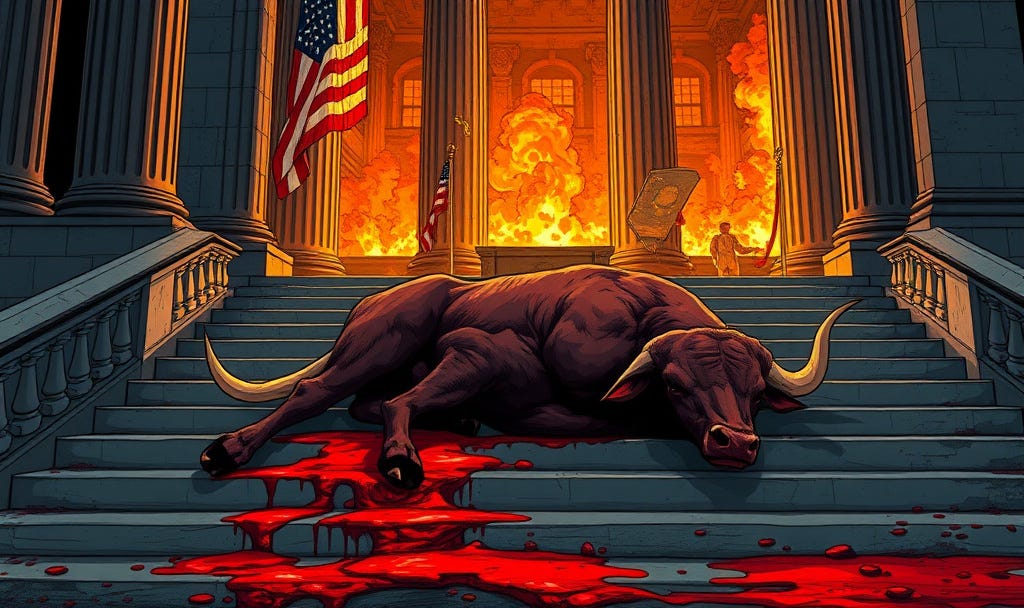
Oversupply of new stock offering, Cramer argues, as does another article today by The Wall Street Journal, could bust the bull wide open on the sidewalks of New York.
The manic bull is likely soon to die, and when it does, it’s death is certain to be spectacular—one for the record the books.
