


The warning I wrote on Wednesday afternoon about Scott Bessent’s big intervention in the Treasury market already proved itself true by Thursday morning—more quickly than I expected. (I would have given it two days to fall apart.) So, I will lead off this Deeper Dive with some headlines for everyone in this part that is available to all readers, starting with these, which were Thursday morning’s lead headlines on Drudge:
Treasury yields rebound, wiping out the decline following Bessent’s intervention
And this one:
The Treasury Market’s Coveted Status as a Safe Haven Is Fading (Two new studies find signs investors aren’t as willing to accept low yields because of Treasurys’ safety)
Dollar Risks Becoming Biggest Loser From Bessent’s Bond Buying
In the whirlwind of news this week about a GLOBAL bond market collapse, it was hard to figure how to cover it all appropriately. I decided in the end to focus primarily on the thing that matters most: What are the risks for all of us? Rather than digging too much into the details about what they did and what is it that is blowing up. Instead looking at what is really at stake here? How will it impact us?
These headlines that address some of the questions I was going to cover came along the very morning I set out to write about it. So here is an introduction based on Thursday’s headlines for everyone in a Deeper Dive I’m putting out early because I’m taking the weekend off for family stuff, barring any news so major that it draws me back in before Tuesday, when I hope to be back on the job here. (That’s when visiting family leaves after arriving late Thursday.) Then I’ll dig in deeper for paying subscribers.
Be sent back
The top headline on Drudge about Scot Bessent’s plan being sent backward caught my attention the most because you may remember my writing just the day before:
It is not as surprising as it is sad that the feds came to the rescue today, nor surprising stocks rose in response to horrendously bad news about a global bond default because it means there is a big new money dump in town. Stocks rose and Treasury yields fell as they were rigged by the Treasury to do, sliding on the long end of the curve. It went according to plan.
Yet, it is precisely because we always solve these things with rescues and never with true fiscal reform that we have built up the biggest bond crisis in history that now needs another rescue. It is because other nations like Japan did the same thing that those nations impact ours because they are so wedded to the global dollar. It is the global dollar that is at stake again, hence the Treasury’s rush to the rescue….
But here’s the problem. The knock out drugs [intended to put the bond vigilantes into a deep sleep], massively powerful as they are, don’t last long. They always require another hit … a bigger hit … and then another to keep the new high going. So, the rescue plans, as we particularly saw during the Great Recession where I cut my economics writing teeth, get bigger and bigger and more drawn out and filled with fancier new tricks. (That path has been my biggest and most consistently accurate prediction ever since that time.)
We just saw all of that play out more quickly than I imagined—in just about twelve hours! While I have yet to be wrong in saying that any of these rescue plans will demand bigger and bigger hits, I’ve never been right this quickly! But there it is in the morning news. The high from Bessent’s rapid intervention has already faded to nothing but a hangover, and the press is already pointing out, as I said in that warning, that the number-one ultimate risk is the dollar! Actually, the dollar and the solvency of the national debt as both are at stake together.
Getting some sense whipped into ‘em
So, let’s go through those articles in order because they summarize well what I set out to write Thursday morning, though I have more to say:
Bond yields climbed Thursday morning, erasing most of the pullback they saw the previous day after the Treasury Department announced an intervention aimed at easing pressure on longer-dated government debt.
One of the biggest problems Bessent sought to overcome was the sudden rise in bond yields tied to the overall global bond crisis. In this part of my Deeper Dive for every reader, the exclamation point here is that Bessent failed with his one bold move to hammer yields back down, and that is MASSIVELY important. Why? Because the national debt yesterday also soared past the cliff-edged mile marker of $40,000,000,000,000. That’s a lot of zeros—a long way to fall. It means a LOT of interest—a lot of which was funded with those long-term Treasuries where Bessent’s move was aimed at bringing down those rates by rolling them over to short term Treasuries that have lower rates.
Of course those short-term Treasuries will go up in interest as soon as the Treasury starts issuing a lot more of them in order to fund the buybacks of the longer treasures. Enough on the mechanics, as I promised not to focus on that. The important part is that the plan immediately flopped on its face. Long term rates shot right back up to the scary elevation they had reached just before the plan.
Now, nothing magical happened when we hit $40T in debt, except the psychological impact, but that can be important for interest rates, too. However, impact or no impact from the big number, it’s a whole lot of interest, and Bessent cannot let those rates soar like they are doing because of a global bond bust that is broader than just US troubles.
The 10- and 30-year yield levels were right around the level they held before the 8:30 a.m. announcement Wednesday that Treasury would be stepping up its bond buyback program.
The yield on the 2-year Treasury note, which more closely follows short-term Federal Reserve rate decisions, was last seen up 1.5 basis points to 4.1927%.
So, longterm bonds are back up to where they were before the intervention, but short-term bonds also nudged up a hair, so everything is immediately as bad or worse than what it was before the intervention. Time already for a much larger hit if we’re going down the path of doing everything the Fed and feds can think of to avert collapse of the dollar and a debt catastrophe.
The moves underscored the difficulty of market interventions, particularly at a time when U.S. debt faces a slew of factors that have been pressuring yields higher.
Even the mighty US, struggling to fund its imperial wars, cannot afford higher interest on a $40T debt.
In a move announced Wednesday morning, the Treasury Department, led by Secretary Scott Bessent, announced it would at least double the size of its government debt buybacks, starting Sept. 9 and running through Nov. 4.
That was a small move. It’s importance, as I said yesterday, was that it showed this IS a debt crisis that required Treasury intervention, but it’s far too big of crisis for that small hit of Treasury medicine to do the job, which bears out the next part that I wrote yesterday:
It is not normal for Treasury rates to fall on the day after massive bond problems blow up in global markets, especially a blowout as tightly wedded to US Treasuries as Japan. The announcement by Be-sent of Trump of a major rescue would spark fear into the hearts of bond investors if not for the fact that the Treasury money will be massive enough to outweigh the risk … so long as there is more to come … as there always is.
The move failed to help because it did, in the end, trigger as much fear as any kind of safety it might have offered. In fact, I am sure it will trigger waves and waves of fear as investors see the scale of new Fed meds rise alongside Treasury drugs, indicating how big the problem is, and Bessent is already calling in the Fed. That is what we saw back in the Repo crisis that I mentioned (the Repocalypse). The more they, did, the more they had to do, until they finally went for broke with TRILLIONS of dollars of intervention, which looked like this:
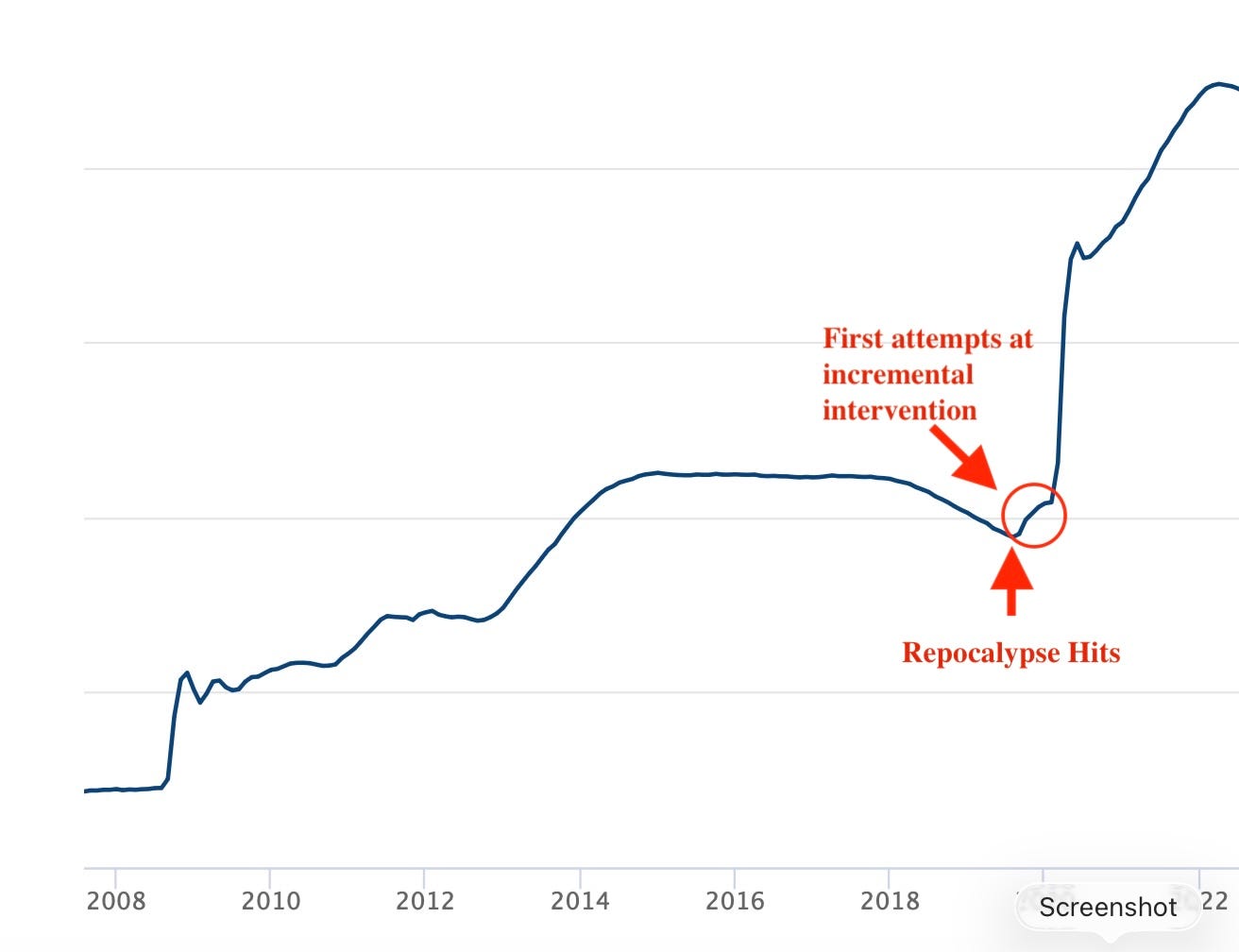
The Repoaclypse was a crisis in normally very boring interbank lending that happens at foundational low interest rates, but the crisis immediately sent those boring interbank interest rates through roof. I don’t mean in the fractions by which such loans are usually measured but a leap right up to 10%, which the Fed tried to clobber back down with larger and larger incremental steps that failed to hold every time. Hence, you see all the little stair steps rising in the red circle.
Then Covid hit, and the Fed did massive interventions with new money for Covid, so that ended the repo crisis, “repos” being what these kinds of loan between banks are called without getting into the gritty detail. We will never know how much it would’ve taken to end the repo crisis. We only know that it was never enough until the Fed did massive intervention for other reasons, creating trillions of new dollars on bank balance sheets (the sudden massive rise in the graph), and that huge burst of new financial liquidity finally drowned the flames out.
The Treasury right now, has just stepped into that small red circle of small interventions, mere billions, that accomplish nothing. As with the repo crisis that I compared to yesterday, each interventions of tens of billion dollars had to be redone in larger amounts only a day or two later, going up to hundreds of billions.
And, so, my warning yesterday went on to this:
We have seen how these game plans go—in 2008 with the almost endless rounds of nearly almighty easing for years and in 2019 during the Repocalypse that ultimately forced the Fed BACK into quantitative easing after its brief experiment with quantitative tightening that former Fed chair Yellen had promised would be as boring as watching paint dry, but it wasn’t.
What happens every time, is they do more, then they have to do more. So get ready for another rodeo ride as the Fed and feds go back to bronco busting the dusty “OK Dollar Corral.” It’s going to be a long ride, fraught with new perils. Just another prediction in which I have total laid-back confidence.
And that prediction is already proving true, less than twelve hours after I wrote it.
Yields tumbled following the announcement, with the 30-year down about 10 basis points after previously hitting its highest in about 19 years, predating the global financial crisis in 2008.
However, the trade quickly unwound, with yields higher Thursday as the market digested the move, as well as the longer-term structural problems facing the fixed income market.
The interventions “belie the underlying structural challenges and do nothing to address them,” Maia Crook, senior research analyst at JPMorgan Chase, said in a client note. “While [Wednesday’s] action forced some decline in longer-dated yields, the more lasting impact is the potential for higher risk premia reflecting a Treasury Department that is intervening in the market and moving away from its ‘regular and predictable’ tenet.”
Uh huh. EXACTLY as I wrote yesterday. The premia are that everyone now sees the Treasury intervening, so they want higher doses of med to compensate for the risk the Treasury just woke them up to by trying to send them all to sleep with short-term drugs. And they are, like “Whoa! What was that quick trip all about.”
Unsurprisingly, the stock market, which I said reacted stupidly on Wednesday, caught up Thursday, too:
Dow tumbles 700 points, S&P 500 falls as Treasury plan to subdue yields fails
Reality is a harsh teacher, so they are getting whipped around because they were dumb yesterday, but then woke up with a heavy hangover from the hard drugs administered by the Treasury yesterday.
U.S. stocks fell on Thursday as Treasury yields reversed course from the decline seen in the prior trading day following the Treasury Department’s debt buyback announcement….
Also weighing on equities, oil prices rose again amid increasing tensions between Iran and the U.S. President Donald Trump said in a Truth Social post late Wednesday that the U.S. would begin “most crushing economic operation ever taken against any country” against Iran. “This will be Economic Warfare and Isolation on an unprecedented scale,” he wrote.
Yeah, well the lasting and escalating impacts of Trump’s War should have been abundantly obvious to everyone by now. So, there are plenty of wakeup calls left to come because an economic war is guaranteed to create all kinds of NEW ECONOMIC CASUALTIES. The other side DOES fight back, and the economic bombs we drop will send out shock waves that reverberate back to us in ways little tiny Trump doesn’t even begin to imagine (just as he still doesn’t imagine that his tariffs are hitting you with inflation or that his war is going to hit you with more than rising gas prices. Oh well!)
Brent’s now at $93. Just one of the little ways that even the announcements of major economic warfare come back to cost you out of your pocket, but we knew the war, one way or another, was going to continue to escalate and drive oil prices higher. However, as I’ve warned all along, wait until you see what happens at the pumps when actual fuel shortage arrive here, as I’ve reported they already have in large ways in Russia. It’s an interconnected oil world, and Russia’s vast oil and refined fuel used to flow everywhere, but now they flow nowhere, except within Russia.
Safe-haven status blown up
The next headline among the three I led off with, I’m going to mostly cover in the Deeper part of this dive for paying subscribers because it takes a lot more digging; but note how major the importance of all of this is. It all calls into question “the Treasury market’s coveted status as a safe haven.”
That status is being blown apart by everything. Literally blown apart by a war that no one but the president and Israel seems to want. That’s driving up US debt at a time when the Treasury market is getting more sensitive about the humungous US debt load, and I’m sure the president’s constant and obvious lying throughout this war is not building trust in the US as a safe and predictable haven.
Neither is the president’s CONSTANT renegotiation of already renegotiated tariffs like the new blowing-smoke-up-the-Canadian-behind tariff he came up with recently because of the smoke drifting into the US from Canadian forest fires. His tariff tactics are more like the old fashioned “rack” used to wrack your bones. Tariffs, as I pointed out long ago, diminish the need for trade DOLLARS, which means they diminish the need for US Treasuries, which are the big packages those dollars are most often transacted in between central banks. A diminished need for the global currency due to restricted trade will impact the value of the dollar. A diminished need for Treasuries will raise the cost of financing them.
So, yes, Treasuries are losing their safe-haven status, and that means the dollar is being dented, too. This war is giving nations a lot of reasons to hate dealing in the petrodollar at the same time that Trump has been giving them a lot of reasons with his endlessly volatile tariffs. They change all over the place all the time. He can never be trusted when he does make a deal to even stay with it for a mere year (which is forever in Trump time). So, the US is increasingly becoming an increasingly unstable financial partner all over the world because of the increasingly unstable person it chose for president.
Investors in US debt are looking for higher and higher risk premia in this unstable world of Trumpian chaos and conflict in which the US seems to be creating most of the instability.
Dollar damage
If we keep proceeding as recklessly as we have been, this will become dollar destroyed. The third headline that I led off with take us from the damage to Treasuries as the longstanding global safe haven to the dollar’s risk of becoming the biggest loser due to the damage happening in the Treasury market, but particularly due to the kind of salvation plan that Bessent has baked up:
Treasury Secretary Scott Bessent’s bold intervention to stem a potentially damaging rise in US borrowing costs has some investors saying the dollar will ultimately pay the price….
Coming after other recent efforts to rein in long-term yields, it’s reviving a concern that US policy could weaken faith in the dollar and push investors toward alternatives.
I think EVERYTHING is doing that right now—wars with their enormous debt burden and especially their destruction of the petrodollar via destruction of reliable oil trade; tariffs with their lessening of need for a global trade currency denominated in dollars as nations move toward less trading with the US and more with each other because US consumers or businesses don’t want to pay the tariffs that make those nation’s products too expensive; a mercurial president who cannot be trusted, who said on Thursday he wants to move to the harshest economic warfare ever seen, oblivious apparently to how the enemy will fight back with its own aims of economic wreckage, which it is doing an outstanding job of already. This all just spirals more and more out of control due to the orange nutball in the White House.
“The dollar certainly is the biggest casualty,” said Gerald Gan, chief investment officer at multi-family office firm Reed Capital in Singapore. He sees Bessent as deliberately pushing down long-term real rates and signaling a tolerance for a weaker dollar to keep the economy afloat.
“I would further diversify away from the dollar,” he added.
And with that, we move on to the part of the Deeper Dive for paying subscribers (because a guy HAS to make a living to keep giving so much time to this.)
First, here are a few more headlines for you since Thursday (when I’m writing this) is usually a daily headline day, too, and these ones aren’t ones I want you to miss because of their economic significance:
Walmart Posts Weakest Sales Growth in Over Six Years
When Walmart is falling back, it means consumers are seriously dialing back due to all the inflation. If they’re dialing back at Walmart, one of the cheapest stores, they must be dialing back at all stores, and that is seriously recessionary. The passthrough of inflation from oil and tariffs is happening.
Personal bankruptcy filings are surging as Americans struggle with debt
People kept up their lifestyle, meaning also their retail purchases, in spite of inflation, by using more credit. That is now collapsing. Debt is becoming an end-of-the-road problem for consumers just as it is for the US Treasury.
7 questions about the national debt hitting $40 trillion
Now, on to the deeper troubles hidden in the global Big Bond Bust:
