


Following up on yesterday’s government report about continually weakening employment, I should have noted that, while a 4-year high in the unemployment rate doesn’t sound like much, remember that takes us back to the greatest unemployment period in US history—the time when we were still coming out of the nationwide, government-forced Covid lockdowns. We will be hard pressed to ever beat the high bars set in those years for the unemployment rate.
If we skip the huge anomaly in employment caused by the Covid lockdowns, then our overall unemployment rate of 4.6% takes us back to the unemployment level at the start of 2017. Look at this current graph where I’ve bridged the anomaly with a red line, curved to show the natural transition in unemployment trends if you just gloss past the anomaly:
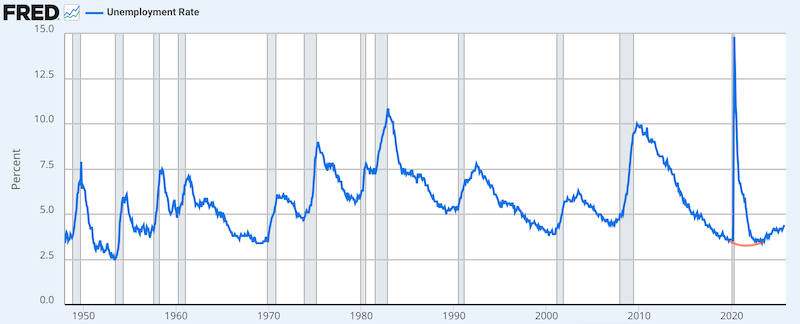
If you look at it that way, we are now on a pretty long upward rise in unemployment if you compare this upturn to all other turns at the bottoms in all prior decades. So, it’s not an insignificant rise, but it also hasn’t all happened under Trump and his tariffs. I was complaining during Biden’s all of last year that we had already entered a stealth recession.
[Added note: The important thing to note from the graph is that it doesn’t matter what level unemployment was at when the turn in the unemployment rate was put in. As soon as the turn was up 0.4 points from the low—no matter what level the unemployment rate low was at was at—the recession started, even though the recession typically was not officially declared until half a year or more later and was, then, backdated to its start.
Given that the lowest point reported in this cycle was a 3.4% unemployment rate, we have now moved well above the 0.4-point upturn, and 0.4 points has been the most accurate indicator of recession we have. There are no exceptions going back to 1950, and I think there was only one exception prior to 1950 where the unemployment rate climbed 0.6 points before the recession started, and we are now well above that.]
How bad it is depends on the group you talk to
The unemployment rate also looks more serious when you realize that many groups are not experiencing this unemployment much, while others are taking the brunt of it. For Blacks, the rate has gone from 7.5% in September—much higher than the 4.6% overall rate in yesterday’s report—to 8.3% in just two months time. That’s a sharp rise!
For teens of any race, the climb is far worse than that. For them, the number jumped from 13.2% in September to 16.3% in November. Teens that stay unemployed become disenfranchised and tend to start causing problems because they get restless and discouraged and believe the system is failing (because, of course, it actually is).
Also, bear in mind that the numbers by nearly everyone’s reckoning—even the Fed’s—are more shoddy than ever. That will help you understand why one article today points out people who’s actual experience sounds more grim than those abstract numbers tell:
If you currently have a good job that you highly value, hold on to it, because finding a replacement for that job would not be easy in this very challenging economic environment. In previous articles, I have shared heartbreaking stories from unemployed Americans that have been unable to find work no matter how hard they have tried. I am going to share more of those stories today. When you are unemployed and month after month goes by without finding a job, it can really do a number on your self-esteem. If you have ever been through a stretch like that, you know exactly what I mean.
People working in tech who said they could easily find jobs during past job searches now report finding it a real struggle to find something in the tech sector. This is just anecdotal, but it may be the picture for more Americans than we realize:
Anna Whitlock was let go from her job in the technology industry in November of 2024…. [She has] 11 years of experience managing network infrastructure projects, a specialized role that involves equipping buildings with internet access, cameras and wifi security systems.
“The last time I had to job search, I found something pretty easily,” she said.
Almost a year later, the 37-year-old is still without a job. Whitlock said she has applied to hundreds of jobs — even for positions she’s overqualified for — to no avail.
And her rising difficulty in finding a job now compared to her last experience would fit in nicely with that graph above where you see the rise to the current level takes us back seven year and up quite a ways from the rock bottom we hit … or were on a course to hit … around 2022.
Since the last two months were also a huge anomaly in the government’s ability to run accurate reports, let’s spread our research across a little longer chunk of time. When you do that, you see an even bleaker picture:
“The U.S. economy is in a jobs recession,” said Heather Long, chief economist at Navy Federal Credit Union. “The nation has added a mere 100,000 in the past six months. The bulk of those jobs were in healthcare, an industry that is almost always hiring due to America’s aging population.”
A total addition of only 100,000 net new jobs in half year! That is far below the 150,000 new jobs every month that we need just to keep our heads out of recession. That’s an average of just 16,700 new jobs each month, meaning new jobs are falling far behind population growth. So, the stresses are bound to be building.
It takes approximately 150,000 new jobs a month just to keep up with population growth.
100k new jobs over the course of half a year leaves us about half a million jobs short of just treading water.
So, when Trump tells you, as he did in his speech this evening (at the time that I am wrapping this up), that employment is improving and that America is stronger than any other nation and says everyone is telling him that, you can only conclude that either every other nation must be doing extraordinarily poorly (which is quite possible but doesn’t mean we are doing well; it just leaves us as the best horse in the glue factory), or he’s just lying through his teeth, hoping he can convince you of something that is not true by making it sound big and bold.
Trump, again, spent a very large amount of time in his speech blaming Biden for problems that have only gotten worse throughout Trump’s first year. It is my experience that people who are constantly blaming others for things that are happening under their watch are not very good at solving things. They’re reaching for excuses. People may cut you slack over the first year, but after that their expectations harden. So, I don’t think his speech tonight will go over that well. We’re at the point where people are likely tiring of the excuses and the old blame game.
The continuous rise in unemployment didn’t start with Trump. It started rising in the middle of Biden’s third year. Not long after that, I stared talking about the stealth recession. However, it has continued to rise just as quickly under Trump as it was rising under Biden. It’s like a little train that just keeps chugging up a hill.
It does take awhile to turn things around, but remember that unemployment has probably actually risen worse than shown in the graph because even the Fed doesn’t believe those reports any longer. Nor should any of us. The BLS was full of bunk even before it was stripped down by the hatchet men and then put on leave for forty days, and the bunk has always been on the side of making the numbers look better than reality.
Perhaps more telling about real-world employment:
In November, the number of full-time workers plunged by 983K from September to 134.17 million. At the same time, in the two months since Sept, the number of part-time workers soared by over 1 million (1.025 million to be precise) to 29.486 million…
That is a pretty large rollover in the last two months from full-time jobs to lower quality part-time jobs. Of course, if you get a part-time job, you are typically not eligible for unemployment benefits and are certainly not counted in the overall unemployment rate. So, the picture is deteriorating substantially in quality (as part-time jobs rarely offer benefits and typically offer lower pay per hour) as well as in the quantity of the unemployed. People who want to work are keeping it together with part-time jobs.
Now, if you’re reluctant to think Trump would actually lie about something this important to people, consider this whopper from two days ago: Trump claimed his tariffs have brought in $18-trillion of government revenue. They’ve actually brought in a tiny fraction of that—under a third of $1-trillion. But you don’t even need to tally the tariffs to see the blatant lie. Just consider that all US foreign trade came to only $3.3-trillion, the only way you could get to $18-trillion in collected tariffs on $3.3-trillion in trade would be if the average tariff rate was 600%. Maybe in Trump’s dreams. The Yale Budget Lab expects tariffs will generate about $2.3-trillion over the course of the next decade.
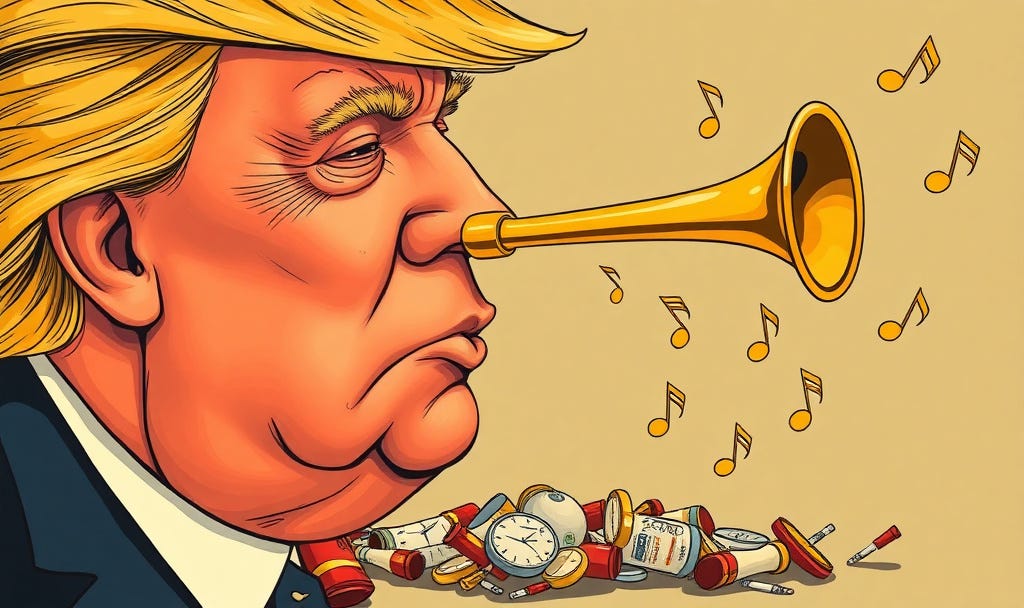
So, he just makes stuff up as he goes and throws it out there to see if it sticks. Pick a number—any number—blow your horn excessively about it, and see what happens. Of course, if you did tax imports at 600%, you would actually collect no tariffs at all because taxation is dynamic; and, at that level, no one is buying.
