


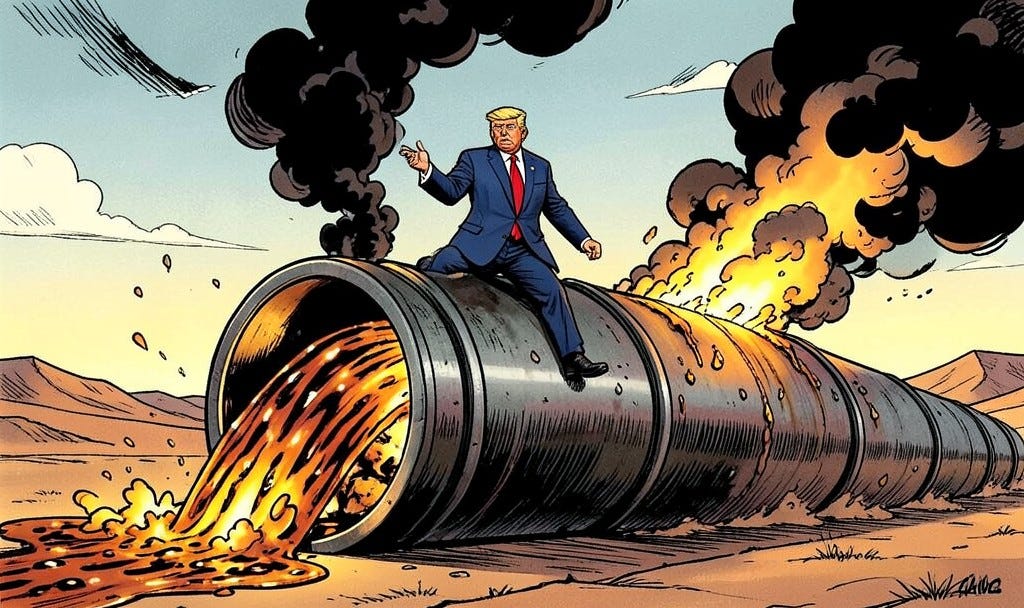
I’m going to have to start using the term “Trumpflation” more often since Trump keeps denying any of the current inflation is his fault. His tariff wars, he always claimed, couldn’t possibly cause inflation. Then when they did cause some, he removed tariffs where the inflation, such as beef, was too scorching hot. His real war with Iran couldn’t be causing it either. So, yesterday he claimed that none of the present inflation was coming from the war with Iran and blamed it all on Zelensky attacking Russia. (Who is, of course, helping Trump out in getting that inflation up with so much successfully and deeply crippling bombing of Russian refineries. (See the headline below on the MASSIVE impact that is having on fuel inside of Russia. It reads and looks in photos like the seventies in America, which is likely where we headed in the months ahead.)
Today, Team Trump dropped back to blaming all the fuel price increases and the derivative increases to other products on Biden. So, I want to make sure the blame rests solidly where it should.
That’s why, though there are a number of stories in the news today about the Iran war in general, I’m going to focus today just on the impacts the war is having on prices of oil and fuel. The most critical news comes from Chevron’s CEO who put out a stark warning that we have hit a major inflection point in the pain we will be feeling from fuel prices.
Mike Wirth [the CEO] told an Austin energy conference that the mechanisms cushioning the market have largely played out and the system no longer has the slack it had when this started.
Asked where prices go, he said he wished he could point to a reason things would ease and could not.
Commercial stocks worldwide have been draining for six months, strategic reserves are near the end of what they can give, and last week’s pipeline strike stranded an estimated 2.5 million barrels a day.
Diesel hit a record $6.23, gas is back to $4.32.
Everything I’ve read has said the pipeline carries from 4-7-million per day, but maybe it was only running at low capacity already before the Houthis blew up the pumping station, so Wirth is talking about the remaining flow that got taken out. That would make sense due to all the other damage to oil infrastructure in Saudi Arabia, including particularly major damage done to the world’s largest refinery that feeds in at the other end of the pipeline, which was bombed by the Iraqis with drones not too long ago.
So, the buffers holding fuel prices down are pretty well exhausted, and Wirth is saying that means the fuel crisis has arrived … but he’s not saying, “We’ve now hit the peak.” He’s warning that the eye wall of this hurricane hasn’t even made landfall yet. We are now in the outer bands of this full-force move up in the price of everything because the buffers are finally gone. For me, that looks like this tonight at one of the fuel stations nearest where I live in a semi-rural area of Washington State:

That’s the cash price for diesel. They add ten cents at the pump if you are paying with debit or credit. The highest prices ever seen for diesel, and RoadRunner isn’t even top-tier fuel around here.
Back when I was first claiming this war was going to cause huge fuel inflation this summer, a few folks did not think so. Well, it’s still summer; and, as I warned back then, when we saw this time hit, that would only be the start of the trouble that is coming. We haven’t even seen much sign of the fuel shortages popping up yet, but I am going to lay out for you now how we’ve reached this juncture where shortages do appear and prices climb even faster.
Two more things worth knowing. Wirth said he hasn’t spoken to Trump since August 3, when the president publicly told oil companies to bring prices down NOW.
And in March the CEOs of Exxon, Chevron and ConocoPhillips warned this administration that a long closure of Hormuz would produce exactly this diesel shortfall.
We do remember that warning, reported here because I knew it was one we’d want to keep an eye on … as in I was certain we would get there. Unsurprisingly, the Trump administration’s response to Wirth was the usual round of lies:
Interior Secretary Doug Burgum told reporters in Houston to make sure the word “temporary” appears in their coverage, and argued prices would have been this high under Biden anyway.
The White House is betting on Venezuelan production and new refining capacity, both of which take years.
He should have used the word “transitory.” It has more panache now that the Fed leaned so heavily on it when giving all of its false assurances that this inflation would go away on its own. We now know they could never fully beat it down with a club, so now we have all the new inflation piling in on top. So, if he used that word, we probably could agree with him and say, “Yes, this inflation is transitory … per the Fed’s revised definition.”
And, of course, there is that typical baby-style blame it all on Biden that we get from Trump between his diaper changes. He never has the manly guts to own any damage he creates. That’s a sure sign of a baby.
The president, as already reported, is making millions off of his oil stocks since day three of this war, as reported in The Daily Doom. So, he’s just grandstanding when he barks at oil companies and tells them, “Bring prices down NOW!”
Here’s the headline:
Trump’s oil investments have gained millions during Iran war as his accounts keep trading
A bright glint of Trumpflation
If you want to see just a little piece of what is going to be driving up the price of fuel more in the near future, but its a very sharp piece, look at this report that just came in about the cost of hiring a supertanker. You may recall I reported yesterday that tanker costs had soared to an all-time record of $800,000 per day! Well look at where they reached today:
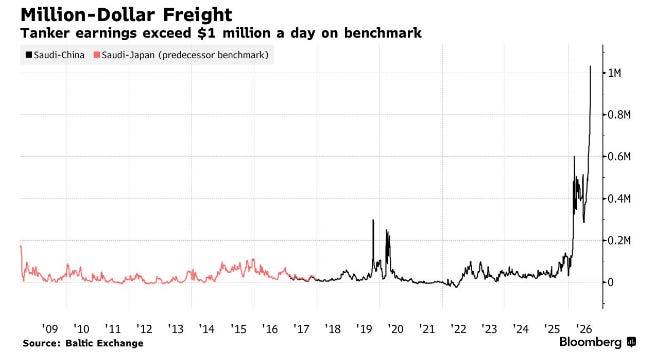
Over a million dollars PER DAY! Higher than what were the highest tanker rates in history just yesterday BY FAR. “Yeah, some of us will risk our lives to get that oil through Trump’s safe corridor for you, but it’ll cost you some serious hazard pay.”

As far as the east is from the west
Right now going from east to west in Saudi Arabia is an almost impossible distance for oil unless you want to take it one tiny little tank truck at a time through the scorching desert. So, because of that successful shutoff of the east-west pipeline that I recapped in the Deeper Dive on Saturday when giving an update on how bad the damage was, the Saudis are already terminating oil shipments that had been scheduled.
Saudi Arabia has informed European customers that some late-September crude shipments are being cancelled following the closure of the East-West pipeline.
This is not a minor disruption. The pipeline has been carrying 4–5 million barrels per day (approx 4–5% of global oil supply) and has become a critical alternative route while shipping through the Strait of Hormuz remains severely disrupted.
Europeans are paying the equivalent of between US$9 and $11 per US gallon for diesel. Well, you can be sure that went up with today’s announcement on tanker costs! That is a cost that gets tagged onto the prices of WTI and Brent. Crude prices have been holding since the pipeline shut down at a global price of around $105/bbl for WTI and$108 for Brent. But when you don’t get any delivered to your neck of the woods, you’re probably going to pay a hefty premium to squeeze delivery out of somewhere else so you can keep refining. The price of WTI—because the US has a lot of it, making it is the market many are turning to—has now nearly caught up with North Sea Brent, even though it is not as useful for making diesel so usually sells for around ten bucks less a barrel; but refineries are squeezing diesel out wherever they can.
In fact, the latest news I have on that refinery that shut down due to power failure in Illinois is that it appears the power failure came from running their section of the electrical grid too hot for too long by refining at maximum capacity, though the cause has not been nailed down for certain, and the repairs are still ongoing. If that’s the correct diagnosis, the all-out squeeze just created a hot friction point.
Of course, Europe is somewhat the cause of its own problems, too, due to its very liberal policies restricting oil production and refining. However, don’t think this stays contained to Europe. As Europe reaches to other sources to make up what was just taken away by Saudi Arabia (thanks to the Houthis), they will reach for your source. That means you get to compete. It’s a global market.
Beyond a diesel shortage in the West, Europeans are also dealing with low natural gas stockpiles heading into the Northern Hemisphere winter, with prices reaching their highest level since December 2022.
The damage is done
Here is the pumping station before and after the attack as was shown in that Deeper Dive very shortly after the satellite imagery was made available, though it is all over the news now:
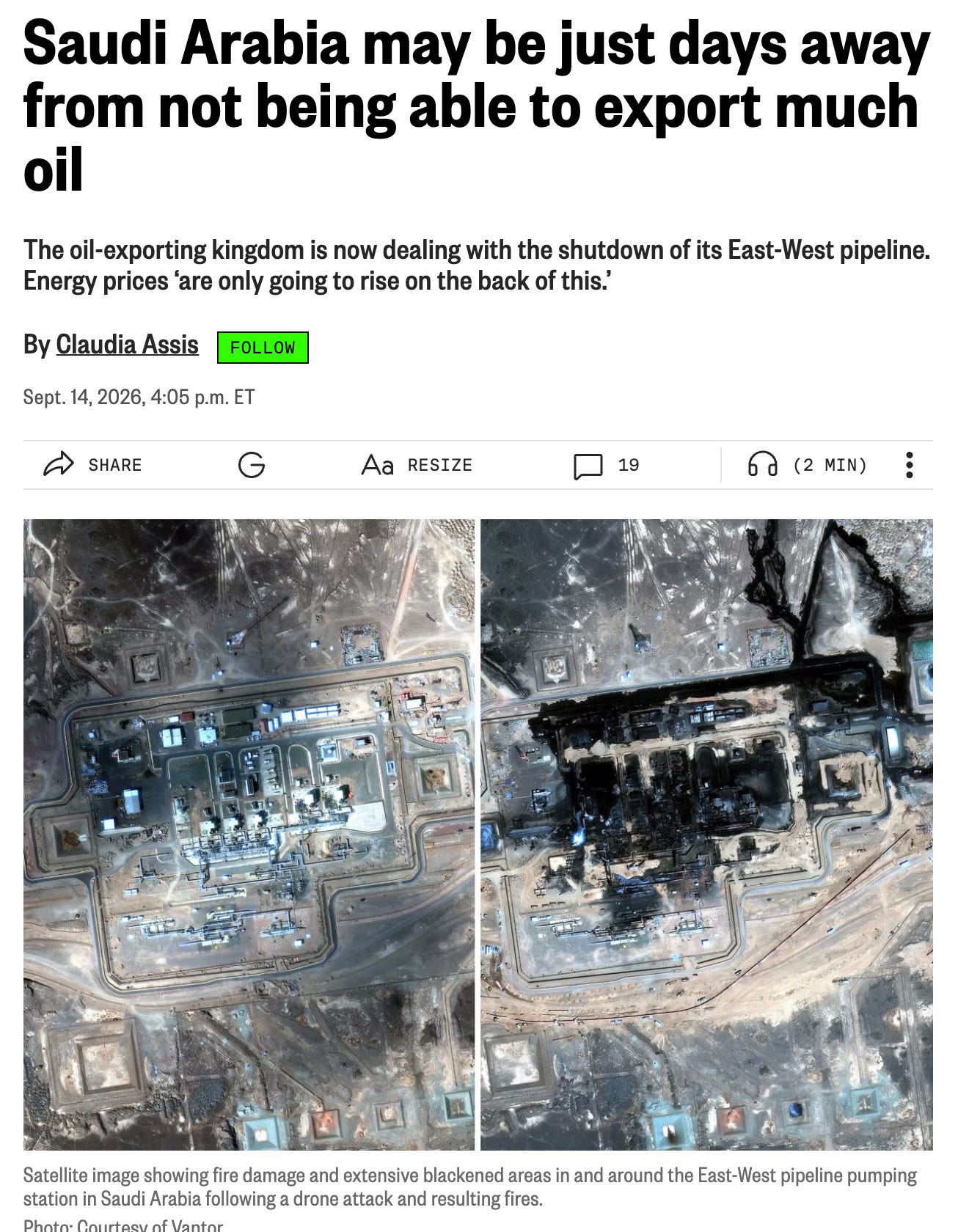
Pretty well burned to a crisp. There are several more photos in the article in the headlines below. Of course Trump’s energy secretary said the big conduit across the desert will be back up and running in a 4-5 weeks. Nah, I don’t think that’s something you snap together in a few weeks. It may take that long just to do the demolition and cleanup … if they RUSH. And don’t you think replacement parts and major pumps might be starting to get a little hard to come by in the Middle East? These guys routinely spout nonsense off the tops of their heads. They make it up as they go. If you think I’m wrong, please wait until next month to tell me when they get the pipeline back to fully operational.
Of course, harvest season is here in the northern hemisphere right as diesel is running out and prices are going trough the roof, so you can guess what that is going to do to your food prices this fall and winter, and clearly that will be worse for people in Europe.
Here’s a video I’ll post for everyone that summarizes the war action I covered in my Deeper Dive back on Saturday, comparing their sweeping takeover of West Yemen for importance to the Vietnam Tet Offensive:
The escalation trap
All of this is part of the Iran Plan, which is to say the “escalation trap” I laid out two Deeper Dives back. Those who read that Deeper Dive can now see how the parts are coming together one step at a time, constantly turning up the heat in the Middle East without tripping Trump into full-on war because he really wants out. Last week brought a major tightening of the screws with the wipeout of this pipeline and seizure of full control over the Bab al-Mandeb (Gate of Tears).
The overall goal of that plan is stated in another article below:
Iran’s leaders were never going to passively submit to slow strangulation. Facing Donald Trump’s blockade of their ports and the near-total loss of their oil exports, the regime is now striking back across the Middle East, aiming to inflict enough damage to force America to relent.
Having locked down Hormuz pretty well, it looks like Iran is doing a darn good job of locking down the other side of Saudi Arabia as phase two of the Iran Plan:
Iran is now doing everything possible to wreck this alternative, which is why the Houthis have strengthened their hold on the choke point, where they have positioned Iranian-supplied anti-ship missiles.
Finally, we have a report from the Congressional Budget Office that says, yes, the Iran war most certainly is driving up Trumpflation. Well, they don’t call it by that name, of course, but they do make clear that his war in now spilling over into the prices of many other things, blaming more than 40% of current inflation on the Trump-Iran War. So, I’m just going to call it as it is. Thank you, Donald Trump for you inflation.
If there remains anyone who is not inclined to blame Trump and his ill-advised war yet, let’s see how they feel in the cold of winter. Maybe that’ll turn the heat up a little on Trump when the heat goes off for many others or, at least, gets turned down to where they can see their breath at the kitchen table.
(Note: Some sources say the Houthis made this attack on the east-west pipeline. Some say Iraq. The Saudis, last I read, believed it was the Houthis. The fog of war.)
As a footnote, I’m noticing most of the stories in the news about the Trump-Iran War still have not caught up to the map of Houthi conquests I presented in my Deeper Dive for paying subscribers, showing the full swath of regions they took over in Yemen like a landslide.
I saw one other person commenting on another site about how hard that information is to find in the mainstream news, making him wonder as I was also wondering whether some of the information is being shut out. It’s also possible, of course, that I got false information since I had only one original source, as I noted at the time made me a little less than fully confident; but I don’t think so. I think it will prove over time the Houthis have taken that full region, unless the Saudis, who are now fighting back with more intensity than they showed earlier, reclaim some of it.
One of the stunning things of that victory that made it for the Houthis what Biden did for the Taliban, was that the Saudi forces left much of their heavy artillery behind when they fled so quickly. So, the Houthis captured some great war plunder that they are now putting to use in round two, better armed, thanks to Saudi Arabia leaving its American-built equipment behind.
Anyway, there are lots of headlines below now covering events of the full past week of the war for the first time, just stopping a little short in their boundaries of what has been taken over by the Houthis from what I presented. Those headlines, even if you don’t read the articles behind them, will give you a good picture of the growing troubles that are coming that will cause significant additional upward pressure on crude oil and fuel prices and then the price of everything.
