


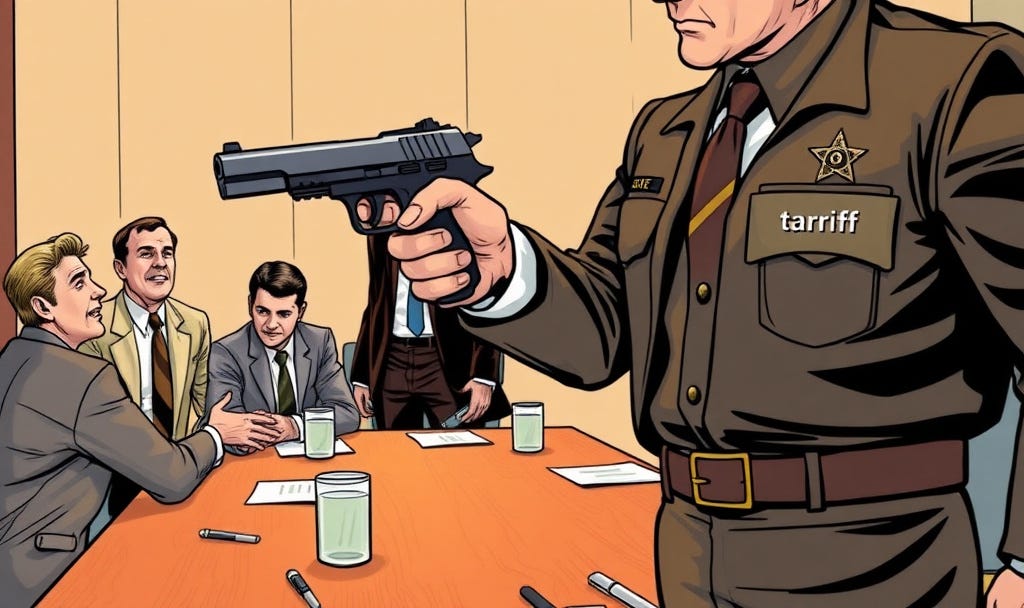
The tariffs are gunning for you!
My overarching theme, in the form of a prediction, all of last year was that the Trump Tariffs would take down the US economy and the dollar and cause a significant rise in inflation, which is how you will pay for them. I also said we wouldn’t see that happen in any obvious way until the final quarter of the year, and I explained why, though I tracked the indicators that such a storm was forming all along the way.
Well, it took one quarter longer, but the results are now in at a such a level that even economists, who are usually last to see these things happening, are now calling out the facts. Two articles in the mainstream press today lay out how damaging the tariffs have been to American businesses and, from there, to consumers.
The timing couldn’t be more appropriate as Trump goes off with his entourage of billionaires to visit China and try to recreate business. As I pointed out along the way China has actually seen its trade increase because of US tariffs because Trump’s biggest mistake was to fight his tariff wars with the whole world at once. That caused all the world to seek refuge in a different trade partner that didn’t do that sort of thing; so, former trade nations with the US ran into China’s embracing arms.
Soy Boy Trump all but destroyed American soy farmers with his tariffs because China countered the tariffs, as could be expected, with tariffs on soybeans. Now he is trying to negotiate on behalf of his pet billionaires to get back some of the volumes of trade he lost. In that context, let’s take a look at the summary judgment today about how bad the tariff damage has been for the US.
In a word, “significant”
Trump’s tariffs have done ‘significant damage’ to US economy, top financial group warns
Over a year has passed since President Donald Trump’s “Liberation Day,” when he rolled out a sweeping tariff regime, imposing steep duties on most foreign imports and fundamentally reshaping U.S. trade policy.
Now, the numbers speak for themselves, and they’re deeply troubling, according to Mark Zandi, chief economist at Moody’s Analytics, an arm of the long‑established global risk‑assessment group.
“We have a year’s worth of economic data since Liberation Day,” Zandi wrote Monday. “The data are definitive; the tariffs have done significant damage to the economy.”
If you thought the tariffs were going to drive production back to the US and produce jobs, as was Trump’s stated objective, you were wrong. The opposite has happened:
“Job growth has come to a standstill, with only the non-traded healthcare industry adding meaningfully to payrolls,” Zandi wrote, referring to the 693,000 domestic health care jobs added last year — without which there would have been a net hiring loss. In total, employers added an average of just 9,700 jobs per month last year, the weakest hiring since 2002, outside of recession years.
9,700 jobs added per month is, as I’ve explained a number of times, deeply recessionary. It takes 150,000 jobs added each month just to keep up with population growth. Now, some of those who lost jobs were sent packing by ICE, but the numbers now clearly say that no one replaced them on their jobs either. We can absorb those big job losses without seeing a sharp rise in overall unemployment because illegal aliens that are sent away don’t get to collect unemployment, so they aren’t counted; but the low average of only 9,700 jobs added per month outside of healthcare tells us that those low-paying jobs were not refilled with other workers. Neither were many new high-paying jobs in manufacturing added.
The only benefit of the tariffs … wasn't
On the plus side, the tariffs added a lot of tax revenue collected from Americans to help balance the budget:
They have generated billions in revenue — $195 billion in fiscal year 2025 alone — a result that Treasury Secretary Scott Bessent has pointed to as a positive step toward lowering the federal deficit.
On the negative side, no one on either side of the aisle or in the White House made any effort to apply that revenue toward balancing the budget because no one in either party cares any longer about deficit spending, other than maybe some almost-silent minority. The president proposed much higher deficits under Big Beautiful Bill, and the Republicans in congress rushed to give him and the military industrial complex everything they asked for so that we could blow it all up in Iran. As a result …
U.S. national debt is now higher than GDP, hitting levels not seen since the aftermath of World War II.
As for Trump’s big lie that other nations would pay the tariffs, not Americans, that is called out, too:
What’s more, the cost of tariffs is being borne by Americans. U.S. consumers have paid for “nearly all” of the tariffs, according to a January report from the Kiel Institute for the World Economy. A February report from the Tax Foundation found that the president’s levies will cost the average household $1,300 more this year.
You pay for them because American companies pay the tax, and they got very little in price adjustments from their foreign suppliers to offset that cost increase; so—as I promised you by sharing the truth that Trump & Co. tried their best to obfuscate—those corporations did what they always do: they passed their increased costs along to the consumer. It boggles my mind that anyone ever thought they wouldn’t. When have we ever not seen cost increases ultimately passed along to the consumer?
The price-weary consumer fought back by changing buying habits, so US companies had to go slow with the price increases. They held out as long as they could by stocking up ahead of the tariffs and during the short in-between breaks when Trump TACOed out, and that got them through that final quarter that I had targeted as the arrival period into this quarter where it is now happening quite apparently.
“Inflation has accelerated, with the consumer expenditure deflator increasing at a 3% year-over-year pace, up from 2.5% before the tariffs and well above the Federal Reserve’s target of 2%,” Zandi wrote.
And the news is actually a whole lot worse than that now that we have the war starting to pile in, too. Figures that are, as of this week, being reported are way above the 3% mentioned in this report that looks before the war. I’ll go over how bad it really is for paying subscribers in my weekend Deeper Dive.
Unsurprisingly …
A March survey commissioned by The Guardian … found 7 in 10 Americans believe the tariffs have cost them more.
Facing widespread pushback, Trump has repeatedly paused, revised or walked back numerous duties, including on coffee, beef and other foodstuffs. Detractors across the media, Wall Street and beyond have branded the president’s tariff retreats as “TACO” — Trump Always Chickens Out.
As for Bessent’s brain-lame comment that tariffs are “the dog that didn’t bite,” in a longer version of the article not available without a subscription, another economist strongly disagrees with Bessent:
“We disagree,” with that argument, Aditya Bhave, chief U.S. economist at Bank of America wrote in a note late last month. “Supply shocks are inflationary because they shift the aggregate supply curve upward. Consumers respond by spending less in real terms and/or saving less. Indeed, since Liberation Day, real consumer spending has slowed, the saving rate has declined and y/y headline PCE inflation has increased by more than 40 [basis points].”
More to come?
Meanwhile, Trump is threatening the EU with higher auto tariffs, and the EU is ready to fight back if he does:
EU finance ministers have urged calm, sticking to the July 2025 deal capping US tariffs at 15% while preparing for retaliation if Trump follows through on his latest threats. German and French officials differ on how quickly to finalise the trade pact, balancing the need to protect industries such as car manufacturing against avoiding escalation….
EU negotiators face a tightrope between quickly implementing the Turnberry deal and insisting on safeguards against future US tariff hikes. The conservative EPP bloc is pushing for rapid adoption to give businesses certainty, while Socialists, Greens, and some diplomats want stronger guarantees to shield the EU from Trump’s unpredictable trade tactics. (MSN)
The chaos continues to swirl.
Voters appear ready to retaliate
The damage from tariffs is not escaping the attention of Republican politicians who are facing what looks like a dreadful election ahead.
A new Financial Times poll has delivered devastating news for Republicans, showing that President Donald Trump’s economic policies and the Iran war are eroding voter confidence ahead of November’s midterm elections.
The nationwide poll, conducted by research firm Focaldata from May 1-5, found that nearly 58 percent of registered voters “strongly” or “somewhat” disapprove of Trump’s handling of inflation and the cost of living—the top issue on voters’ minds heading into the midterms.
The damage extends across Trump’s signature economic agenda. Just over 50 percent disapprove of his handling of jobs and the economy overall, and a striking 55 percent said Trump’s tariffs have hurt the U.S. economy. Only about one in four voters believe his trade policies have helped the economy, according to the new poll.
That news will become far more jarring for Republican politicians as the inflation from the Iran war starts to come in on top of the slightly delayed rise in prices from tariffs. The war inflation is, of course, already showing up bigly in gasoline prices, which are always as volatile as gasoline is physically, even as Trump tries, as usual, to lie his way into an alternate reality with, as his former adviser Kelly Ann Conway once said, “alternative facts”:
Trump has claimed in recent days that gas prices are “way down,” but the reality tells a different story. The average price in the U.S. was about $4.60 a gallon last week—almost 50 percent higher than when the Iran war began in late February.
While Republican voters continue to strongly back the lying president, the hurt will come from independent voters, who have turned by a fairly large majority against him:
The damage is especially severe among independents: more than 58 percent view him unfavorably.
Reacting to the news, geopolitical analyst Brandon Weichert simply stated Sunday, “They’ve sunk the party.”
Trump’s only saving grace might be that Americans are pretty unhappy with both parties right now.
